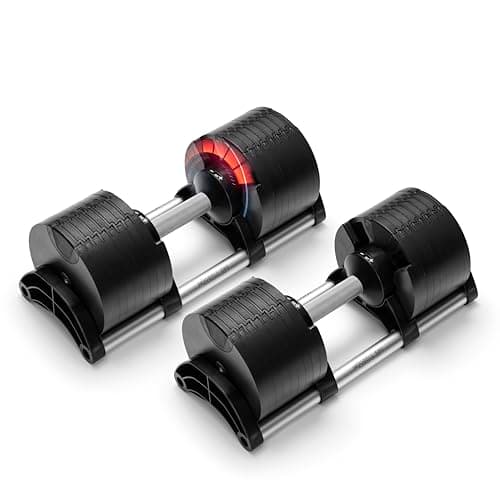
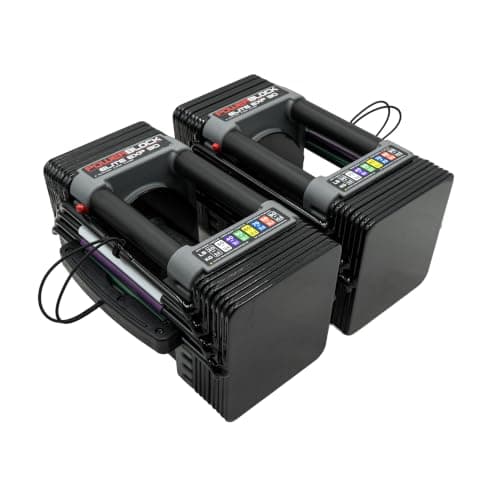
For a small space, the PowerBlock Elite EXP wins: the block shape is shorter than a dial dumbbell at every weight, there is almost no plastic in the load path, and expansion kits take it to 70 or 90 lb per hand without buying a second pair. Buy the Nuobell 580 instead if you want 80 lb per hand in a body that feels like a normal dumbbell and you are willing to pay roughly twice the mainstream price for that.
This is the pairing people land on after they have already decided they want something better than the default. We cover the two easier comparisons elsewhere — Bowflex SelectTech vs PowerBlock and Nuobell vs Bowflex SelectTech — and in both of those a premium pick is being weighed against the mainstream one. Here both are premium, which makes the question sharper and the answer less obvious.
The one difference everything else follows from
PowerBlock is a cage with a selector pin: the weight sits in a nest and you lift a core out of it. Nuobell is a handle in a cradle: you twist the handle and plates engage on either side. That single mechanical difference produces every trade-off on this page.
- Shape and length. The block is roughly 12 by 6 inches per hand and is the same length at 5 lb as it is at 50 — the weight gets denser, not longer. A twist-handle dumbbell is longer than a fixed dumbbell at the top of its range, because the plates have to live somewhere. In a room where the dumbbells store on a shelf or under a desk, the block is the smaller object every time.
- Feel. The Nuobell wins this and it is not close. It looks and handles like a dumbbell, which matters for pressing and for anything near your face. The block surrounds your hand with a cage, which some people never get used to — its own card says the shape is polarizing, and that is a genuine reason to choose against it.
- Ceiling. Nuobell reaches 80 lb per hand out of the box. PowerBlock starts at 50 and reaches 70 or 90 with expansion kits, which means the headroom is there but arrives as a second purchase.
- Materials in the load path. The block is almost entirely metal, which is the quiet argument for it over several years of use.
How they compare
| Spec | PowerBlock Elite EXP | Nuobell 580 |
|---|
| Range per hand | 5-50 lb (Stage 1) | 5-80 lb |
| Expandable | Yes — 70 or 90 lb with kits | No — 80 lb is the top |
| Increments | Selector pin, stage-dependent | 5 lb steps |
| Footprint each | About 12 x 6 in — shortest here | Barely longer than a fixed dumbbell |
| Adjust method | Pull the selector pin | Twist the handle in the cradle |
| Replaces | A rack of fixed pairs | About 16 pairs |
| Shape | Cage around the hand | Conventional dumbbell |
Who should buy which
Buy the PowerBlock if storage is the binding constraint — a closet shelf, under a desk, inside a cabinet. Buy it also if you expect to keep these for a decade, because there is less to crack, and if you want the option of more weight later without replacing the pair. It is the pick our main adjustable ranking rates highest on fit for exactly these reasons.
Buy the Nuobell if you already press more than 50 lb per hand, or expect to within a year, and you do not want to think about this purchase again. Buy it also if the cage shape bothers you when you try it, which is a real and sufficient reason: the best dumbbell is the one you reach for. Our heaviest adjustable dumbbells page is the wider field if 80 lb per hand is still not enough.
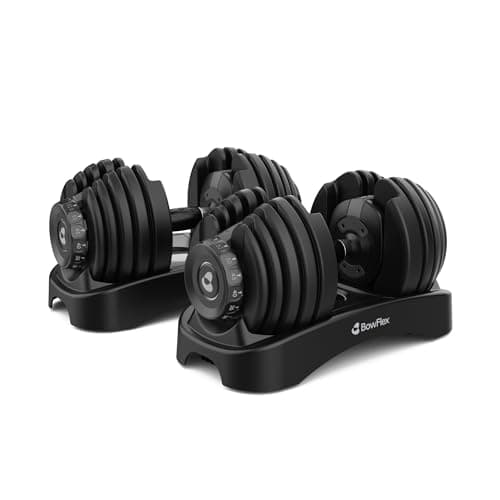
Buy neither if you will not press past 50 lb per hand and the premium is not comfortable. Both of the other two picks on this page are honest answers: the Bowflex SelectTech 552 is the default for most small-space lifters at 5 to 52.5 lb with a published 16.9 by 8.3 in footprint, and the NordicTrack 55 buys a little more headroom on a wider cradle. There is no shame in the mainstream answer; it is the mainstream answer because it works.
The thing both share, and it matters
Neither is built to be dropped. The mechanisms in every adjustable dumbbell on this site are the expensive part, and the plates are not rated for impact the way a fixed dumbbell is. We go through what actually happens in can you drop adjustable dumbbells, and the practical rule is the same for both: set them down, do not release them. In an apartment that discipline is doing double duty, because a dropped dumbbell is also the loudest thing you own — see lifting without annoying the neighbors.
Measure the cradle, not the dumbbell
The number that decides this in a small room is not the dumbbell — it is the tray or cradle it lives in, because that is what occupies the shelf for the other twenty-three hours. Both of these ship with one, and both trays are larger than the dumbbell alone. Measure the gap you intend to use, in all three dimensions, and check it against the cradle rather than the product length in the title. This is the mistake we see most often in this category, and it is a non-returnable one once the box is open.
If storage turns out to be the real problem, the fix is sometimes the shelf rather than the dumbbell. Our dumbbell storage guide and vertical storage ideas cover the options that get a pair off the floor without a rack.
The expansion-kit arithmetic
PowerBlock's expandability is a real advantage and it is worth doing the sums honestly rather than treating it as free headroom. A Stage 1 pair plus a kit is two purchases and two shipping events, and the total lands closer to the Nuobell than the headline comparison suggests. Where it genuinely wins is cash flow and certainty: you can buy the 50 lb version now, find out whether you actually outgrow it, and only spend the rest if you do. For most people in a small apartment, that is the better bet, because most people never pass 50 lb per hand on a dumbbell press.
What a pair of either replaces
This is the argument that makes both of these sensible rather than extravagant in a small room. A single Nuobell pair stands in for roughly sixteen pairs of fixed dumbbells and the rack they would need; a PowerBlock pair does much the same from a smaller object. The comparison that matters in an apartment is not price against a cheap fixed pair, it is footprint against a complete set — which is the case our are adjustable dumbbells worth it page makes in full, and the reason adjustable versus fixed is barely a contest once the room is small enough.