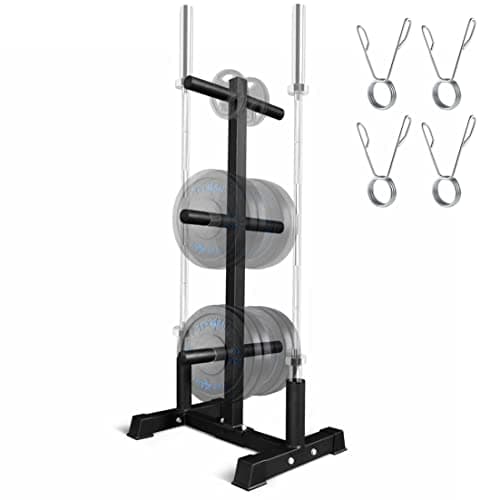
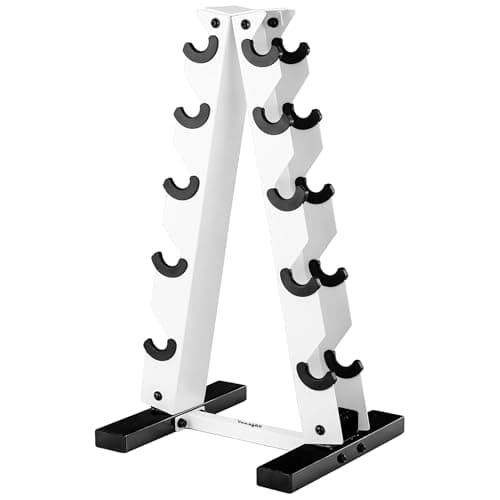
Store dumbbells vertically, on a narrow A-frame rack or tree, against a wall you don't walk along — that single move converts sprawling floor clutter into a footprint about the size of a suitcase. Under-bed and under-sofa storage is the next best option for lighter weights, and a mat under everything protects the floor you don't own.
The storage problem in a small apartment isn't really about tidiness. It's that weights lying on a floor make a room unusable in a way their actual volume doesn't justify — you can't walk a straight line, you can't vacuum, and you eventually kick something cast iron in the dark. Dumbbells stored badly also take a slow toll on flooring that a renter is financially responsible for. Getting them off the floor and onto something vertical solves all three problems with one purchase.
Go vertical first — it's the highest-leverage move
A narrow A-frame dumbbell rack is the single best storage buy for an apartment, and it's cheap enough that hesitating over it is false economy. It stacks tiers of dumbbells upward rather than outward, so a set that was consuming a stretch of wall floor collapses into a base you can step around. There's no assembly drama, no wall anchoring and nothing on your lease to worry about. Match the rack to your weights, though: light-tier A-frames are built for smaller fixed dumbbells, not heavy hex, and they aren't shaped to hold adjustable-dumbbell cradles.
If you also own plates and a barbell, a vertical plate tree does the same job for the round stuff. Plates leaned against a wall take a surprising amount of floor, slide, scuff the baseboard and are genuinely dangerous to a bare foot. A tree with pegs and barbell holders turns that pile into a small square base. Check the peg diameter against your plates before buying — Olympic trees take 2-inch plates and won't accept standard 1-inch ones.
Under the bed and under the furniture
The second-best storage in any apartment is the volume you're already renting and not using. Under a bed is the obvious one, and it works well for lighter fixed dumbbells, plates and an adjustable pair's cradle if the clearance allows. Two rules make it work: put the weights on something that slides — a low tray or a piece of hardboard — so you're not dragging iron across the floor every session, and keep them within arm's reach of the bed edge, because storage you have to crawl for is storage you stop using.
Sofas, console tables and the gap beside a dresser work the same way. The constraint is always weight-per-point-of-contact rather than total weight: a dumbbell resting on two small contact patches concentrates enough load to dent vinyl, laminate or soft wood over time. Spread the load with a mat or board underneath and the problem disappears. Our under-bed weight storage ideas covers the clearance measurements worth taking before you buy anything. If a bench is already claiming floor in the same room, a bench with built-in weight storage puts the dumbbells inside that footprint instead of beside it.
Wall and closet storage without drilling
Wall-mounted dumbbell shelving is the cleanest-looking option and the one most renters can't use, because it needs anchoring into studs to hold anything heavy. Drywall anchors are not a substitute — a shelf of dumbbells pulling out of drywall takes a chunk of the wall with it and turns a storage project into a security-deposit conversation. If your lease permits anchoring into framing and you're confident locating studs, it's an excellent use of vertical space; our vertical dumbbell storage ideas goes through the mounted options in detail.
If you can't drill, closets are the underrated answer. A closet floor already exists, already has a door in front of it, and puts the weights fully out of the room's visual space. Put a board or mat down first to spread the load, keep the heaviest items at the back where you won't catch a shin, and treat the closet floor as a storage surface rather than somewhere things get dropped.
Protect the floor, and the lease
Whatever you choose, put something between iron and the floor. Interlocking mats or a single dense mat under the storage zone and the lifting zone do two jobs at once: they spread point loads that would otherwise dent a soft floor, and they cut the impact noise that travels to the apartment below. This is cheap insurance against the two costs that actually hurt a renter — a damage deduction and a complaint. Our apartment flooring guide covers what thickness is worth buying for weights versus cardio.
What not to do
- Don't store weights on a balcony. Weather ruins the finish on cast iron and steel fast, and many leases restrict what can be stored outside.
- Don't stack dumbbells on furniture that wasn't built for it. Particleboard shelving sags under concentrated weight and eventually fails all at once.
- Don't leave adjustable dumbbells outside their cradle.The tray keeps plate spacing correct and stops the selector taking a knock. It's part of the product, not packaging.
- Don't rely on drywall anchors for anything heavy.If you can't hit framing, go vertical on the floor instead.
The bottom line
Storage is the second half of a small-space gym, and it's the half people skip. Buy the vertical rack at the same time as the weights, not six frustrated months later. And if you're still choosing what to store, the easiest storage problem is the one you avoid entirely — a single adjustable pair from our adjustable dumbbells roundup arrives with its own cradle and needs no rack at all.