Under a bed is the right home for flat, low-profile gear: weight plates lying flat on a mat, a folding bench that closes flat rather than upright, foam floor tiles, resistance bands and a jump rope. It is the wrong home for anything you need daily, anything that rolls, and anything taller than your frame clearance minus a finger's width. Everything else should go vertical.
Every small-space gym eventually runs into the same wall: you have bought well, you have bought compact, and there is still nowhere to put it. The instinct is to look for more floor. The better move is to look for volume you already own and are not using — and in most homes the largest single block of unused volume is the rectangle under the bed. It is flat, it is hidden, it is roughly the size of a double mattress, and it costs nothing. The catch is that it is a slot with a fixed height, and gym gear is unusually dense. Get the two measurements right and it solves most of your storage problem. Get them wrong and you have dragged a forty-pound plate across a bedroom floor for nothing.
What actually fits under a bed
The honest list is shorter than the internet suggests, and it is defined by one shape: flat.
- Weight plates, lying flat. A plate on its face is one of the lowest-profile objects in a home gym. Stacked two or three high on a mat, plates slide under most frames easily. Standing them on edge is the mistake — that is when the diameter, not the thickness, becomes the height you need.
- A bench that folds flat, not upright. This is worth checking before you buy a bench. Some fold to stand on their end; some close down into a slab. Only the second kind goes under a bed. If you are still choosing, our folding bench roundup flags how each one stores.
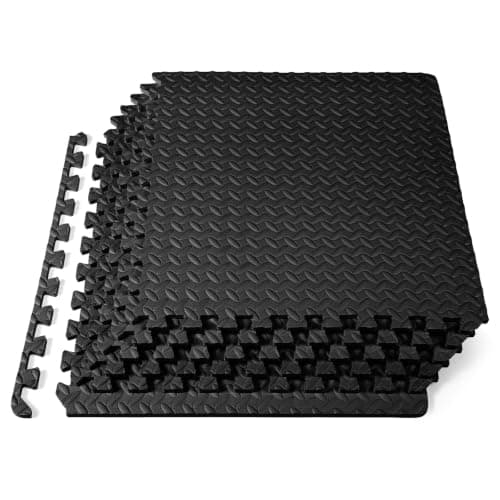
- Interlocking foam tiles. Half-inch puzzle mats separate into a flat stack and slide away with the bench, which makes a lift-and-store gym floor genuinely practical in a shared room.
- Bands, straps, a jump rope, a mat. Obvious, but people leave these on the floor. A shallow underbed box collects the small stuff that otherwise sprawls.
- Light fixed dumbbells, in a flat container. Hex dumbbells up to modest weights lie flat and do not roll. Round-headed ones do roll, which is a separate problem covered below.
The clearance math, in two measurements
This takes ninety seconds and prevents almost every under-bed mistake. Measure the clear height from the floor to the underside of the bed frame — not to the mattress, and not to the slats if there is a solid rail lower down. Then measure the tallest point of the object you want to storein the orientation it will actually sit in. Subtract roughly a finger's width from the clearance as your working number, because you need to slide things in and out without scraping, and because floors and frames are rarely perfectly level.
Three things to watch. Plates are measured by thickness when flat and by diameter when on edge, and the two numbers are wildly different — always plan for flat. A stack of anything is the sum of its parts plus whatever it is sitting on, so include the mat or tray in the total. And if the number comes up short by an inch or two, bed risers are the cheapest fix in this entire article: four blocks under the legs buy you several inches of usable clearance across the whole footprint. Check your frame is rated for risers before using them on a heavy bed.
Protect the floor — and the plates
Never slide bare iron across a floor you care about, and especially not one you do not own. Cast plates and hex dumbbells will mark hardwood, tear carpet fibers and dent vinyl, and they will do it on the way in as readily as on the way out. The fix is trivial: put the gear on something that slides instead. A pair of foam tiles laid face down works as a sled, a shallow underbed tray works better, and either costs a fraction of a floor repair. The same foam tiles are the ones you should be lifting on anyway — see our apartment flooring guide for the full version of that argument.
Watch moisture too. Under a bed is a low-airflow space, and bare iron plates left on a concrete-slab floor in a basement bedroom can pick up surface rust. A mat between the metal and the floor solves that as well as the scratching.
What should NOT go under there
- Anything that rolls. Round-headed dumbbells, kettlebells on their side and loose barbell collars all migrate to the middle of the space, which is the one part you cannot reach. Rolling weight under a bed is also a genuine hazard if anyone reaches under for a shoe.
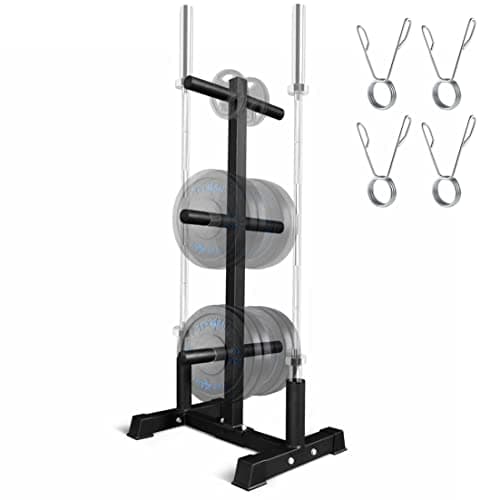
- Barbells. A bar is long, it is not flat, and the knurling will chew anything it slides against. Bars belong on a wall bracket or on a plate tree with barbell holders.
- Anything you use every session. Storage that makes you crawl on the floor before each workout is storage you will abandon in two weeks. The under-bed slot is for the gear you touch weekly, not daily.
- Your heaviest plates, if the floor is upstairs.Concentrating a large mass in one spot is worth a moment's thought in an older building. Spread the load across the footprint rather than stacking it all in one corner.
- Adjustable dumbbells. They come with a tray that is designed to be their home, they are the thing you use most, and their selection dials do not enjoy grit. Leave them out.
Where the rest of it goes: vertical
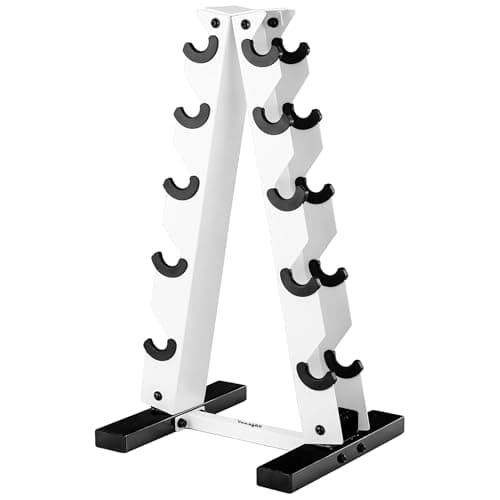
Under-bed storage is the flat half of the solution. The other half is upward. Anything that rolls, anything heavy, and anything you reach for every session should live on a vertical rack in the smallest floor footprint you can manage: a narrow A-frame for fixed dumbbells, a plate tree with barbell holders for plates and bars. Both take a footprint smaller than a nightstand and both keep the walking path clear, which is the actual goal — an apartment gym fails on trip hazards long before it fails on square footage. For the full set of vertical options, see our vertical dumbbell storage ideas and the wider small-space weight storage guide.
Put the two together and a complete compact gym disappears in about a minute: bench folds and slides under the bed, tiles stack on top of it, plates lie flat beside them, dumbbells and bar go on the tree in the corner. The room reads as a bedroom again, which is the whole point. If you are still assembling the kit itself, start with a bench from our adjustable bench roundup and work outward from there.