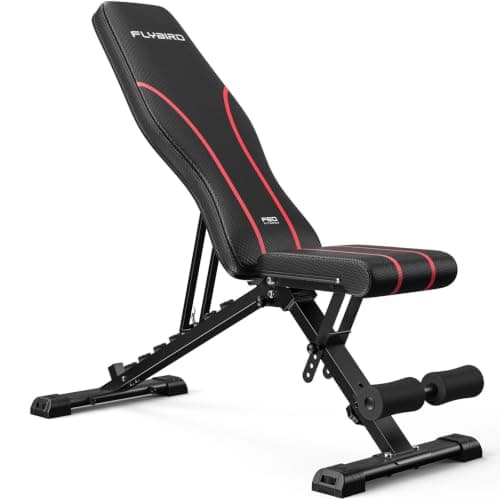
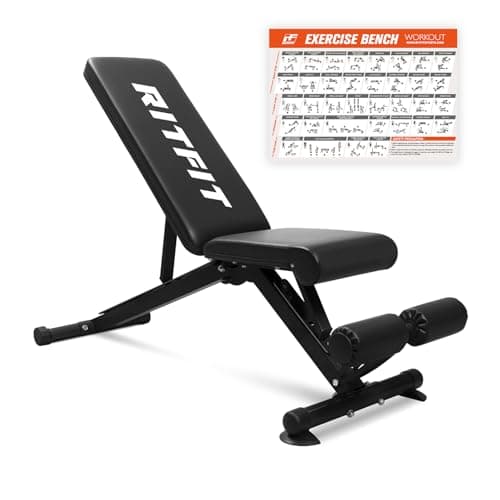
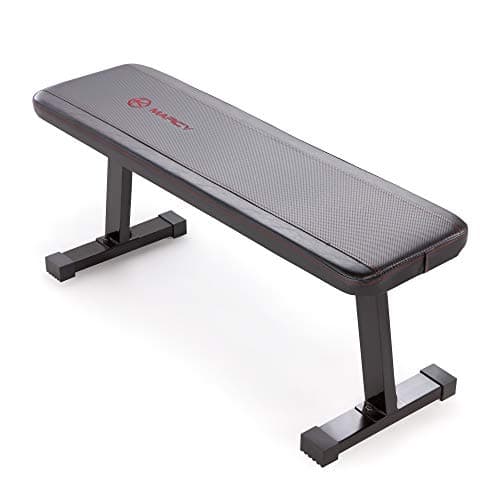
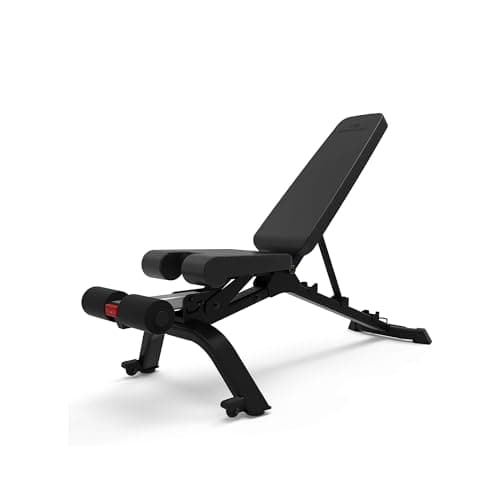
In a small room an adjustable bench has to earn its floor twice — once while you train, and again when you're done. The Bowflex 3.1S is our top pick because it does both: four back angles including a decline, a wider pad than the budget field, and a frame that stows upright against a wall. The FLYBIRD WB2 is the value route and the bench most compact gyms actually end up with. The RitFit adjustable is the like-for-like swap when the FLYBIRD is out of stock. And the Marcy flat bench is on this list for the case nobody likes to admit: plenty of people buy an adjustable bench and then press flat on it forever.
The word "adjustable" hides two very different promises. Some benches adjust the back pad only, giving you flat through incline. Others adjust the back and the seat, which is what stops you sliding down the pad at a steep angle and is what unlocks a genuine decline position. Neither is wrong, but they store differently and they feel different under load, so we treat the angle mechanism as a spec and not a marketing word. What we do not do is rank on how many positions the listing claims — a bench with ten notches you never use is worth less than a bench with six you actually train through.
Our four criteria, in the order they matter in a room you also sleep or live in: stowed size, pad width, angle range and stability. Stowed size comes first because it is the criterion the category pretends is free — every listing photographs the bench open and none of them tell you what it looks like standing behind a door. Pad width comes second because it is the comfort spec that cheap benches quietly cut, and a narrow pad is the difference between a bench you press on and a bench you tolerate. Angle range comes third, and stability fourth only because every bench here is stable enough for the loads a compact home gym realistically sees.
We rank from published manufacturer specs, listing documentation and the pattern of what owners consistently report — not from lab work, which we do not do and will not pretend to. We put the stow behavior, angle mechanism and a planted-versus-portable read on every Spec Block so the trade is visible before you buy. If you care more about folding flat than about incline specifically, our folding bench roundup ranks the same category on a different axis. And a bench is only half a free-weight setup — pair it with adjustable dumbbells or a folding squat rack and you have a complete compact gym in the footprint of an armchair.
How to choose an adjustable bench for a small room
Buy for the bench's two states, not one. Almost every buying guide compares open dimensions, because that is what manufacturers publish and photograph. In a small space the stowed state is the one you live with for twenty-three hours a day, and it is the state that decides whether the bench stays in the room or migrates to a closet and then to a marketplace listing. Ask the boring question first: when this is folded, where exactly does it go? Behind a door, in a closet, flat under the bed, upright in the corner? If you cannot answer that in one sentence, the bench will end up in the walking path.
Stowed size: upright, flat, or not at all
There are three honest outcomes. A bench that stows upright stands on its end against a wall and takes a footprint close to a floor lamp — the best result, and the reason the Bowflex leads this list. A bench that folds flat slides under a bed or behind a sofa, which is even better if you have that slot and useless if you do not. And a bench that does not fold is not automatically disqualified: a compact flat bench like the Marcy is small enough to tuck against a wall permanently, which is a different kind of solved. Decide which of the three your room supports before you compare anything else.
Pad width and the gap between the pads
Pad width is the spec budget benches cut, and it is the one you feel every session. A narrow pad puts more of your shoulder blade off the edge, which is fine for light dumbbell work and progressively less fine as the load climbs. The other detail worth checking on any adjustable is the gap between the back pad and the seat pad at incline — a wide gap sits right where your lower back wants support. Neither number is universally published, so where a maker stays quiet we say so on the Spec Block rather than guessing at it.
Angle range: how much do you really need?
Be honest about your training. If you press flat, row, and do the occasional shoulder press, a bench with flat plus two incline positions covers everything you will ever set up. Decline is a genuinely useful position that most folding benches skip, but it is also the position most owners use least. The trap is paying for angle range and then losing pad width or stow quality to get it. If your answer is "flat, basically always," buy the flat bench, keep the money, and get a sturdier platform for it.
If you are buying the dumbbells at the same time, the bundles that pair an adjustable bench with a dumbbell set are worth a look — with one caution about how their listings quote weight. We go through that in weight bench and dumbbell sets.
Stability, and where wobble actually comes from
Every adjustable bench has a hinge, and the hinge is where flex lives. In practice, wobble in a compact bench comes from three places: the ladder or notch mechanism having play, the feet not sitting level on an uneven floor, and the bench being loaded off-center. The first is a build question, the second two you can fix yourself. A set of interlocking mats under the bench levels a floor and cuts noise into the room below at the same time — see our storage and flooring notes for the cheap version of that fix. A flat bench with no hinge will always feel more planted than an adjustable at steep incline; that is physics, not a defect.