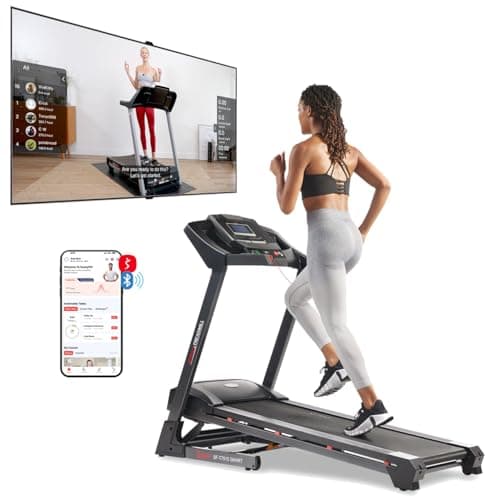
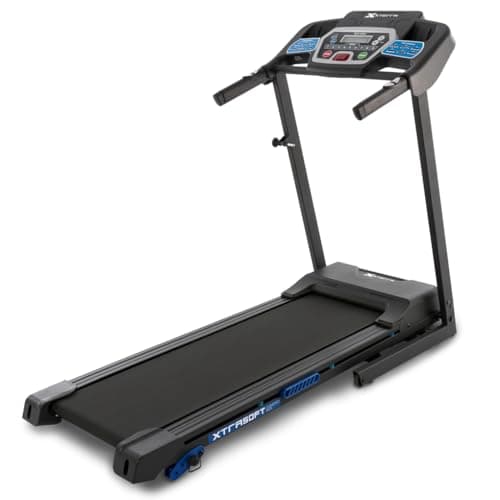
Store a folding treadmill vertically, against a wall, on its transport wheels — that is the configuration that reclaims the most floor in the smallest space. Before you buy, check three numbers: the folded height against your ceiling, the folded footprint against the wall you plan to park it on, and the swing arc the deck needs as it comes up. Put a dense mat under it both where you run and where it stands, and move it by rolling on the wheels rather than lifting.
A folding treadmill is a compromise machine, and storage is the half of the compromise people underestimate. You get a real running deck — the thing a walking pad can never give you — and in exchange you accept an object that is heavy, tall when folded, and awkward in exactly the rooms where space is tight. Handled well, that object spends most of the week standing quietly against a wall taking up less floor than an armchair. Handled badly, it lives permanently unfolded in the middle of a room because folding it turned out to be a two-person job you never feel like doing. The difference is planned before delivery, not improvised after.
Vertical fold or flat storage
Most folding treadmills, including both machines on this page, fold vertically: the deck hinges up and locks near-upright so the frame occupies a narrow strip of floor instead of a long rectangle. This is the fold you want in a small home. It converts the machine's biggest dimension from horizontal to vertical, and vertical space in an apartment is usually the space you aren't using.
A hydraulic or soft-drop mechanism matters more than it sounds. On the way down, a deck that free-falls the last stretch slams the floor — bad for the floor, bad for the machine, and a genuinely loud event for anyone below you. A soft-drop system controls that descent, which is why it's on the Spec Block for both picks here. On the way up, an assisted fold is the difference between a routine you keep and one you abandon.
Flat storage — sliding the machine under a bed or couch — is a walking-pad trick, not a treadmill one. Running decks are too thick and too heavy, and their consoles and uprights don't flatten. If sliding it away is your requirement rather than your preference, you are shopping in the wrong category and should read walking pad vs folding treadmill before ordering anything.
The clearance math
Do this with a tape measure and the product listing open, before you buy. Four numbers decide whether the machine works in your room:
- Folded height against your ceiling.A folded deck stands tall. Compare the listing's folded height to your ceiling, and remember sloped ceilings, soffits, low basement ductwork and the top of a doorway all shrink the real number.
- Folded footprint against the wall.Measure the strip of wall the folded unit will occupy and confirm it doesn't block a radiator, a vent, a door swing or a window.
- Swing arc.The deck sweeps through an arc as it rises. That arc needs to be clear of a coffee table, a shelf, a floor lamp and a ceiling fan. This is the measurement people forget, and it's the one that leaves a dent.
- The route in. Doorways, hallway turns, stair landings and elevator depth. A treadmill that fits your room but not your hallway is a return shipment.
If any of those four fail, the honest answer is a different machine rather than a clever workaround — our best folding treadmills roundup covers the size range, and walking pads exist for rooms where a running deck was never realistic.
Moving it on your own, safely
Nearly every folding treadmill has transport wheels at one end. The technique is to fold and lock the deck first, then tilt the machine onto those wheels and roll it — never carry it, and never drag it flat across a floor. Keep the tilt shallow, push rather than pull so the weight stays ahead of you, and go slowly over any threshold, because a wheel catching an edge shifts a lot of mass suddenly.
Two rules save backs and floors. First, unplug it and route the cord before you move — a cord under a transport wheel is how power supplies die. Second, confirm the fold latch is actually engaged before tilting. An unlatched deck can swing while the machine is on two wheels, and that is the failure everyone regrets. On carpet, expect real resistance from the wheels; a hard mat or a sheet of hardboard along the travel path makes the trip much easier. If the machine is genuinely too heavy for you to control alone, that's information about the machine, not about you — park it somewhere it can stay folded between uses instead.
Floor protection, in both positions
A treadmill needs floor protection in two places, and most people only think about one. Under the running deck, a dense mat protects the floor from the feet, keeps the machine from creeping, and cuts the footfall impact that reaches the unit below. In the stored position, the folded machine concentrates its full weight onto a small number of contact points, which is exactly the recipe for permanent dents in laminate, vinyl or softwood — so put a mat or a hard pad there too.
For renters this is the difference between a deposit returned and a conversation about floor repair. Interlocking foam tiles are cheap and lift out on moving day; denser rubber does more for impact noise. Our apartment home gym flooring guidecovers which surfaces hold up under cardio, and if there's someone below you, read will a treadmill bother my downstairs neighbors? before you plan a running schedule.
What we can't tell you
We haven't weighed these machines on a scale or tested folded stability in a lab, and we don't claim to have. Everything here comes from manufacturer folding and transport instructions plus the ordinary physics of moving a heavy object in a small room. Your specific model's manual outranks this page on any point of detail — particularly the fold latch and the transport procedure. Read it once before the first fold, and the machine becomes a piece of furniture you can move rather than a fixture you live around.