Measure four rectangles, in this order: the belt you walk on, the frame that surrounds it, a clear dismount zone behind the machine about one stride deep, and the slot the machine lives in when it is folded. For the compact treadmills and walking pads we rank, the published footprints run from 42.5 to 58.2 inches long and 19.6 to 24.9 inches wide, and the frame is always 6 to 13 inches longer than the belt inside it. Add those up before you buy, not after delivery.
This page is about the space a treadmill needs to be used. Where it goes afterward is a related but separate problem, and our folding treadmill storage guide covers that in detail. If you are planning a whole room rather than one machine, start with how much space you need for a home gym.
Rectangle one: the belt, which is smaller than you think
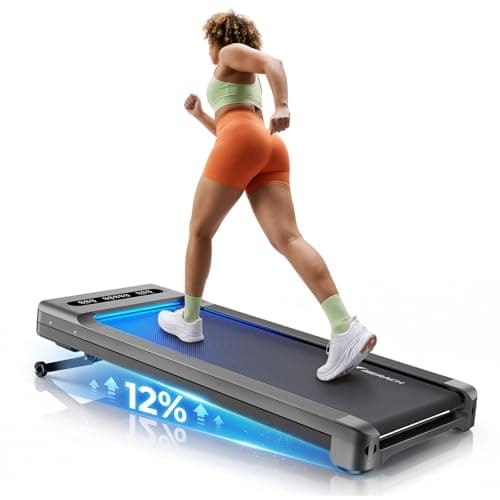
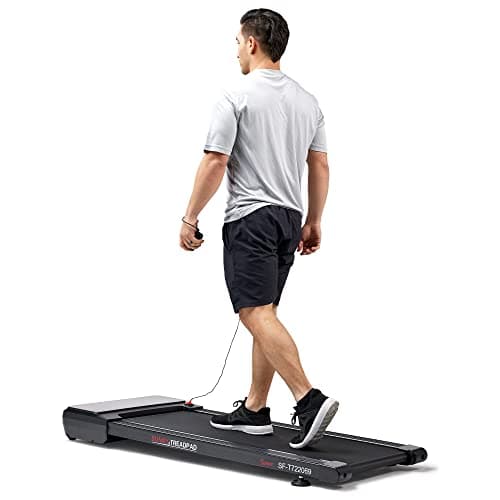
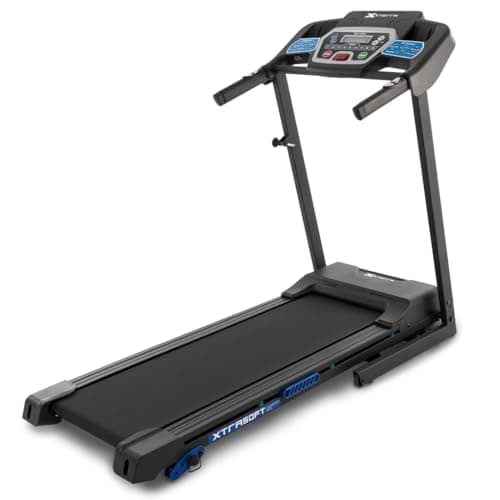
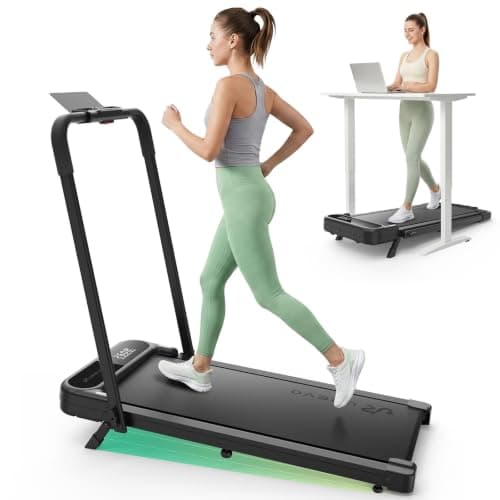
The belt is the only part you actually use, and it is the number most listings bury. From the real listings in our registry: the UREVO Strol 2E Pro publishes a 36.2 by 15.2 in running surface, the MERACH UltraWalk W60 publishes 41.3 by 16.5 in, and the Sunny Treadpad SF-T722069 publishes 45.7 by 16 in. Those are walking and jogging decks. For reference on how uneven disclosure is in this category, the one full-size folding treadmill we rank — the XTERRA TRX1000 — does not publish a deck size at all, and we say so on its card rather than estimating one.
What the belt length decides is your stride. At a walk, a 36 in belt is comfortable. As speed rises your foot lands farther back, which is why the longest decks here are the ones a taller user can jog on without clipping the rear roller. If you intend to run rather than walk, belt length is the first specification to check and the one most likely to be missing.
Rectangle two: the frame around the belt
A treadmill is always longer than its belt, because the motor housing sits in front and the rear roller sits behind. The gap is consistent and worth internalizing: on the three machines above it is 6.3 in, 10.1 in and 12.5 in respectively. So a 45.7 in belt arrives as a 58.2 in object.
- UREVO Strol 2E Pro — 42.5 in long by 21.9 in wide in use, handle up, around a 36.2 in belt.
- MERACH UltraWalk W60 — 51.4 in by 22 in, around a 41.3 in belt.
- Sunny Treadpad SF-T722069 — 58.2 in by 24.9 in, around a 45.7 in belt.
Width matters more than people expect in a corridor or beside a desk: 19.6 to 24.9 in is the published range across the pads in our registry, and a 24.9 in machine will not pass a 24 in gap between a desk leg and a wall.
Rectangle three: the dismount zone behind it
This is the one nobody measures and the only one with a safety consequence. If the belt moves and you step backward off it, you need floor behind the machine — not a wall, not a bookcase, not a radiator. We are not going to quote you a gym-industry standard we cannot link, so here is the rule we use and the reason for it: leave at least one of your own strides of clear floor behind the rear roller, which for most adults is roughly two to three feet, and keep it clear permanently rather than "mostly."
Two practical notes. On a pad with no handrail — which is most walking pads, including two of the picks below — the dismount zone matters more, not less, because you have nothing to grab. And on the sides, give yourself enough room to step off laterally; a machine wedged between a wall and a desk leaves you only one exit, which is the wrong number.
The honest total for a compact walking pad: a 42 to 58 inch frame, plus two to three feet behind it, plus enough side room to step off. Call it 7 to 8 feet of floor length in use for most of the pads we rank, and more for a full-size folding treadmill with a run range.
Rectangle four: the stored slot
This is where compact cardio earns its place, and the specifications here are unusually good. Folded or flat heights in our registry run from 3.9 in to 6.5 in — thin enough to slide under most beds and sofas, which converts a permanent 8 sq ft claim on the floor into a temporary one. The comparison that matters is folded height against the clear height under the furniture you plan to use, measured from the floor to the underside of the frame rails.
Weight is the companion number: 36.6 to 73.9 lb across the same set. A 40 lb pad is a one-person job on a flat floor; a 74 lb pad with transport wheels moves across a room but not up a staircase without help. If the machine has to live in a different room from where it is used, read the weight before the footprint.
What to look for, in order
- Published belt length and width. If a listing does not state it, treat that as a gap rather than an average. Walking is fine on 36 in; jogging is not.
- Published in-use footprint. Expect it to be 6 to 13 in longer than the belt. Tape the rectangle on the floor before ordering.
- Folded height, against the gap you intend to store it in. 3.9 to 6.5 in in this field. Measure under-bed clearance at the rails, not at the mattress.
- Machine weight. The constraint on moving it, and on whether storage is something you will actually do twice a day.
- Whether a handle folds or the machine folds. A pad whose handle drops flat is a different object from a treadmill that hinges upright; the second needs ceiling clearance in its stored position.
The four machines these numbers came from
The picks below are the machines whose published dimensions this page is built on, ordered by how much floor they need. The UREVO is the smallest published in-use footprint with a run range; the MERACH sits in the middle with a motorized incline; the Sunny Treadpad is the longest pad here and the one with the longest belt; the XTERRA is the full-size folding treadmill, included deliberately as the example of a listing that does not publish a deck size. Each card carries its live price and its own spec block.
If the room is too short
Three things actually work, in order of cost. Turn the machine to face the other way so the dismount zone falls into open floor rather than toward a wall. Move it to a different wall — a pad needs length, not a corner, and the longest clear wall in a small room is often not the one you first thought of. Or buy a shorter machine: the gap between the shortest and longest pad in our registry is nearly 16 inches of floor, which is the difference between fitting beside a desk and not.
What does not work is treating the dismount zone as optional. If the only way the machine fits is with a wall directly behind the rear roller, buy a different category. A seated under-desk machine or a mini stepper needs no run-off at all.
Ceiling height, for the folding kind
A pad whose handle folds flat has no ceiling requirement. A treadmill that hinges upright for storage does — the deck stands vertically and the stored height is roughly the deck length plus the base. If you plan to store a full-size folding treadmill upright in a room with a sloped ceiling or a low basement duct, measure that before anything else; our ceiling height guide has the clearances for the rest of a home gym.
The floor underneath is part of the footprint
A mat is not a space saver, but it changes what the space can be. It stops a light frame creeping across hard boards, protects the finish under the feet, and takes the edge off what the room below hears. It also adds a few inches to the rectangle on every side, so size it with the machine rather than after. Our mat guide for pads answers the yes-and-no version of this question, and pads on carpet covers the case where the floor is soft.
And what the neighbor hears
Floor space and noise are different problems with the same cause: a treadmill is the one piece of home cardio where your body lands repeatedly. None of the pads in our registry publishes a decibel figure except the MERACH, which states around 54 dB average — and even that describes the machine, not your footfall. If the room below is occupied, will a treadmill bother downstairs neighbors is the page that addresses it honestly.