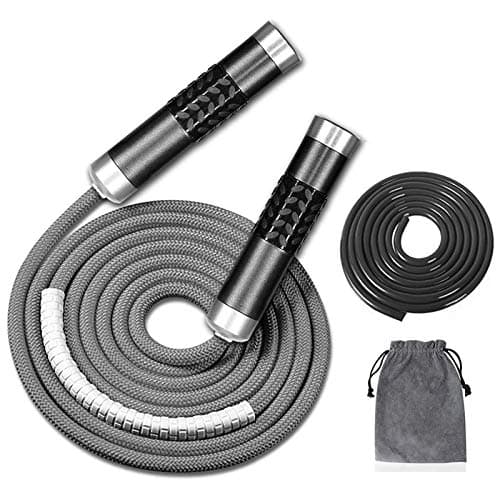
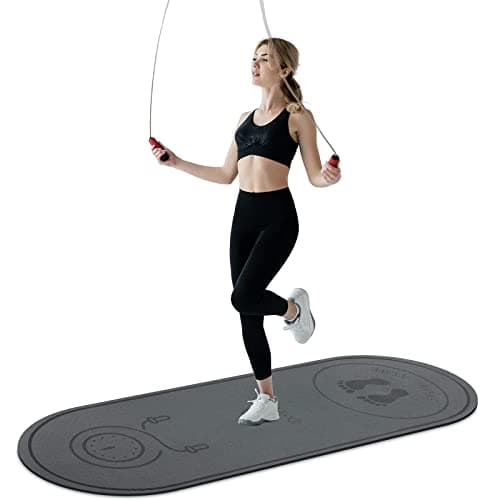
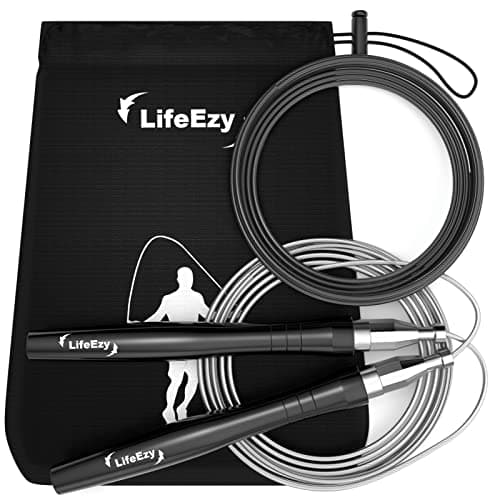
For apartment jumping, buy a rope and a mat together — the mat is what stops the rope cracking against a bare floor on every pass, and it is the difference between a workout and a complaint. The LIFEEZY speed rope is our pick for most people; the Redify with its braided cotton cable is quieter still and better on an upper floor.
A jump rope is the highest cardio return per cubic inch of any equipment we cover — a rope weighs half a pound and fits in a jacket pocket. But it is also the piece of equipment with the largest gap between what it costs and what it demands from a room, and nobody selling one mentions either constraint.
Two things decide whether you can jump rope where you live. Ceiling clearance, which is a simple measurement most people never take. And impact transmission to the floor below, which is not about the rope at all — it is about you landing, roughly a hundred times a minute. We cover both honestly below, including the case where the answer is that you should not do this in your apartment.
The ceiling math
A rope needs to clear the top of your head with the handles at hip height. Practically: stand up straight, raise one arm overhead, and measure from your fingertips to the ceiling. If that gap is under about six inches, you will clip the ceiling on the up-pass. Common failure points are ceiling fans, pendant lights and low basement ducting rather than the ceiling itself.
If you fail the measurement, the fix is not a shorter rope — it is a different exercise. Skipping in place with a ropeless handle set, or a mini stepper, gives you the conditioning without the arc. Our ceiling height guide covers the clearance every movement needs.
The floor math, and the honest answer
Jumping rope is repeated impact from a person landing. A quarter-inch mat damps the rope strike and softens the landing a little; it does not isolate a 180 lb impact from a joisted floor. If you live above someone in a wood-framed building, they will hear you jumping, and a mat reduces rather than removes that.
That is the honest position, and it means: jump on a ground floor or a slab if you have one, jump during reasonable hours if you do not, and layer a thicker interlocking mat under the jump mat if you want to do more. It is the same physics we set out in lifting in an apartment.
Cable type is the specification that matters
Ropes come in three broad cable types and they behave very differently in a small indoor space.
- Coated steel cable. Fastest, thinnest, best for double-unders. Loudest on a hard floor and the harshest when it hits you. This is the LIFEEZY.
- Solid PVC. Middle ground. Durable on concrete, moderate speed, moderate noise.
- Braided cotton or fabric. Slowest turn, softest impact, quietest on a floor and by far the most forgiving when you miss. The Redify includes one alongside a PVC cable.
For apartment use specifically, that ranking inverts the usual advice. A serious rope athlete wants steel; someone jumping above a sleeping neighbor wants cotton.
Weighted or not
A weighted rope — the Redify is about a pound total — turns slower and builds more shoulder and forearm fatigue per minute. That makes it better conditioning per unit of time and worse for learning technique or practicing speed work. If you are new to rope, start with the light rope; the weighted one is a step up, not a starting point.
Sizing the rope correctly
Both ropes here are 10 feet and adjustable, which is long enough for anyone under about 6 ft 6 in. To size it: stand on the middle of the cable with one foot and pull the handles up along your body. The handle tops should reach somewhere between your armpit and your sternum. Shorter is faster and less forgiving; longer is slower and easier to learn on.
The LIFEEZY's screw-free lock matters here more than it sounds. Ropes with a grub screw and an Allen key tend to get set once, badly, and never adjusted again — which is how people conclude they are bad at skipping when they actually just have a rope that is four inches too long.
What the mat is doing
Three separate jobs, and it is worth being clear which is which:
- Protecting the rope. Concrete and tile abrade a cable fast. A mat roughly doubles cable life.
- Protecting the floor. A cable striking a hardwood floor a hundred times a minute leaves marks.
- Reducing noise. The rope strike is a sharp, high-frequency crack that carries well. Damping that specifically is a real improvement even when the landing impact remains.
A 71-inch mat is long enough that the cable lands on mat rather than on the edge, which is the common failure of a small yoga mat pressed into service.
Where a rope fits in a small gym
It is the cheapest conditioning tool you can own and it stores in a drawer, which makes it a natural companion to strength gear rather than a competitor. If your room already holds a rack or a bench, a rope adds cardio for the price of a takeaway and no floor at all. Our essentials guide places it early in the buying order for that reason.