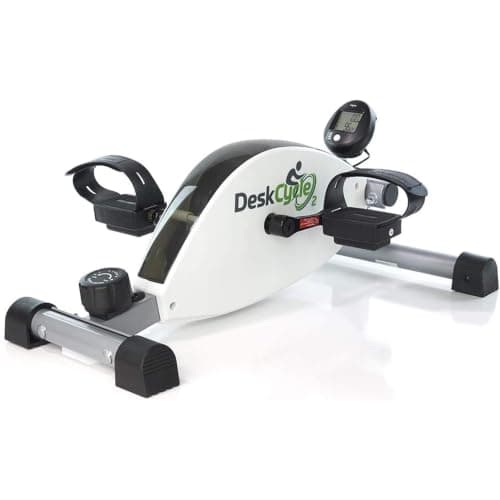
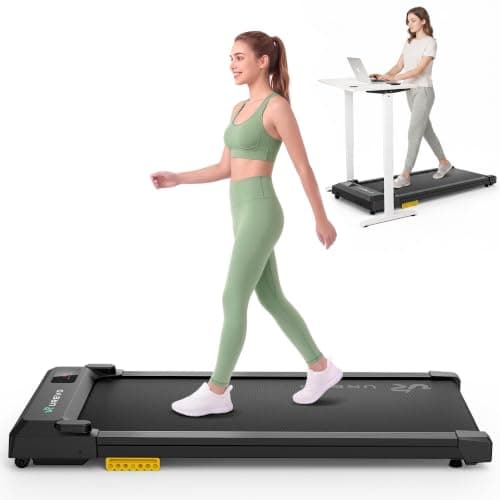
If your desk raises, buy the walking pad — the UREVO Smart Walking Pad is our pick because it is a flat slab with double shock absorption that slides under the desk or the bed between uses and costs less than most pedal units. If your desk does not raise, buy the pedal unit, and the DeskCycle is the one to buy because it is built low enough to fit under a genuinely standard desk, which is exactly where the category usually fails.
That is the whole decision, and it is worth being blunt about why: almost every article comparing these two treats it as a preference, and it is not. A walking pad only works if your work surface can be at standing height, because there is no version of this where you type at a seated desk while walking. A pedal unit only works if there is real clear height under your desk for your knees to travel, because the pedal arc is taller than the unit itself. Two measurements settle it before any spec comparison starts.
Take two measurements first
- Does the desk go up, and how high? A standing desk, a converter on top of a fixed desk, or a counter you can work at. If the answer is no, the walking pad is out — a pad under a seated desk is a pad you step off to use, which is a different purchase with a different justification.
- Clear height from the floor to the underside of the desk.Then subtract the pedal unit's own height and check what is left against your knees through the full circle. This is the number that sends pedal units back, and it is why the DeskCycle's low pedal height is its headline feature rather than a footnote.
Add a third if a walking pad is winning: a pad raises you by its own deck thickness, so a fixed-height standing desk that was right flat may be slightly low once you are standing on a machine. It is usually an inch or two, and it is usually fine, but it is free to check.
How the four compare
| Machine | Posture | Needs | Stores how | Can you type on it? |
|---|
| UREVO Smart Walking Pad | Standing, walking | Standing-height desk + outlet | Slides under furniture, no fold | Yes at low speed, with practice |
| DeskCycle | Seated, pedaling | Clear height under the desk | Lives under the desk | Yes — hands are free and still |
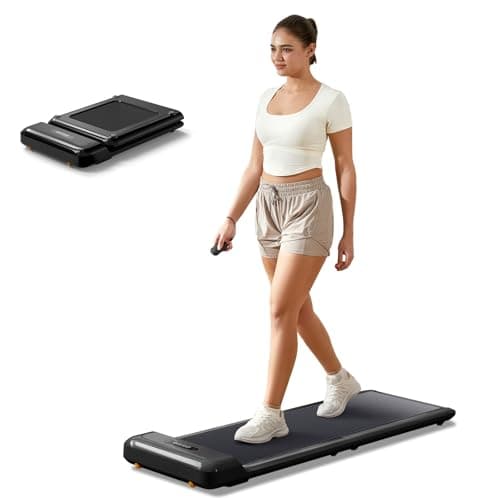
| WalkingPad C2 | Standing, walking | Standing-height desk + outlet | Folds in half, stands in a closet | Yes at low speed, with practice |
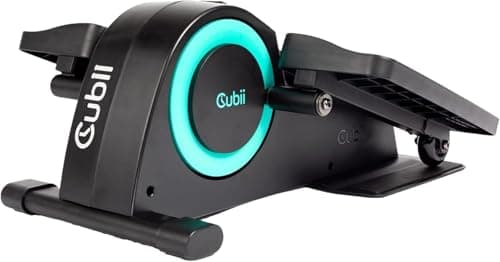
| Cubii JR1 | Seated, elliptical motion | Clear height under the desk | Lives under the desk | Yes — torso stays still |
What each one is actually good at
The walking pad is the better machine and the worse desk accessory. It moves your whole bodyweight, which is more work than pedaling against magnetic resistance, and it is the one of the two that could plausibly replace a walk outside. The cost is that it needs floor space while running, it needs an outlet, it makes a motor sound, and detailed typing while walking takes genuine practice — most people end up doing calls and reading on it and stepping off to write. Our is a walking pad worth it page is the honest version of that trade.
The pedal unit is the worse machine and the better desk accessory. Nothing about your working posture changes: your hands stay on the keyboard, your torso stays still, your screen stays where it was. It is near-silent, needs no outlet, and disappears completely because it already lives under the desk. What it will not do is replace a training session, and we would rather say that than imply otherwise. Our under-desk roundup ranks the whole category on pedal height.
The noise answer, which surprises people
For a shared wall or a neighbor below, the pedal unit wins outright and it is not close. A seated magnetic unit has no motor and nothing lands, so there is essentially nothing to transmit. A walking pad has a brushless motor plus a footfall every step, and footfall is the one noise path a mat does not solve — it goes into the structure, not the air. If you are above a light sleeper and you work early, that single fact may decide this for you. See will a treadmill bother downstairs neighbors for where the line really falls, and the mat question for what to put underneath.
Storage decides which walking pad, if the pad wins
Both pads here are good; they store differently, and in a small apartment that is the whole choice. The WalkingPad C2 hinges in half and stands upright in a closet, which is the smallest stored object in the category. The UREVO does not fold at all — it is a flat slab that slides under a couch or a bed, which is fine if you have somewhere flat and useless if your only storage is a narrow closet. Measure the gap you intend to use, including under-bed clearance, before you choose. Our walking pad ranking goes deeper on both.
Buying both is a reasonable answer
Worth saying because the two are cheap relative to a treadmill and they do not compete for the same hour. The pedal unit covers the four hours you are at the desk writing; the pad covers the thirty minutes of calls where you can be standing. Together they cost less than one folding treadmill and ask less of the room than one, which on a small-space site is the recommendation that keeps coming out of the arithmetic. Our work-from-home gift guide is built around exactly this combination.
What neither one is
Neither is strength training, and in a small apartment strength is the thing with the worse coverage and the better return per square foot. A band set lives in a drawer and a pair of adjustable dumbbells lives under a desk; both can share the room with either machine on this page. If you are furnishing a home office from scratch, our small-space essentials list is the order we would buy in.