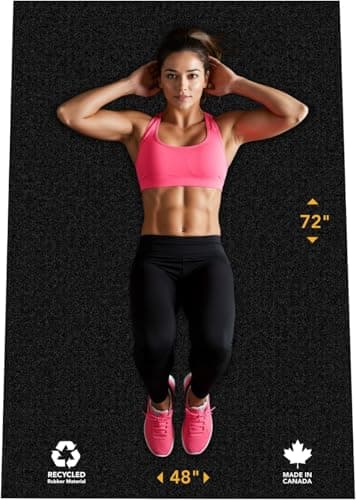
Yes, put something under it — and the honest reason is floor protection, not noise. A thin single-piece rubber mat like the Rubber King 3 mm is the right default under a walking pad: 24 square feet in one 13 lb piece, enough to stop castors, sweat and scuffs, and cheap enough that it is not a real decision. What a mat will not do is stop the thump of your footsteps reaching the apartment below. That is worth knowing before you spend, because it is the reason most people buy one.
A walking pad is a light machine doing a repetitive thing in one spot, usually on somebody else's floor. That produces three problems a mat genuinely solves and one it mostly does not, and the thickness you want depends entirely on which of them you have.
The three things a mat actually fixes
- Floor protection.The real one. The pad's feet sit in the same four spots for months and press into whatever is under them — a dent in vinyl plank, a polished patch on hardwood, crushed pile in carpet. In a rental this is a deposit question, not a comfort one, and it is the single best argument for the mat.
- Creep. A belt dragging under your weight pushes the machine backward a fraction with every step, and on a hard floor a pad can walk itself across a room over a week. A rubber surface grips the feet and stops it. This is also why a mat should be rubber rather than slick plastic.
- Stability on carpet. On carpet the problem is not the floor, it is the machine. Soft underlay lets the deck flex and rock as you step, which is unpleasant and hard on the frame. A firm layer between pad and carpet fixes it — see can you use a walking pad on carpet, which is the longer version of this specific case.
The thing it mostly does not fix
Impact noise reaching the room below. It is worth separating two things that get called the same word. The sound you hear in your own room is largely airborne, and a mat does take the edge off it. What the neighbor below hears is structure-borne — your footfall enters the joists and comes out of their ceiling, and a few millimeters of rubber sitting on top of the floor does very little to interrupt that path. Thicker helps slightly. Nothing you can buy at this price point solves it.
If the neighbor below is the actual problem, the fixes that work are different ones: walk at a lower speed, walk at a time the room below is empty, choose a machine where nothing lands at all — see low-impact cardio machines — and read will a treadmill bother downstairs neighbors before you spend money on flooring expecting it to be the answer. How to soundproof a home gym covers the few interventions that genuinely change the structural path.
What to look for, in order
- Rubber in contact with the machine. Grip is the point. Foam alone compresses under four small feet and lets the pad rock; rubber holds it.
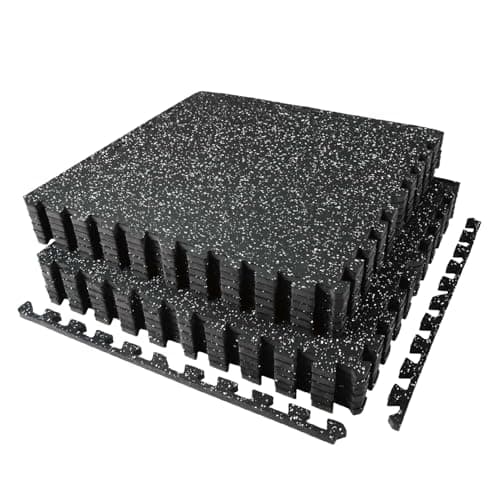
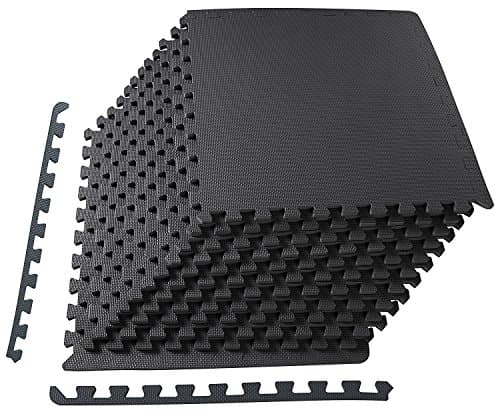
- Thickness matched to the job. 3 mm is right for a pad on a hard floor: protection and grip, no bulk, no trip edge. Half an inch of foam is right if you also train on the same patch. Dual-layer rubber-over-foam is for heavy gear, not a 60 lb pad.
- Size, with margin. Buy a mat longer than the deck, because your feet land behind the belt when you step off and a mat that stops at the deck edge is a tripping lip. A 4 by 6 ft mat covers every pad we rank with room to spare.
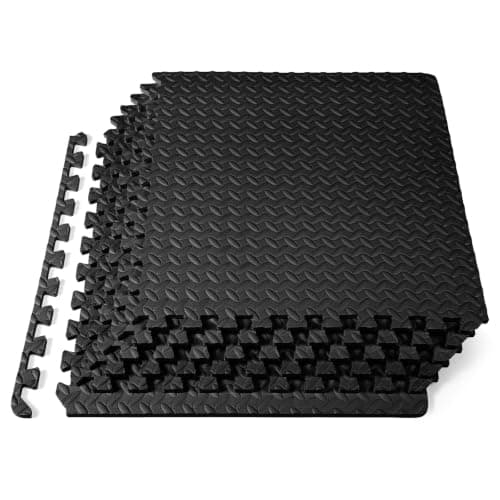
- Single piece or interlocking. One piece will not shift apart under a belt. Tiles are easier to carry up a staircase and easier to extend later. Both work; tiles need their seams running across the direction of travel, not along it.
- What the maker says about carpet. Rubber King explicitly does not recommend either of its mats over carpet, and we print that rather than ignoring it. On carpet, interlocking tiles or a rigid board under the tiles is the safer stack.
The four we would put under a pad
These are ordered for a walking pad specifically, which is a different order than our general home gym mat ranking — that page is weighted for dropped weights and this one is weighted for a machine that sits still and vibrates. Each card carries its live price; we never type a price into the prose, because the number on the card is the one that is current.
How thick, really
For a pad on a hard floor, 3 mm of rubber is enough and more is mostly wasted: the job is grip and protection, and the machine weighs a fraction of what a loaded barbell does. Go to half an inch of interlocking foam if the same patch of floor also hosts floor work, a bench or dumbbells, because then you are protecting against things that get set down rather than things that sit still. Go to a dual-layer rubber-over-foam tile only if the area carries a rack or plates as well — under a pad alone it is money spent on the wrong problem, and the tile's own card says so.
On carpet, the stack matters more than the mat
Carpet is the one case where the mat is doing structural work rather than cosmetic work, because the instability is the whole complaint. The order that works is: carpet, then a rigid flat layer if the underlay is soft, then the mat or tiles, then the machine. Our home gym on carpet guide works through when the rigid layer is necessary and when it is not, and rubber gym flooring compares the full flooring field if you are doing a whole room rather than one machine.
Two small things that save a return
First, unroll a rubber mat and leave it a day before putting the machine on it — recycled rubber keeps a memory of the roll, and a pad standing on a curled corner sits unevenly. Second, if the pad lives under a desk, check the mat's edge against your chair castors; a 3 mm lip is nothing to walk over and plenty to catch a wheel. Both are obvious in hindsight and both are the sort of thing nobody mentions until it has annoyed you for a week.