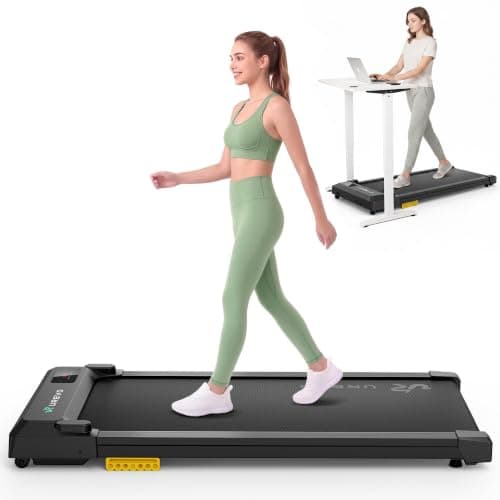
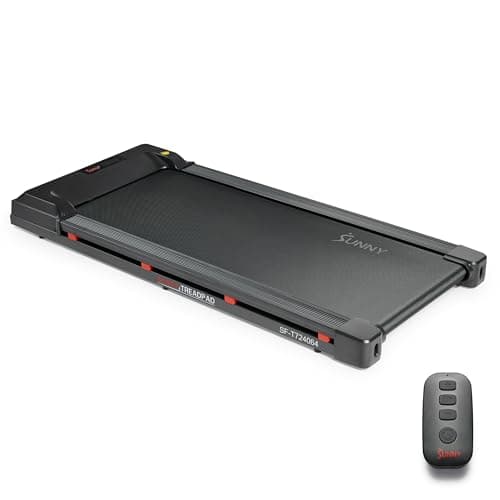
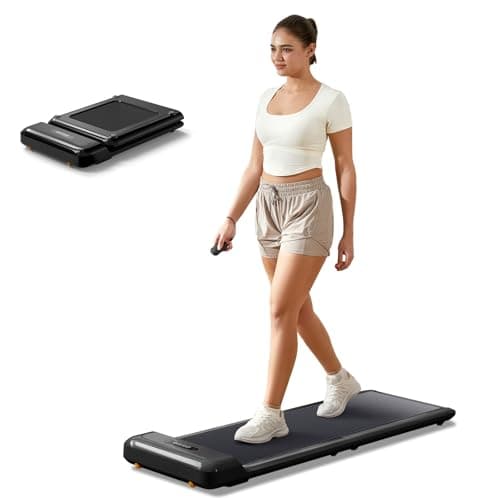
A walking pad is worth it if you have a use for it that repeats — most often a standing desk and a workday — and somewhere flat to store it. It is not worth it if you are buying it to run, to climb, or as a treadmill that happens to be cheaper. Those are three different machines, and the walking pad is only one of them.
We get asked this more than almost any other question on the site, and the reason is that the walking pad looks like a bargain treadmill and is not one. It is a slab with a belt on it that moves at walking speed, with no handrail, no incline and no running mode. Whether that is worth owning depends entirely on whether walking is the thing you will actually do — so this page is organized around the honest tests, and the three pads at the end are the ones that pass them.
Test one: will you use it during the day?
The walking pad exists because of the standing desk. Its entire advantage over every other cardio machine is that you can be on it while doing something else: a call, a document, a slow afternoon. Nobody does a “workout” on a walking pad; people walk several thousand steps on one while working, and the machine earns its place by being used for hours, not minutes.
So the first test is blunt. Do you have a desk you stand at, or could you? If yes, a pad is probably worth it and the rest of this page is about picking one. If your plan is to walk on it for twenty minutes in the evening as exercise, be honest that a walk outside is free, and that a folding treadmill you can jog on may hold your attention longer.
Test two: is walking the workout you want?
A walking pad does not run. The good ones top out at a brisk walk, on purpose, because there is no rail to grab and the belt is narrow. If any part of you is planning to “start walking and work up to running,” that machine is a folding treadmill, and our walking pad vs folding treadmill comparison is the page to read instead. Buying a pad and then wanting to run on it is the most common way this purchase goes wrong.
There is also no incline. If a walk at a grade is what your knees or your goals want, a pad will disappoint. And if intensity without a motor is the aim, a mini stepper or a vertical climber delivers more effort in less floor.
Test three: where does it go?
This is the one people skip. A pad in use is a slab on the floor; a pad not in use is still a slab, and if it has nowhere to go it becomes a thing you step over. There are only three storage stories in the category, and they map onto the three picks below:
- It folds in half and stands up. Only some pads do this. The one that does can live in a closet or against a wall, which makes it the answer for a studio with no clearance under anything.
- It slides under a couch or bed. Most pads. This requires a gap longer than the machine and taller than its thickest point, which you should measure before you order rather than after.
- It stays under the desk. The easiest story, and the one where the pad is most likely to be used, because it is always ready.
If none of those three describes your room, the pad is not worth it regardless of the price, and the storage guide is the place to check whether a different shape of machine fits.
What to check on the listing before you buy
- Whether it folds, and how. “Foldable” in a title can mean the deck hinges in half, or that a handle drops down, or nothing at all. Read the dimensions.
- The stored thickness against your gap. Most makers publish it; measure the gap under your furniture and compare.
- The top speed. If it is a walking speed, it is a walking pad. If it goes faster, it is a treadmill with the rail missing, which is not an upgrade.
- Shock absorption and the floor beneath. A pad publishes cushioning or it does not; either way a mat underneath is the cheap insurance, and if the floor is carpet, the carpet guide explains the plywood trick.
The three pads below pass the tests on this page in three different ways: one folds in half, one is the cheapest way in and publishes double shock absorption, and one arrives assembled from a brand with a parts channel. They are the same three machines our walking pad roundup ranks, listed here so you can see the live price next to the storage story that fits your room.
The honest cost-per-use math
A walking pad is not expensive against the rest of this hub, but the question is not the price, it is the price divided by the hours it runs. A pad under a desk that runs an hour a day for a year is the cheapest fitness equipment most people will ever own. A pad that is used for two weeks and then slid under the bed is one of the most expensive per hour, and the category has a reputation for the second outcome because of the running mistake above.
The pattern that works is the boring one: the pad lives under the desk, you start every call on it, and the step count takes care of itself. The pattern that fails is buying the pad as a resolution and expecting it to create the habit.
When a walking pad is clearly worth it
- You work from home, at a desk you stand at, and you would walk during calls.
- Someone lives below you and a treadmill is off the table for noise reasons.
- You have a couch, bed or desk with clearance beneath it, or a closet if the pad folds.
- Your goal is daily movement rather than a workout.
When it clearly is not
- You want to run, or think you might. Buy a folding treadmill.
- You want incline. Buy a folding treadmill with motorized incline.
- You have nowhere flat to store it and it does not fold. It will become furniture.
- You want a hard workout in a small footprint. A compact rower trains more of you and stands in a corner.
The budget question
The pads on this page span a range, and the cheapest is not a compromise if a slab that slides under furniture is your storage story. Where money buys something real is the fold-in-half hinge, which is worth paying for in a studio and worth nothing if the pad lives under a desk. We ranked the tier below the fold-in-half price separately in the best folding treadmills under $300, which is where to look if the hinge does not matter to you.