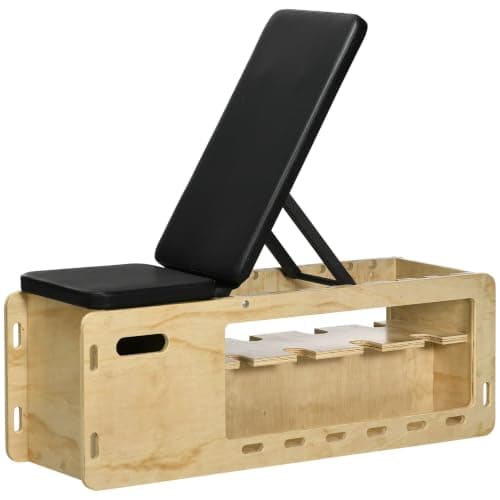
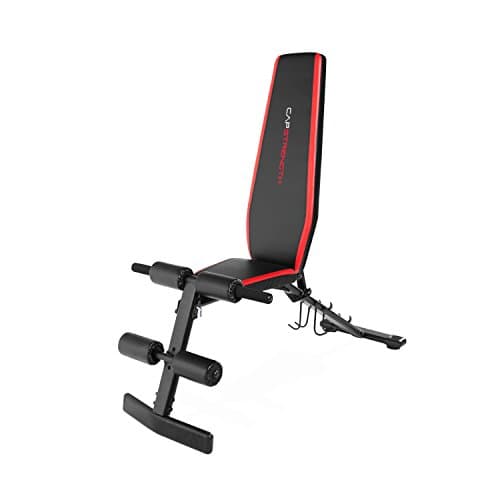
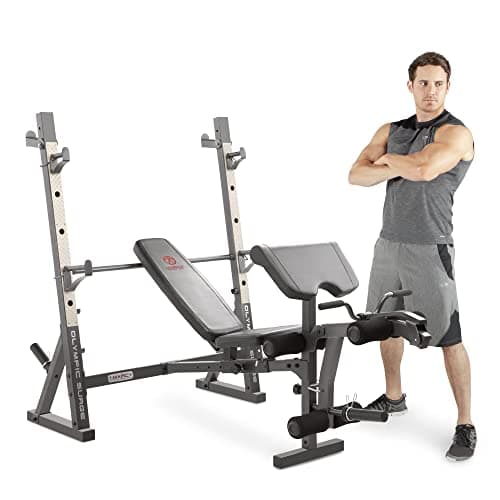
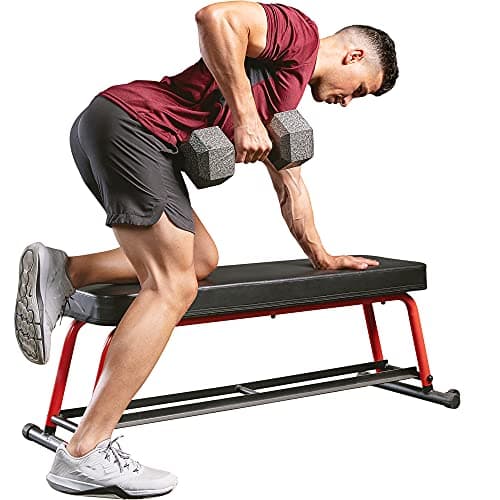
For most small rooms the Sunny Power Zone SF-BH6996 is the pick: a 49.6 by 16.1 in steel flat bench whose frame-mounted rack is rated to 300 lb, which is the only storage figure on this page a maker states in pounds. Take the Soozier instead if you need the bench to incline and to occupy the least floor in the room, or CAP's FM-CS104B if price is the binding constraint and you can live with a listing that publishes almost nothing about it. The Marcy MD-857 is the only pick here that stores Olympic plates rather than dumbbells, and it wants 26 square feet to do it.
The reason this category exists is the arithmetic of a small room. A bench is roughly five and a half square feet. A dumbbell rack is another two to four. Set them side by side with walking room between and a corner that looked adequate has become a corner you edge around with the laundry basket. A bench that carries its own weights collapses two objects into one and gives that walking room back, which is the entire proposition — and it is a real one, provided the storage actually holds the weights you own.
That last clause is where most of these purchases go wrong, and it is what this page ranks on. "With storage" is a phrase, not a specification. One bench here is rated to 300 lb but never says how many dumbbells that is. One counts eight slots and publishes no pound figure at all. One has holders welded to the frame and publishes neither a rating nor a count for them. And one stores 2 in Olympic plates, which is a different problem with a different answer.
Two products share this name
Search "bench with weight storage" and you get two categories wearing one label, and they suit different rooms and different training.
- Dumbbell-storage benches. A flat or adjustable bench with trays, a frame-mounted rack or slots that hold a hex or adjustable set. These are apartment-scale — four to six square feet — and they are what most people typing that phrase actually want. Three of the four picks here are this.
- Plate-storage benches. An Olympic bench with storage posts on the frame for 2 in plates, usually with bar catches and a leg developer attached. These are garage-scale. They solve a barbell problem, not a dumbbell problem, and they do not fit in the corner of a bedroom.
If you own a barbell and plates, skip to the Marcy and read the footprint line twice. If you own dumbbells — which, in a room this size, you probably should; see our adjustable dumbbell roundup for why — the first three picks are your list.
The four things we ranked on
No hands-on testing happens here and we do not pretend otherwise. What we do is read every published number, put the four benches on the same axes, and refuse to quote a figure a maker has not stated. The axes:
- Published storage capacity, in pounds. A slot count tells you nothing — eight slots sized for 15 lb dumbbells is not the same product as a 300 lb rack. Where a maker publishes pounds, we rank on pounds. Where it publishes only slots, or nothing at all, we say so and mark it down.
- Assembled floor area. Length times width, in square feet, because that is the number the room enforces. The spread across the three benches that publish it is enormous: 4.1 sq ft at the smallest and 26.4 sq ft at the largest. The CAP publishes no assembled dimensions at all, which is the main reason it sits third.
- Whether the storage costs extra floor. Trays built into the frame footprint are free. A rack that hangs off the end of the bench is not. All three apartment-scale picks here keep their storage within the frame — Sunny on a rack under the pad, Soozier in slots along the side, CAP on holders welded to the rear leg brace.
- Whether the backrest moves. In a one-bench gym, incline is most of your upper-body variety. The bench with the best-documented storage here is the one that does not adjust at all, which is the single most annoying fact about this category.
The capacity number that is not what you think
Bench listings publish capacity two different ways, and the two are not interchangeable. A total capacity counts you plus everything on the bench — the dumbbells in your hands, and on some listings the weights on the rack as well. A maximum user weight is you alone. The first number is always bigger, so the first number is what gets printed in the title.
The Soozier on this page is the clean illustration. Its Amazon listing states a weight capacity of 660 lb. Soozier's own published specification for the same SKU states 660 lb total and 264 lb maximum user weight. Both are true. Only one of them tells a 200 lb lifter holding two 50 lb dumbbells whether they are inside the design envelope — and at 300 lb combined, they are not, even though 300 is comfortably under 660.
So read for the smaller number and plan around it. If a listing publishes only the big one, assume the user limit is well below it. This is the same reading discipline we set out in how much weight a weight bench can hold, and storage benches are where it bites hardest, because a bench holding 200 lb of dumbbells is already carrying a load before you sit down.
How the four compare
| Bench | Floor area | Storage | Max user | Adjusts? |
|---|
| Sunny SF-BH6996 | 49.6 x 16.1 in (5.5 sq ft) | 300 lb rack | 550 lb | No — flat |
| Soozier A91-243 | 43.3 x 13.8 in (4.1 sq ft) | 8 slots + 20 L box | 264 lb | Six angles |
| CAP FM-CS104B | Not published | Frame holders; not rated or counted | 300 lb | Four positions |
| Marcy MD-857 | 80 x 47.5 in (26.4 sq ft) | 2 in plate posts | 300 lb | Four positions |
Read the max-user column against your own bodyweight first, because it disqualifies faster than anything else on the table. Then read floor area against the corner you have measured. Sunny publishes 550 lb as a user limit outright, which is the most generous honest number here; the CAP states 300 lb and then stops, with no dimensions and no storage rating to set against it.
Does a storage bench actually save space?
Sometimes, and less than the marketing implies. Run the numbers on the alternative: a plain flat bench is about 5 sq ft, and a compact dumbbell rack or A-frame is roughly 2 to 4 sq ft depending on how many pairs it takes. Two objects, seven to nine square feet, plus the gap you leave between them so you can reach both.
A storage bench does the same job in four to six square feet with no gap, because the weights live inside the frame's own footprint. That is a genuine saving of roughly a third, and in a bedroom corner a third is the difference between a gym and an obstacle — provided the maker publishes the footprint at all, which one of the four below does not.
Where it stops being a saving is capacity. If you own more dumbbells than the bench takes, you now own a storage bench anda rack, which is worse than either plan. Count your pairs before you buy: Sunny gives you a pound figure to divide by your own set, eight dumbbells is the Soozier's limit, and CAP states nothing at all, which means measuring the holders yourself once it arrives. Our guide to storing dumbbells in a small apartment covers what to do with the pairs that do not fit.
Match the rack to the dumbbells you already own
This is the step people skip, and it is the one that decides whether the bench works. Three common setups, and what each needs:
- A light-to-middling hex set (5 to 30 lb pairs).The Sunny's 300 lb rack swallows this and keeps the pounds published, which is the most common home setup and the best-served one. If you do not own the dumbbells yet, CAP sells its discontinued FM-103S tray bench as a bundle with a matching 150 lb hex set, which is still listed; we compare it with the other bundles in weight bench and dumbbell sets.
- A heavy hex set, or a few big pairs.The Sunny's 300 lb rating is the highest number on the page. It is also the only rating that scales with your set rather than capping the individual dumbbell weight.
- One pair of adjustable dumbbells. Honestly, none of these four. An adjustable pair sits in its own cradle and does not need a bench rack at all; what you want is a bench that inclines, which points you at our adjustable benches for small spaces rather than at this page. Storage benches earn their keep against a spread of fixed weights, not against one pair that changes weight.
Plates are a different problem
If what you need to store is 2 in Olympic plates, a bench is an inefficient way to do it. The Marcy is on this page because it is the honest answer to the plate half of the query and because its posts and bar catches genuinely remove the need for a separate rack — but 26.4 square feet is a garage or a spare room, full stop.
The better small-space answer is almost always to separate the two jobs: a compact bench for pressing, and plates on a wall or in a tree that costs you a couple of square feet. Vertical plate storage takes about two inches of wall depth and holds a full set, which no bench frame can match. See the best weight plate storage racks for the wall rails and trees we rank, and small-space weight storage for where everything else in a home gym goes.
A loaded bench does not move
The trade nobody mentions on the listing: storage and portability are opposites. A folding bench earns its place by disappearing between sessions. A storage bench earns its place by being permanently loaded with 200 lb of iron, which means it is not going anywhere, and it is not going to be lifted onto its end and slid behind a door.
Only the Sunny has transport wheels, and wheels move a bench across a level floor once you have taken the dumbbells off it. If the bench has to vanish when you are done — a living room, a shared bedroom, a studio — you want the opposite product, and our folding weight bench roundup is the right page. Choose one plan or the other; a bench that neither folds nor holds anything is the worst of both.
What this does to your floor
A storage bench concentrates its own weight plus the stored dumbbells onto four small feet, permanently, in one spot. The Sunny at 35.6 lb with its rack loaded to the published 300 lb is well over 300 lb standing on maybe twelve square inches of contact area, and unlike a rack you unload after every session, it stays there.
On hardwood that dents. On carpet the feet sink and the frame goes slightly out of level, which is worse on a bench than on a rack because you notice it under one shoulder. A firm mat is the fix, not a soft one — see our home gym mat roundup for what survives a point load, and home gym on carpet if the room in question is carpeted, as most bedrooms are.
Renters get one piece of good news: nothing on this page drills into anything. All four are freestanding, all four assemble with the supplied hardware, and all four leave with you. The only lasting mark any of them makes is the one under the feet, which is exactly what the mat is for.
Who should buy something else instead
- You want the bench to disappear. Buy a folding bench and store the weights separately. A loaded storage bench is a permanent object by design.
- You mainly need incline and decline. Storage is a poor reason to give up adjustment. The adjustable benches we rank go to steeper angles and higher user limits than anything on this page.
- You want a barbell station. A bench with uprights is a different product; see folding weight benches with a rack for the combos, and note the honest limit stated there about what bench uprights are for.
- Your problem is plates on the floor. Wall storage beats any bench frame on capacity per square foot — plate storage racks.
If none of those describe you — if you own a spread of fixed dumbbells, you have one corner rather than two, and you would rather that corner held one object than three — then this is the right category, and the four benches above are the ones whose published numbers we can stand behind. Work out the corner first; how much space you need for a home gym covers in-use versus stored footprint across everything we cover.