Skip to content
RACK:RATIO

HUB 06 · Small-Space Gym Guides

How to Soundproof a Home Gym in an Apartment

You're not building a recording studio — you're cutting the impact that travels down through the floor. Mats, control and timing do most of it.

By Stephen V.Reviewed How we research
#ad

We earn a commission when you buy through our Amazon links, at no extra cost to you. It never changes our rankings, and we say so when the cheaper product is the better buy. How this works.

Soundproofing a home gym in an apartment mostly means reducing impact — the energy that travels down through the floor into the unit below — not blocking airborne sound the way a studio does. Interlocking mats under the training zone, lifting that never drops a weight, and sensible timing do the large majority of the work. Everything after those three is diminishing returns.

The word "soundproof" sets the wrong expectation, and that's why so many people spend money on the wrong things. Real soundproofing is a construction job: mass, decoupled layers, sealed air gaps, built into the floor and wall assemblies. A renter cannot do any of that, and an owner would spend more on it than on the entire gym. The good news is that you almost certainly don't need to. The complaint a home gym generates is nearly always about one specific thing, and that thing is fixable for the price of a few foam tiles and a change of habit.

Two kinds of noise, and only one is your problem

Airborne noise is what travels through the air first — music, voices, the roar of a fan-based cardio machine. Your floor and ceiling assembly already blocks a fair amount of it, and turning the speaker down handles most of the rest.

Impact noise, sometimes called structure-borne noise, is what happens when something strikes the floor. The energy goes straight into the structure and radiates out of the ceiling below as a thump you feel as much as hear. A dropped dumbbell, a bar returned to the rack carelessly, a running footfall, a rack foot rocking under load — those are impacts. This is the entire noise problem of a home gym, and it is why the acoustic foam panels people buy do nothing for it. Those panels absorb reflections inside your own room; they have no effect on energy already traveling through a joist.

The stack that actually works

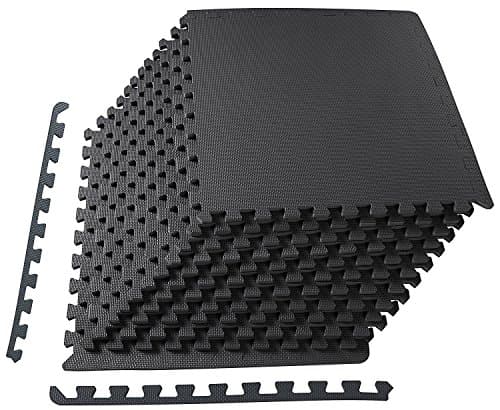
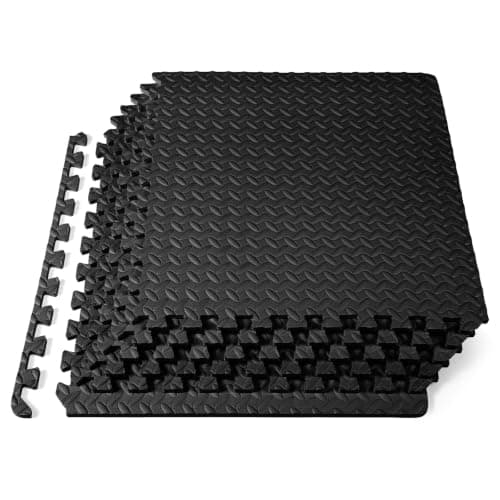
  1. Put a compliant layer between the impact and the structure.Interlocking half-inch EVA tiles under the whole training zone are the baseline, and they're the reason both picks on this page are mats. Where weights actually come down, double up: a second layer of tiles, or tiles under a plywood spreader and more tiles beneath that, spreads and absorbs far more than one thin layer.
  2. Remove the impact at the source. This is the free one and the most effective. Control the lowering phase instead of letting go. Set dumbbells down rather than dropping them. Favor dumbbells over a barbell for pressing and rowing. If you barbell train, use a stand or catch bars you can rack the bar onto so nothing falls from height.
  3. Choose equipment that doesn't generate impact. A magnetic rower, a walking pad, an under-desk machine and a bodyweight power tower all produce essentially no floor strikes. A treadmill you run on produces one per stride. Our quietest cardio machines guide ranks the category on exactly this.
  4. Time it. The same thump is a complaint at 11pm and unnoticed at 11am. Building tolerance for noise is heavily a function of the clock, and shifting your heaviest session into normal daytime hours costs you nothing.
  5. Talk to the person below you. A thirty-second conversation before you set up buys more goodwill than any product on this page, and it tells you immediately whether you have a real problem or an imagined one.

What foam tiles can and can't do

Half-inch interlocking foam takes the edge off footfall, bench feet, set-down dumbbells and the general shuffle of training. It will not silence a loaded barbell dropped from waist height, and no thin mat will — that impact needs either a proper platform or, far more sensibly in an apartment, not dropping the bar. Foam also compresses under concentrated point loads, so a loaded rack foot can dent a tile over time; put a firmer spreader under rack posts if that's your setup. The full trade-off against rubber rolls and glued flooring is in our apartment flooring guide.

What not to spend money on

  • Acoustic wall foam and egg-crate panels. They treat echo inside your room. They do nothing about impact through the floor, which is the noise your neighbor hears.
  • A single thin yoga mat under a rack. Too little material, too small an area, and it slides.
  • "Soundproof" paint and door seals. Both address airborne leakage. Useful for a recording booth, irrelevant to a dropped dumbbell.
  • Anything glued down, if you rent. Adhesive flooring converts a noise problem into a deposit problem. See our renter-friendly guide.

What we can't tell you

We have not measured a single decibel. No sound level meter, no controlled before-and-after, no lab — the count of units we have acoustically tested is zero, and we would rather say so plainly than dress a guess up as data. What's above is the well-understood distinction between airborne and impact transmission, what the mat manufacturers publish about their materials, and what owners consistently report. The only measurement that matters for your specific building is the one you can run for free: ask the neighbor below to stand in their living room while you train, and adjust from there.

If noise is the constraint shaping your whole setup, build the gym around it from the start. Our apartment lifting guide covers the drop-free ways to train heavy, and the compact home gym kit is deliberately weighted toward gear that makes very little noise in the first place.
The short answer

Quick picks

#ProductBest forScorePrice
01
ProsourceFit ProsourceFit Puzzle Exercise Mats
ProsourceFit Puzzle Exercise Mats

Half-inch interlocking foam tiles that protect a rented floor, cut impact noise to the apartment below, and lift out in seconds when you move. The cheapest, most renter-friendly flooring for a compact gym.

Protecting the floor (and the neighbor)
8.8
$26.99Amazon
02
BalanceFrom BalanceFrom Puzzle Exercise Mat (1/2 inch)
BalanceFrom Puzzle Exercise Mat (1/2 inch)

Half-inch interlocking EVA tiles that protect a rented floor and take the edge off impact noise, at the lowest price per square foot here. They lift out in seconds when you move.

Cheapest floor protection
9.0
$36.99Amazon

#ad · Live prices from the Amazon Product API, as of Sep 9, 2026. Where we have no verified live price, we show none — we would rather leave a gap than print a number that has rotted.

In detail

The picks, in full

01
ProsourceFit ProsourceFit Puzzle Exercise Mats

Protecting the floor (and the neighbor)

ProsourceFit Puzzle Exercise Mats

½-inch EVA foamInterlocking tiles24 sq ft / packRemovable
8.8/10

Half-inch interlocking foam tiles that protect a rented floor, cut impact noise to the apartment below, and lift out in seconds when you move. The cheapest, most renter-friendly flooring for a compact gym.

Good

  • Protects a rented floor with zero adhesive
  • Deadens dropped-weight and footfall noise
  • Lifts up and moves with you

Trade-offs

  • Half-inch foam won't fully silence heavy drops
  • Edges can dent under a loaded rack foot
Fit
9
Value
9
Install
10
Build
7

Skip this if…

you'll drop heavy loaded barbells — foam tiles cushion but don't replace proper lifting platforms for that.

Spec sheet

Type
Interlocking EVA foam tiles
Thickness
½ inch
Coverage
24 sq ft (6 tiles) per pack
Install / renter
Interlock — no adhesive, lifts out
Noise / floor
Cuts impact + protects the floor below
Unit weight
Light
$26.99View on Amazon

Price as of Sep 9, 2026. Prices change — Amazon's is the one that counts.

#ad · we may earn a commission from this link to ProsourceFit Puzzle Exercise Mats

02
BalanceFrom BalanceFrom Puzzle Exercise Mat (1/2 inch)

Cheapest floor protection

BalanceFrom Puzzle Exercise Mat (1/2 inch)

1/2-inch EVAInterlockingRemovableLowest cost / sq ft
9.0/10

Half-inch interlocking EVA tiles that protect a rented floor and take the edge off impact noise, at the lowest price per square foot here. They lift out in seconds when you move.

Good

  • Lowest cost per square foot of coverage
  • No adhesive — fully renter-reversible
  • Deadens footfall and dropped-plate noise

Trade-offs

  • Half-inch foam won't silence heavy barbell drops
  • Edges dent under concentrated rack feet
Fit
9
Value
10
Install
10
Build
7

Skip this if…

you drop loaded barbells — foam tiles cushion but don't replace rubber or a proper platform for that.

Spec sheet

Type
Interlocking EVA foam tiles
Thickness
1/2 inch
Coverage
Multi-tile packs (see listing)
Install / renter
Interlock — no adhesive, lifts out
Noise / floor
Cuts impact + protects the floor below
Unit weight
Light
$36.99View on Amazon

$39.998% off

Price as of Sep 9, 2026. Prices change — Amazon's is the one that counts.

#ad · we may earn a commission from this link to BalanceFrom Puzzle Exercise Mat (1/2 inch)

How we picked

We don't run a testing lab

We compiled published specifications, manufacturer documentation and aggregated owner reviews, then scored each product against a published rubric that weights fit-for-small-space, value, install reversibility and build. The scores are judgments from documented research — they are notmeasurements we took, because we don't have a lab and we're not going to pretend we do. Every dimension is cited in Sources.

Questions

Frequently asked

Can you really soundproof a home gym in an apartment?
Not in the construction sense — you can't add mass and decoupling to someone else's floor. But you can cut the noise that actually reaches a neighbor, which is impact transmission, by a great deal: mats under the training zone, lifting that never drops a weight, quiet cardio and daytime sessions. That combination solves the realistic version of the problem.
Do foam mats actually stop gym noise?
They reduce impact noise, they don't stop it. Half-inch interlocking foam absorbs footfall, bench movement and set-down weights well, which covers most of what an apartment gym does. It cannot absorb a heavy barbell dropped from height. If your training involves dropping, the fix is technique or a proper platform, not a thicker mat.
Does acoustic foam on the walls help a home gym?
Not for your neighbors. Acoustic foam panels absorb sound reflecting inside the room, which makes the room sound less echoey to you. The noise a downstairs neighbor hears entered the structure through the floor and never touched your walls, so wall treatment has no effect on it. Money spent there is money not spent on flooring.
Should I double up my gym flooring?
In the drop zone, yes. A second layer of interlocking tiles, or tiles sandwiching a plywood spreader, absorbs and distributes far more impact than one thin layer, and it costs little because you only need it under the small area where weights come down. The rest of the training zone is fine with a single layer.
How many decibels does a home gym make?
We don't know, and we won't invent a figure. We have taken no acoustic measurements — we don't own a lab or a calibrated meter — so any decibel number here would be made up. What we can tell you with confidence is the mechanism: impact into the floor is what carries, and reducing impact is what fixes it.
Is a treadmill or a walking pad quieter for apartments?
A walking pad, clearly — because the noise is impact, and walking generates far less of it per step than running. Running on a treadmill is the loudest thing most home gyms do. If cardio is part of the plan, our treadmill and neighbors guide covers the vibration side in detail.

Keep reading

Receipts

Sources

We don't run a testing lab, and we don't pretend to. Every dimension and rating traces to a manufacturer spec sheet or manual, named and linked above. Where a maker doesn't publish a number, the spec reads "Not published" rather than a guess. Read our full method.