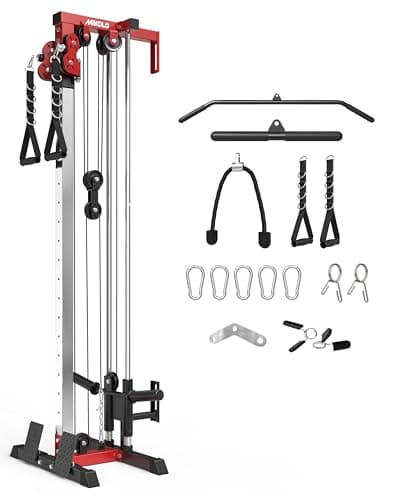
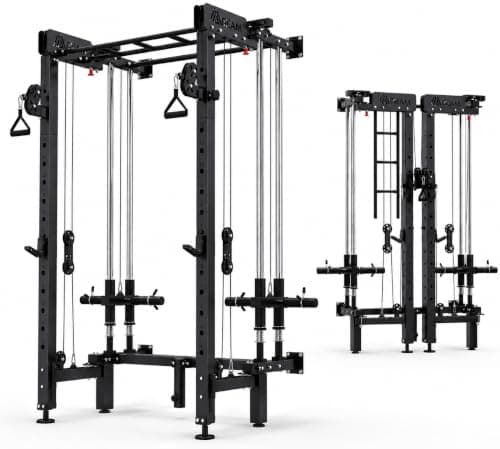
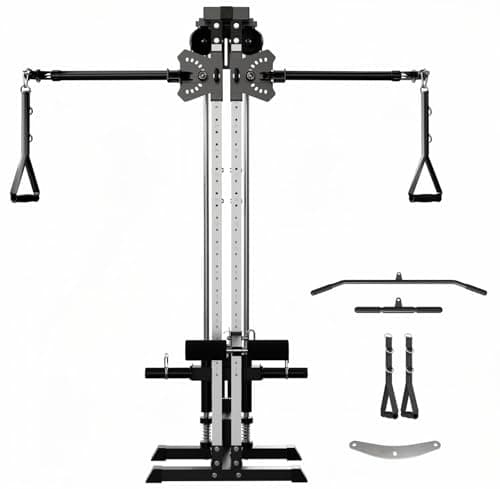
A wall-mounted cable machine is the smallest way to own cables, full stop: the frame, the pulleys and the load path all live on the wall, so the floor you give up is close to nothing. The price of admission is non-negotiable — you must be able to drill into studs. The GMWD station is our top pick for the sheer range of its dual swivel arms. The Mikolo wall cable is the value route to the same idea. The Mdeam folding wall rack is the pick if you want cables and a squat rack out of one wall.
Everything else in home cable training carries its own structure around with it. A freestanding functional trainer needs a wide, heavy base because it has to resist being pulled over by the person using it. That base is the footprint, and in a small room the footprint is the whole problem. Bolt the load path into framing instead and the structure disappears into the wall — which is why a wall-mounted station can be a fraction of the size and still handle the same pulls. The wall is doing the work the base used to do.
That makes the first question a building question, not a fitness one. You need studs (or solid blocking) where you want to train, hardware driven into the center of that framing rather than into drywall, and a landlord who is fine with the holes if you rent. If any of those fail, stop here: a wall cable is not the machine for you, and forcing one onto drywall anchors is the single most dangerous thing you could do with the advice on this page. The honest alternative is a freestanding trainer, which we weigh against these units in functional trainer vs wall-mounted cable machine.
Assuming you can drill, the criteria that actually separate these machines are pulley range, arm geometry and what you have to supply. Pulley range is the number of height positions the carriage can lock into — more positions means one station covers pulldowns, rows, flyes, pressdowns, face pulls and curls instead of two or three of them. Arm geometry decides whether you get true crossover movements or a single fixed line of pull; swiveling dual arms are worth real money here. And every unit on this page is plate-loaded, which keeps them small and cheap but means the honest footprint includes somewhere to keep plates. We list positions, loading and install type on every Spec Block.
The three units on this page are not three versions of the same machine, and the differences are structural rather than cosmetic. Two of them are dedicated cable stations whose whole job is pulleys — the smallest, simplest way to put cables on a wall, and the ones that mount in the least wall run. The third is a folding squat rack that happens to carry a pulley system, which is a different proposition: a bigger, more involved install that turns one anchored wall into both a squat station and a cable station. If your wall can only host one thing, that consolidation is worth the extra assembly. If you already own a rack, it is not.
Then there is the space a listing never mentions: the working area in front of the machine. The frame itself projects only a short distance from the wall, but a cable row means stepping back into the room, a crossover means arms wide, and a pulldown means a bench or a pad on the floor. In practice you need a couple of clear strides in front of the wall, unobstructed, at the time you want to train. That is still dramatically less committed floor than a freestanding trainer, because the space is shared rather than surrendered — a coffee table can live there and be moved for twenty minutes. But plan it deliberately rather than discovering it after the holes are drilled.
Worth saying plainly: a wall cable is an addition, not a foundation. It does not squat, it does not bench, and it will not be the first thing you should buy for an empty room. It is what you mount once the basics are covered and you have started to miss the movements only cables do well. If that is not you yet, our compact cable machine roundup covers the freestanding side of the category too.
What to check before you buy a wall cable station
Find your studs first and buy second. Locate the framing where you want the machine, confirm the spacing matches the unit's mounting pattern, and check there is clear wall run above for the top pulley to travel. A wall cable that has to be mounted three feet off-center because that is where the studs are is still a usable machine — a wall cable you cannot mount at all is a return.
Anchoring is the whole safety story
These machines are exactly as strong as their anchors. Lag bolts into stud centers, or into blocking you have added between studs, is the standard; drywall anchors are not, at any rating. The forces here are lower than a loaded squat rack but they pull outward on the fasteners, which is the direction drywall fails in. The install principles are the same ones in our guide on how much weight a wall-mounted rack can hold, and they apply here without modification.
Count the plates, then count the space again
Plate loading is what keeps these units small and affordable, and it is free capability if you already own plates. If you do not, add the cost of plates and a home for them to your plan — a pile of iron against a wall undoes some of the floor you just saved. And if you want the wall to do more than cables, the folding rack-plus-pulley option turns one anchored footprint into a squat station as well, which is the same logic behind our wall-mounted squat rack picks.