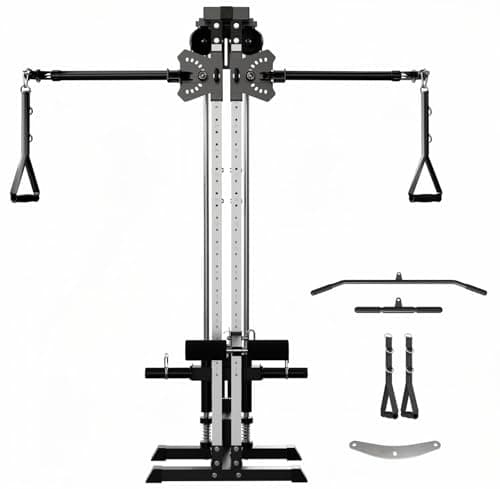
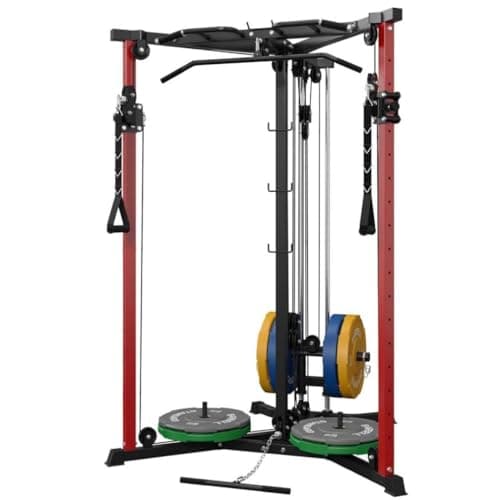
These two machines do the same job and charge you in different currencies. A freestanding functional trainer charges you floor: it needs a permanent corner because its base is what keeps it upright. A wall-mounted cable machine charges you permission and a drill: it takes almost no floor because your studs carry the load instead. If you rent and cannot drill, the Mikolo functional trainer is your machine. If you can anchor into framing, the GMWD wall station gives you nearly the same movements for nearly none of the floor.
It helps to see why the shapes differ. A cable pull does not just lift weight — it tries to drag the machine toward you. Something has to resist that. A freestanding trainer resists it with mass and geometry, which is why the base is wide and the frame is heavy; take the base away and the machine tips. A wall-mounted station resists it with your building. Once the framing is carrying that force, the machine only has to hold pulleys, so it can be a fraction of the size and still handle the same work. Neither approach is cleverer than the other. They are the same physics solved with different resources.
Verdict by use case
You rent and cannot drill — freestanding trainer. This is not a close call. A wall cable that cannot be anchored into studs is not a machine, it is a hazard, and there is no renter-safe workaround. The functional trainer needs no permission, leaves no holes, and comes apart when the lease ends. You pay for that with a corner you do not get back. Our renter-friendly home gym ideas cover the rest of a no-drill setup.
You own, and floor is the scarce thing — wall-mounted. If the room is shared with a bed, a desk or a car, the wall unit wins on the only metric that matters. It gives you the floor back the moment you step away, which a freestanding trainer never does. Confirm stud locations before you buy, because the mounting pattern has to land on framing.
You are not confident with a drill — freestanding. Owning the wall is not the same as being comfortable anchoring into it. Locating stud centers, driving lag bolts straight and squaring a frame across two studs is a real job, and a cable station installed approximately is a cable station installed badly. If that description makes you uneasy, either get help with the install or take the freestanding route — the movements are the same, and a frame you trust is worth more than the floor you saved.
You want the heaviest possible loading — freestanding, usually. Both of these are plate-loaded, so the ceiling on either is set by how much iron you are willing to hang. But a heavy freestanding frame is more forgiving of aggressive, high-load pulling than a wall unit whose limit is ultimately the anchors, not the steel. If you plan to load hard, the anchoring question stops being theoretical — see are wall-mounted squat racks safe? for how anchors actually behave.
The room has to be a room again — freestanding, reluctantly, or neither. This is the case people get wrong. A wall unit takes almost no floor, which sounds like the answer for a shared room, but it is permanently visible on the wall and permanently in that spot. A freestanding trainer is movable in theory and immovable in practice, because they are heavy. If the space genuinely has to convert back into a bedroom or a living room every evening, be honest that neither of these is a fold-away solution, and consider whether adjustable dumbbells and a folding bench serve you better than any cable machine will.
You already own plates — either, and lean wall-mounted. Both picks here are plate-loaded, which is a bargain if there is already iron in the room and an unbudgeted expense if there is not. Where it changes the decision is storage: a freestanding trainer plus a plate tree is two footprints, while a wall unit plus a plate tree is one footprint and a wall. If you are counting square feet, that difference is larger than the machines themselves.
You want cables plus everything else — reconsider both. If a cable station is meant to be your whole gym, it will disappoint; neither machine squats or benches. A folding rack with a pulley, or a full all-in-one, may serve better. Both routes are covered in our wall-mounted cable roundup and compact cable machine picks.
How the two compare on the things that matter
Footprint. The wall unit wins outright, and it is not close — it projects a short distance from the wall and gives back everything else. The freestanding trainer needs its base plus clear working space around it, which in a small room usually means a corner is spoken for permanently. If you are choosing between them and floor is your binding constraint, the decision is already made.
Install, permission and reversibility
The freestanding trainer wins here just as decisively. It bolts together, stands up and is done; nothing about it is permanent and nothing about it needs asking. The wall unit needs a stud finder, lag bolts into framing centers and — if you rent — a landlord who is fine with patched holes on move-out. That reversibility is worth a lot to anyone whose housing might change.
Movement range and loading
Both cover the cable staples: pulldowns, rows, flyes, pressdowns, face pulls, curls. The real differentiator is pulley positions and whether the arms swivel, not whether the machine is on the wall or the floor — we list positions on every Spec Block. Both are plate-loaded, so budget for plates and a place to keep them either way. Neither one replaces free weights; both are the addition you make once the basics of the room are handled.