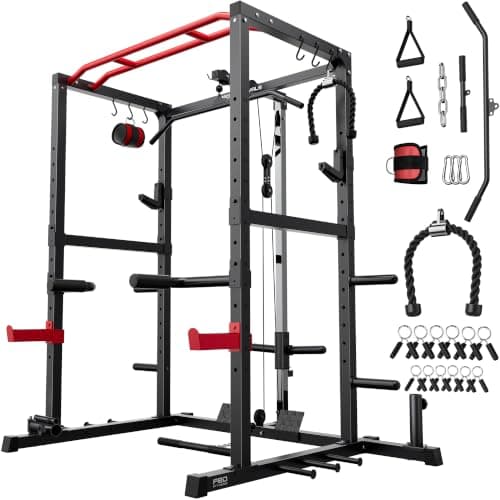
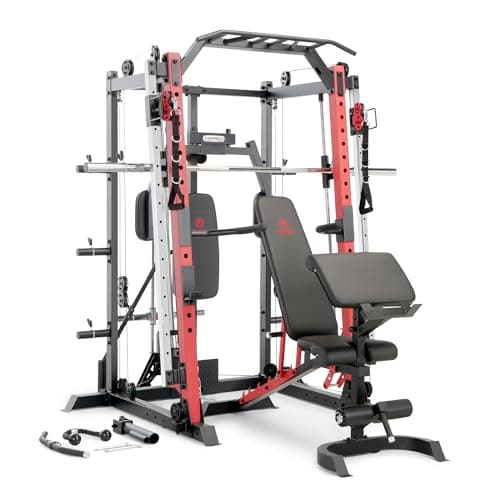
For a genuinely small room, the answer is mostly no. A Smith machine is a large, permanent fixture that never folds, and its fixed bar path trains you along a track rather than teaching you to control the bar. It is the right call for one specific person: the lifter with a dedicated room who trains heavy alone, with no spotter, and wants a bar that can be racked from any position mid-rep.
Let us be clear about what a Smith machine actually is, because the marketing tends to blur it. The bar runs on fixed rails, so it can only travel up and down along one line. You cannot drift forward, you cannot drift back, and at any point in the rep you can rotate the bar a few degrees and it locks into the nearest catch. That last property is a genuine safety feature and it is the entire reason the machine exists. Everything else about it — the size, the price, the cabinet-like footprint — is the cost of providing it.
Why it usually fails the small-room test
The footprint is the first problem and the biggest. A Smith machine does not fold, does not break down and does not move once assembled. It claims a substantial rectangle of floor and a substantial column of height, permanently, in a way that a folding wall rack or even a power tower does not. In a spare bedroom that also has a bed in it, or a living room that has to be a living room again by dinner, that is disqualifying on its own. Our whole approach to small-space gear starts with reclaimable floor, and this machine offers none.
The second problem is the fixed bar path itself. Because the rails do the stabilizing for you, the muscles that normally keep a bar tracking correctly get much less work. That is fine as one tool among many in a commercial gym. In a small home gym, where you can probably only afford one big piece of equipment, spending it on the machine that trains stabilization the least is a poor allocation. A free barbell in a rack is a harder, more transferable, and considerably smaller purchase.
The third problem is opportunity cost. The floor and budget a Smith machine consumes could buy a folding rack, a bench and a set of adjustable dumbbells — a combination that covers more movements, folds away, and grows with you. That is not a hypothetical trade; in a small room it is the actual choice in front of you.
Who a Smith machine is genuinely right for
There is a real case, and it deserves to be stated fairly. If you have a dedicated room — a garage, a basement, a converted spare room that stays a gym — and you train heavy on your own with nobody to spot you, the Smith machine's ability to rack the bar mid-rep from any height is a safety margin free weights do not offer. Bench pressing alone is where this matters most. Add in that most Smith cages ship with pulleys and a bench station, and one machine can legitimately be a whole gym for someone whose constraint is a spotter rather than square footage. If that is your situation, the machine on this page is a reasonable buy and the objection above does not apply to you.
What to buy instead in a small room
If your constraint really is space, buy in this order. A folding squat rack gives you squats, presses and pull-ups from a footprint you get back between sessions, and with safeties set correctly it covers the solo-lifting risk that draws people to Smith machines in the first place. Add a folding adjustable bench and you have a pressing station. If you want a single machine and no barbell at all, an all-in-one home gym puts the resistance inside the frame with no loose plates, and a power tower is the cheapest capable option of the lot. The freestanding cage listed alongside the Smith machine here is the middle path: a real cage with cable work built in, no drilling required, and far less machine than a Smith.
What we can't tell you
We have not measured these machines in a lab — we do not have one, and we will not pretend otherwise. What we can do is read the published dimensions and be honest about what a large non-folding cage does to a small room, which is the part most buying advice glosses over. Measure your actual space, including the swing of the door and the ceiling at the exact spot, before you commit to anything in this category. For the wider plan, our small-space home gym guide puts these choices in order.