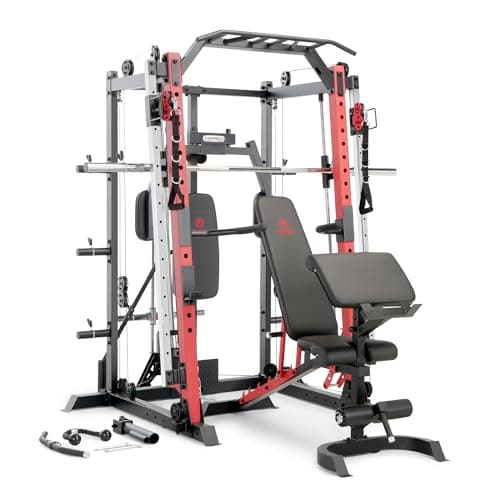
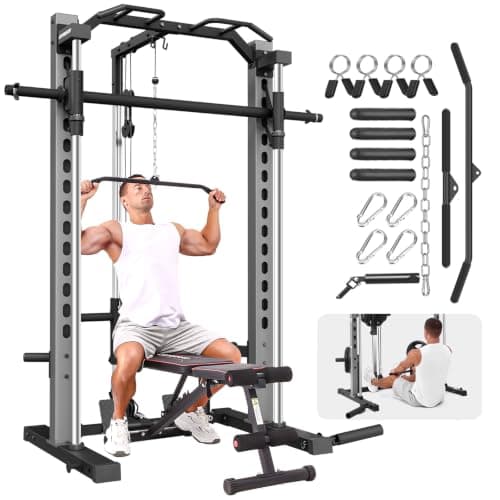
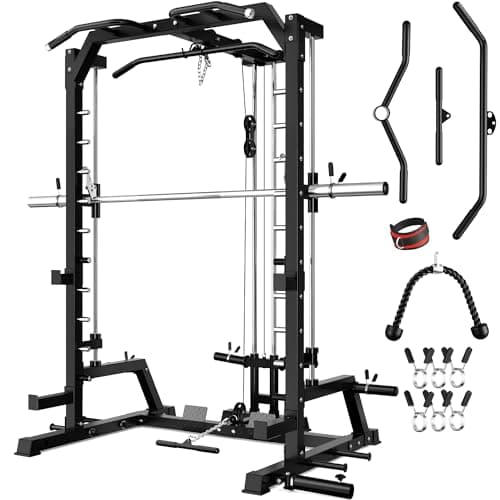
For a small room, the Smith machine to buy is a half-frame like the JELENS SR01: the triangular rear leg carries the load without a fourth upright, so it takes roughly four feet of width instead of six. Every Smith machine here is 81 inches tall or more, which means the first number to check is not the price — it is your ceiling.
We have an existing guide arguing that a Smith machine is usually the wrong buy for a small home gym, and nothing on this page contradicts it. But "usually" is not "always." If you train alone, take pressing and squatting close to failure, and cannot get a spotter, a guided bar with fixed catch points does a job a squat stand cannot. The question then stops being whether to buy one and becomes which one your room can survive.
That is a dimension question, and it is the one Smith machine listings answer worst. Every product page leads with attachment count — cable crossover, landmine, T-bar row, pull-up bar — and buries the fact that the frame is 86 inches tall and 52 inches deep. Below, the numbers come first. Each pick lists its published overall size and load rating from the manufacturer listing, and each one is honest about how much of the room stops being a room.
The three numbers that decide it
- Height. All three of these are 81 to 86 inches tall before you stand on a mat. A standard 8-foot ceiling is 96 inches, which sounds fine until you account for a ceiling fan, a light fixture, or a basement soffit. Measure the specific spot the machine will stand.
- Depth. This is where a half-frame wins. A four-post Smith cage is deep because it has to be square; a half-frame leans its load onto a rear brace and can sit closer to a wall.
- Bar path length. A Smith bar travels on a fixed rail, so the machine also needs the vertical run of that rail clear. Nothing can hang above it.
Why a half-frame is the small-space answer
A full Smith cage puts four uprights on the floor and joins them at the top, which is why it is stable and why it is enormous. A half-frame — the JELENS layout — puts two uprights at the front and braces them backward with an angled leg. The load path is still sound, but the footprint becomes a triangle rather than a square, and a triangle can tuck into a corner in a way a square cannot.
The compromise is that a half-frame is less happy with heavy loading at the extreme front edge, and it does not enclose you the way a cage does. In practice, for the loads a home lifter puts on a guided bar, that is a theoretical concern rather than a practical one — the published 2,000 lb rating on the JELENS is many times any realistic home load.
What a Smith machine actually buys you in a small room
Three things, and it is worth being precise about them because the marketing is not.
Solo safety on the bar path. Rotate the bar at any point and the hooks catch it. That is genuinely useful if you press alone, and it is the same reason a power rack with catch bars earns its footprint.
Density of function. All three of these carry a lat pulldown, and two carry a cable crossover. If a room is only going to hold one object, the object that also does pulldowns and rows is doing more work per square foot than a bare rack.
A lower skill floor. The fixed bar path removes the balance component, which makes the first months of training less intimidating. That is a real benefit and also the main criticism — you are not learning to stabilize a free bar.
What it costs you, honestly
The fixed path is the whole trade. A Smith bar moves in one plane, which means your body has to fit the machine rather than the other way around. Some lifters find the fixed squat path uncomfortable at the knee or hip; there is no adjusting it. And the machine never folds, so the floor it takes is floor you do not get back between sessions — unlike a folding squat rack, which is the honest alternative for a room that has a second job.
The other cost is assembly. All three ship in multiple boxes, and the JELENS ships in three that may arrive separately. Budget an afternoon, a second person, and a socket set. Check the doorway width of the room before you order — the packages are long.
What to put underneath it
Any of these concentrates several hundred pounds onto four or six small steel feet. On a wood floor that marks; on a tile floor it can crack a tile. Put interlocking tiles down first — our gym mat roundup covers what handles rack feet and what does not. If you are in an apartment, read whether your floor can hold a home gym first — the machine plus a plate set is a concentrated load worth understanding.