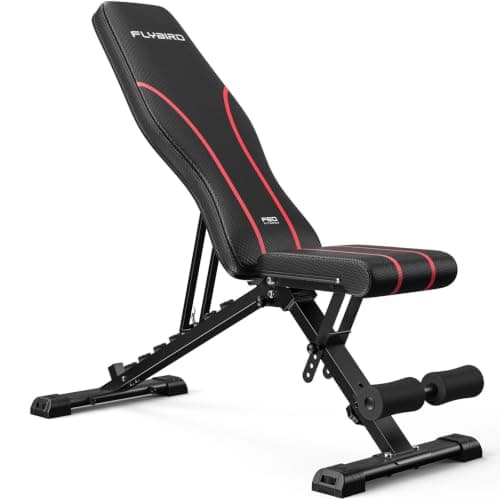
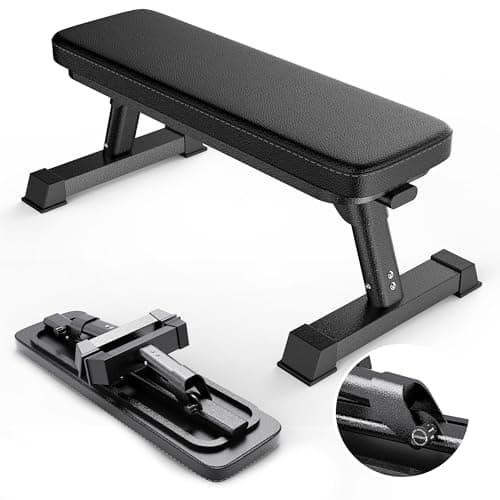
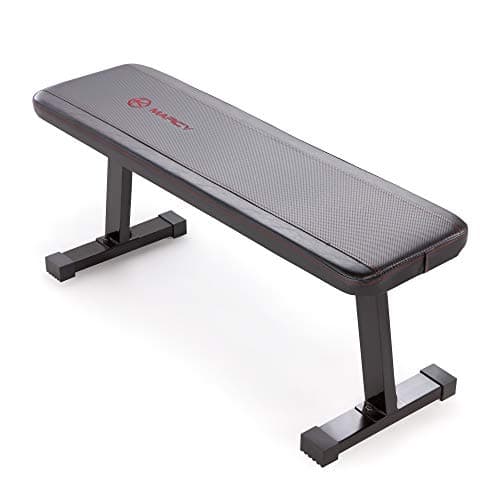
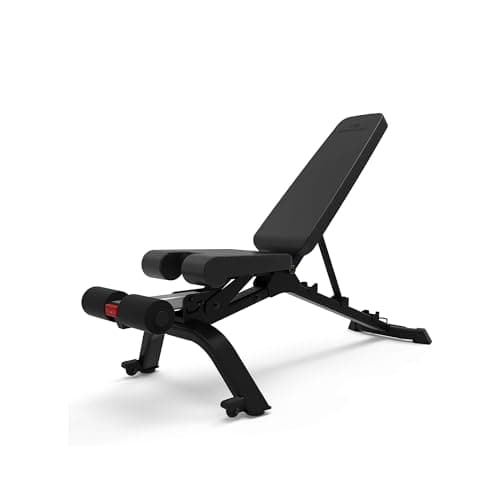
Buy an adjustable bench if you own dumbbells and want incline pressing, shoulder work and seated variations — it is the more useful object for most small home gyms, and the good ones fold flat against a wall. Buy a flat bench if you press a barbell, want maximum stability per dollar, or need the smallest, cheapest, most reliable object in the room.
This decision feels obvious until you actually try to make it. Adjustable sounds strictly better — more angles, more exercises, one purchase covers everything. Then you look at the stored footprints and the prices, and you notice that a flat bench costs about half as much, has nothing that can wobble, and slides under a bed. In a room where the bench is the piece that has to disappear when you have company, that matters.
Below we compare both on the four numbers that decide it in a small space, then rank two picks on each side. The short version: the adjustable wins if your gym is dumbbell-centered, the flat wins if it is barbell-centered or space is the binding constraint.
Head to head
| Factor | Adjustable bench | Flat bench |
|---|
| Exercises covered | Flat, incline, decline, seated, shoulder work | Flat pressing, rows, step-ups, dips support |
| Stability under load | Good — but there is a hinge that can flex | Best — nothing moves by design |
| Stored size | Folds flat or stows upright on good models | Smallest — many slide under a bed |
| Pad height | Higher — the mechanism sits under the pad | Lower — easier to get dumbbells into position |
| Typical price | Roughly double a comparable flat bench | The cheapest real equipment in a home gym |
| Failure points | Ladder, hinge, pins, seat adjustment | Essentially none |
The row people underestimate is pad height. An adjustable bench has to house its adjustment ladder underneath the pad, so it sits noticeably higher off the floor than a flat bench. When you are kicking fifty-pound dumbbells into position on your own, that extra height is real work — and it is exactly the moment when dropping an adjustable dumbbell becomes tempting.
Choose adjustable if your gym runs on dumbbells
A pair of adjustable dumbbells plus an adjustable bench is the most exercise coverage available in the smallest total footprint, which is why it is the default recommendation for apartment gyms. Incline pressing, seated shoulder pressing, incline curls, chest-supported rows and decline work all need an angle you cannot get from a flat pad. If your training is dumbbell-based, buying flat means giving up roughly half of what dumbbells are good for.
In a small room, insist on one thing: it has to fold or stow upright. A bench that has to stay assembled and horizontal is a piece of furniture, and furniture is what small rooms do not have room for. Both adjustable picks here stow.
Choose flat if your gym runs on a barbell — or on square footage
For barbell bench pressing, a flat bench is not a compromise, it is the correct tool. Nothing flexes, the pad sits low so your setup is stable, and the money you did not spend on a mechanism went into steel. If your rack is the center of your gym — see power rack vs squat stand — the flat bench is almost certainly the right buy.
The other case is pure space. A flat bench is the smallest useful object in strength training. Several slide under a bed, which is the storage tier above "folds against a wall" and the reason our under-bed storage guide exists. If your room genuinely cannot host a bench in the open, flat is the category that solves it.
The middle path nobody mentions
You can own both. A flat bench and an adjustable bench together often cost less than one premium adjustable, and in a small gym the flat becomes the bench you leave out and the adjustable comes off the wall for the sessions that need it. It is not the answer for a studio apartment, but in a spare room or a garage corner it is a genuinely good outcome that people rule out because it sounds redundant.
What to check before you buy either
- Stored dimensions, not assembled dimensions. The number that decides whether it works in your room is how big it is when you are done, and it is the number least likely to be published. If a listing does not state it, assume the worst.
- Pad length and width. Short pads leave taller lifters with their head off the end. Narrow pads feel unstable under a heavy press. Both are more common on folding benches than fixed ones.
- Published rated load.Some benches state it, many do not. Where a maker publishes a number we put it on the Spec Block; where they do not, we say "not published" rather than guess.
- Feet and floor contact. A bench with hard plastic feet on a hard floor will slide and will mark. Mats fix both — see apartment gym flooring.
If you land on adjustable, our adjustable bench roundup ranks the full field. If you want a bench with an integrated rack so it replaces two objects, see folding benches with a rack.
Once you have picked a side, the shortlist under a fixed budget is the best weight benches under $200 — two folding adjustables, a folding flat, a flat with a dumbbell rack and the cheapest 600 lb-rated flat bench on the site.