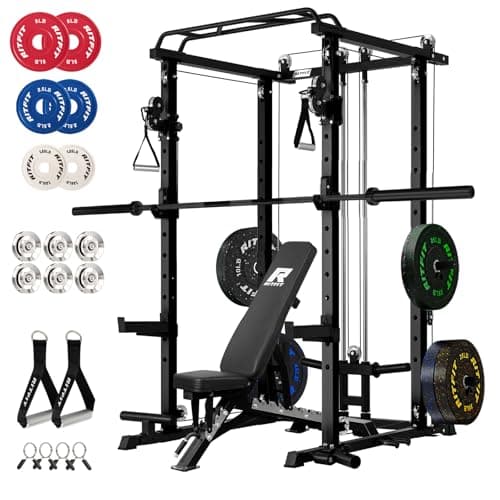
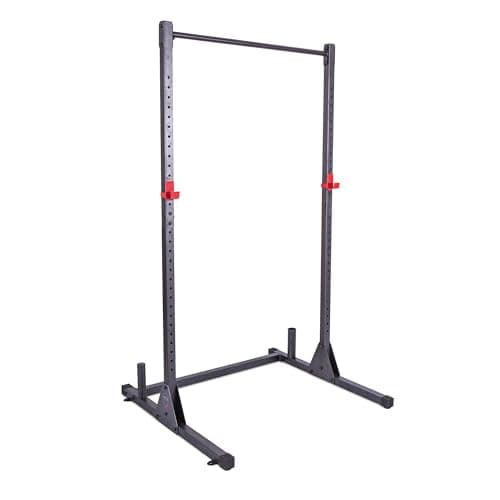
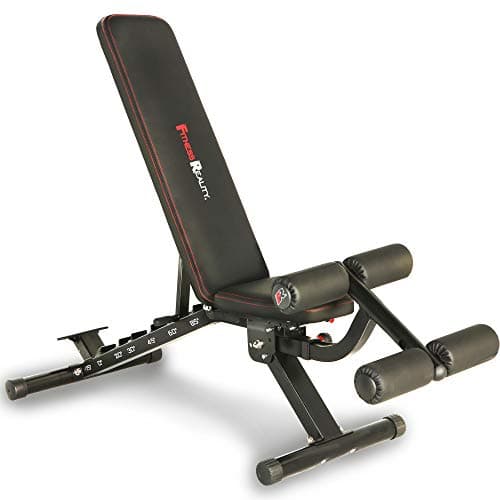
Buy a bench with integrated uprights when your room can fit one object but not two, and when the barbell work you want is pressing. The Fitness Reality 2000 Super Max XL is our top pick for exactly that job: an adjustable bench and a set of barbell uprights in one freestanding frame, no drilling, no separate rack purchase. If you have a garage or a spare room rather than a corner, the RitFit power cage package arrives as a matched cage, bench and cable system in a single order. And if you already own a bench, the CAP power rack is the cheapest way to put a real cage with catch bars around it.
Here is the honest limit, stated up front because most listings bury it: an integrated bench's uprights are a pressing station. They are designed to hold a barbell at bench-press height so you can unrack and rerack a press safely on your own. They are not a squat rack. Taking a heavy loaded bar off your back at shoulder height into lightweight uprights bolted to a bench frame is a different set of forces, applied higher up, with a much less forgiving failure mode. If squatting is a real part of your program, you want a rack with catch bars at squat depth — either an enclosed cage or a folding wall-mounted rack.
With that boundary set, the combo is genuinely good value in the right room. Buying a bench and a rack separately means two purchases, two assemblies, and — the part that actually bites in a small space — two footprints that both have to sit somewhere. An integrated unit gives you one footprint and one set of geometry that was designed to work together, so the bench is already at the right height and position relative to the uprights instead of being shuffled into place before every set.
The trade you make is fold. Almost nothing in this category folds the way a standalone bench does — an integrated bench-and-upright frame is one rigid object that claims its floor permanently. That is the central tension of this page: you gain by combining two items, and you lose the ability to make either of them disappear. For rooms where reclaiming the floor matters more than consolidating the purchase, a stowable adjustable bench plus a fold-flat wall rack is the better pairing, and we would rather point you there than sell you the combo.
There is a third path worth naming, because it is the one most people actually take without planning it: buy a cheap enclosed cage and put a bench you already own inside it. That is what the CAP rack is doing on this list. You do not get the integrated geometry, and you do give up the floor permanently, but you get catch bars at squat depth and a pull-up bar, which is more capability than any bench-mounted upright can offer. We rank these three together rather than splitting them across pages because they are answers to the same question — how do I get a barbell station into a room this size — and the right answer depends entirely on whether you squat, whether you can drill, and how many separate objects the room will tolerate.
When one unit beats a bench plus a rack
The combo wins on three specific conditions, and it is worth checking all three rather than assuming. First, your room has one spot, not two. If there is a single square of floor the gear can live on, consolidating is straightforwardly better than fighting for a second position. Second, your barbell work is pressing-led: bench press, close-grip, floor-adjacent accessory work, maybe a light overhead press from the uprights. Third, you cannot or will not drill, which rules out the wall-mounted racks that would otherwise be the small-space answer.
Miss any of those and the separate-purchase route usually wins. Two objects that each fold or stow beat one object that never does, and a proper rack — even a budget cage — gives you catch bars at the heights that make solo lifting safe across more than one movement.
What the uprights are actually rated for
Published capacities in this category are inconsistent. Some listings state a rated load for the bench and say nothing about the uprights; others give one number for the whole assembly. Where a figure is not published we write "Not published" on the Spec Block rather than inferring one, and we would tell you to confirm it on the listing before you load anything near your limit. Treat an unpublished capacity as a reason to stay conservative, not as a blank check.
Assembly is a real cost in a small room
Nobody puts this on a spec sheet, but it belongs in the decision. These units arrive as a box of steel and a bag of bolts, and assembling one takes floor space you may not have while the parts are laid out. More importantly, a combo unit is far harder to move once built than a bench is — which means the spot you pick on assembly day is usually the spot it keeps. Walk the room first, check the doorway the box has to come through, and confirm the built unit will not block a window, a radiator or a closet door before you start. Going back and tightening every bolt after the first few sessions is also worth doing; bolted frames settle, and most reported wobble in this category traces back to hardware that was never fully torqued.
The cage route, and what it costs you in space
A real power rack solves the squat problem the bench combo cannot: four posts, adjustable catch bars, and safety geometry that catches a failed rep at depth. The price is footprint. A cage owns a permanent rectangle of floor and needs ceiling height for the pull-up bar, which is why we score it low on small-space fit even when it is excellent value. If you have the room, our compact power rack picks cover that route properly.
Floor first, then frame
Any of these units concentrates load into four or six small feet, and every one of them lives somewhere that probably has a neighbor below or a floor you do not own. Interlocking mats under the whole footprint spread that load, stop the feet marking the floor, and cut the transmitted noise of a rerack — see the apartment flooring guide. If you find yourself wanting cables as well as a press station, the trade shifts again and the all-in-one machines become the comparison worth making.