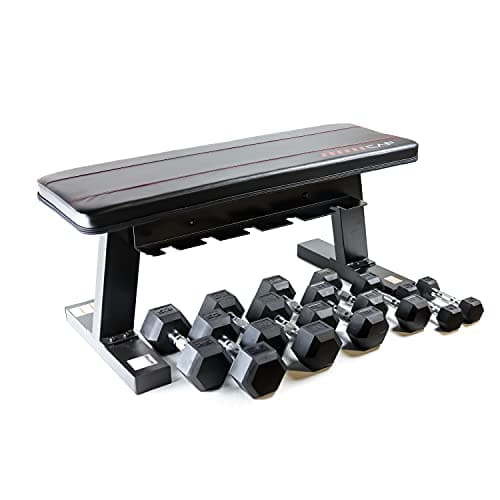
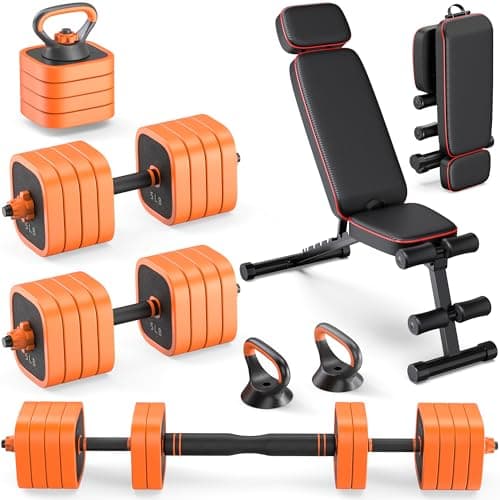
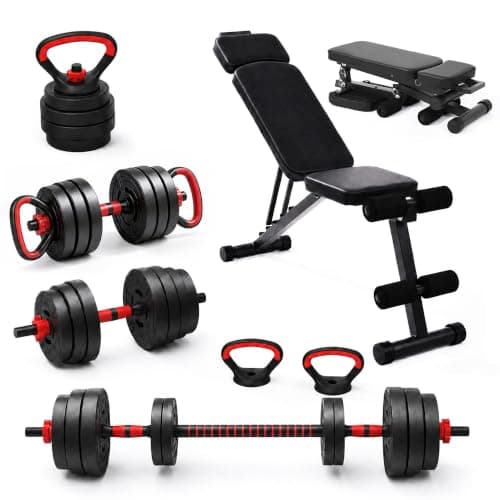
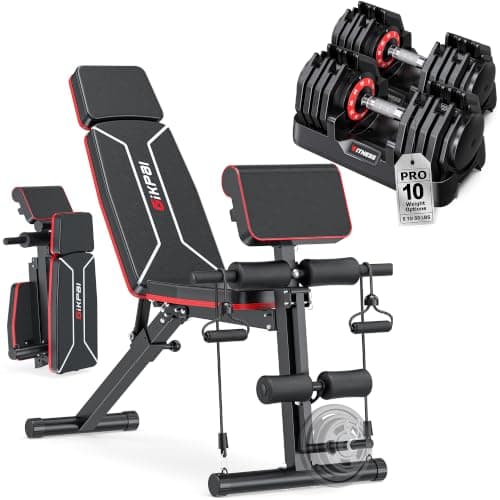
For most small rooms the GIKPAL set is the pick: a pair of dial-adjustable dumbbells that run 5 to 50 lb per hand, and a folding bench with seven backrest positions — the only bundle here that will still fit your training in a year. Take the CAP bundle instead if a known brand and an Amazon-sold order matter more than the ceiling; its trays hold the whole hex set inside the bench footprint, but the heaviest pair is 25 lb. The Rendpas has the best bench of the four, and the HulkFit is the cheapest honest start.
A bench and a set of dumbbells is the most useful strength setup a small room can hold. It covers pressing, rowing, split squats, curls and step-ups in roughly the floor space of a single bed's width, and nothing in it needs a wall, a stud or a ceiling. Buying the two in one box is the obvious shortcut, and that is exactly why the category is full of listings built to look complete rather than to be good.
Before the picks, one piece of honest context. A bundle is not a discount. Buying a known-brand adjustable bench and a proper pair of adjustable dumbbells separately costs roughly what the better bundles here cost — our adjustable bench roundup and adjustable dumbbell roundup rank the parts we would choose. What a bundle buys you is one order, one delivery and one set of instructions. That is worth something, provided the two halves are both worth owning.
The trap in every listing: total weight versus per hand
Bench-and-dumbbell listings quote dumbbell weight in two incompatible ways, and they do not tell you which one they are using. It is the single most important thing to check before you buy.
- Per dumbbell."5 to 50 lb" means each hand goes to 50 lb. GIKPAL quotes it this way, and it is the number that tells you how long the set lasts.
- Total of the set."85 lb set" or "150 lb set" is everything in the box added together. The CAP's 150 lb is five pairs, and its heaviest pair is 25 lb. The Rendpas's 85 lb and the HulkFit's 40 lb are convertible plate sets that also build a barbell, so the total goes on the bar and roughly half of it goes in each hand.
The practical test: find the heaviest weight one hand can hold. If the listing will not tell you, divide the total by two and assume that is the ceiling. A 40 lb set sounds like a real weight. A 20 lb dumbbell is a warm-up for a row within a few months of training.
The four things we ranked on
- Per-hand ceiling. The number above. It decides whether you are buying a setup or a starter kit you replace next year.
- Whether the bench adjusts. In a one-bench gym, incline is most of your upper-body variety. Three of the four benches here adjust; the CAP is flat.
- How the set stores. One pair of adjustable dumbbells sits in about the footprint of one dumbbell. Five hex pairs need a rack — unless, as on the CAP, the bench itself is the rack.
- Who sells it, and what is published. Two of these ship from Amazon and two from third-party stores. Bench ratings and dimensions are missing on most listings; where they are missing, our spec sheet says so rather than guessing.
How the four compare
| Set | Dumbbells | Heaviest hand | Bench | Sold by |
|---|
| GIKPAL | Dial pair | 50 lb | 7 positions, 770 lb | Third party |
| CAP FMS-103S150 | 5 hex pairs | 25 lb | Flat, 600 lb | Amazon |
| Rendpas 4-in-1 | 85 lb plates | Not published | 10 angles, 800 lb | Third party |
| HulkFit | 40 lb plates | Not published | 5 angles, unrated | Amazon |
Read the "heaviest hand" column first. It is the one that decides whether this is the last set you buy, and it is the one half the listings would rather you did not look at.
Dial, hex or plates: the three kinds of dumbbell in a bundle
Every bundle on the market uses one of three dumbbell designs, and each one changes how the set lives in a small room:
- Dial selector (GIKPAL). Turn a dial and the handle picks up the plates you want; the rest stay in the cradle. Changing weight takes a second, and the whole range sits in the footprint of one dumbbell. The weak point is the mechanism, which is why dropping adjustable dumbbells is the habit to break before you buy one.
- Fixed hex (CAP). Five separate pairs, each a single piece of cast iron. Nothing to break and nothing to adjust — and five objects to store, which is why the CAP bench carries them in its own trays.
- Convertible plates (Rendpas, HulkFit). Loose plates, a handle and a threaded collar. The most versatile, because the same plates build a barbell or a kettlebell, and the slowest, because every change means unscrewing a collar.
For a small room the order of preference is usually dial, then hex on a storage bench, then plates. Our adjustable vs fixed dumbbells comparison goes through that decision in full.
The bench is the half that gets skimped
Bundle makers put the dumbbells in the photograph and the bench in the fine print, and it shows. One of the four benches here has no published weight rating at all, and three of the four publish no dimensions. A bench you lie on under a pair of dumbbells should state what it holds. Treat an unrated bench as a light-duty one.
What to look for, in order: a published weight rating (and whether it is a user limit or a total — see how much weight a weight bench can hold), a backrest that reaches a genuine incline, and a fold that stands the bench against a wall. If the bundle's bench misses on two of those, you are better off buying the dumbbells alone and pairing them with one of the folding benches we rank.
What it does to a small room
Budget the floor for the bench at full length plus about two feet on each side to get on and off it with a dumbbell in each hand — that is the working area, and it is what the room actually has to give up during a session. Between sessions, the difference between these sets is where the dumbbells go:
- A dial pair sits in its cradle in a couple of square feet and slides under the folded bench.
- A hex set needs a rack or trays. On the CAP the trays are part of the bench, so the set costs no extra floor at all — the one real advantage of the design.
- A plate set is a handle, a bar and a stack of plates, which is more loose pieces than it looks in the photograph. A box or a low shelf keeps it from spreading across the floor.
For the rest of the storage plan, see how to store dumbbells in a small apartment, and for what goes under the bench, our home gym mat roundup.
Buying from a third-party store
Two of the four sets ship from third-party sellers rather than Amazon itself. That is not a reason to skip them — it is how most of this category is sold — but it changes two things. Returns go through the seller's policy, which varies. And replacement parts, the thing that matters most on an adjustable dumbbell, depend on a brand you cannot look up a history for. If a missing bolt or a cracked plate would end the set's life, the CAP and HulkFit bundles, both sold by Amazon, are the lower-risk orders.
Six things to check on any bundle listing
If you are shopping beyond this page, these are the questions that separate a set worth owning from one that just photographs well. A listing that cannot answer most of them is telling you something.
- What does one hand top out at? Per dumbbell, not per set. If the listing only gives a total, halve it.
- What is the bench rated to, and is that you or the total? No number at all means treat it as light duty.
- How many backrest positions, and does one reach a real incline? Flat plus two inclines covers most programs.
- What are the plates made of? Iron is compact; cement or sand in a plastic shell is bulkier for the same weight and can crack if dropped.
- How does the weight change? A dial takes a second, a collar takes a minute. Over a whole session that difference decides whether you keep using it.
- Who sells it, and what is the return window? A heavy box that turns out to be wrong is expensive to send back, and the policy depends on the seller.
Who should buy something else instead
- You already know what you like. Buy the two halves separately. Our adjustable benches and adjustable dumbbells are known-brand parts with published specs, at about the same total as the better bundles.
- You want the dumbbells stored in the bench.CAP has stopped listing this bundle's bench on its own, but the benches that still are — rated by what their storage actually holds — are in weight benches with built-in storage.
- You want a whole starter gym, not just two pieces. The best home gym under $500 adds pulling, a mat and a plan to the same bench-and-dumbbell core.
- You mainly want heavier weights than any bundle offers. Start with 50 lb adjustable dumbbells and add the bench afterward.
If none of those fit — if you want one order that sets up a real strength corner and you have checked the per-hand ceiling — the four sets above are the ones whose published numbers we can stand behind.