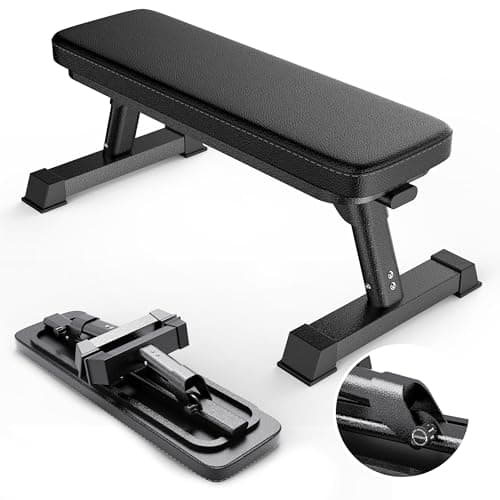
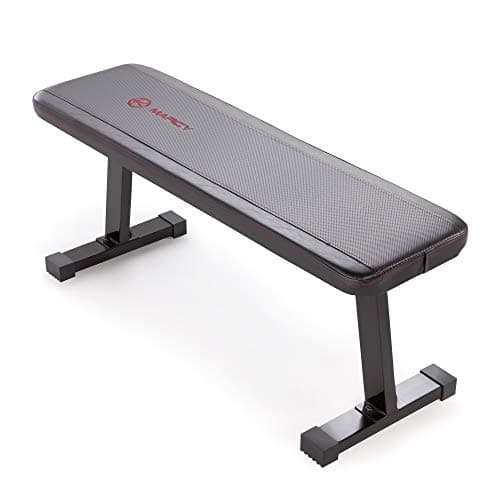
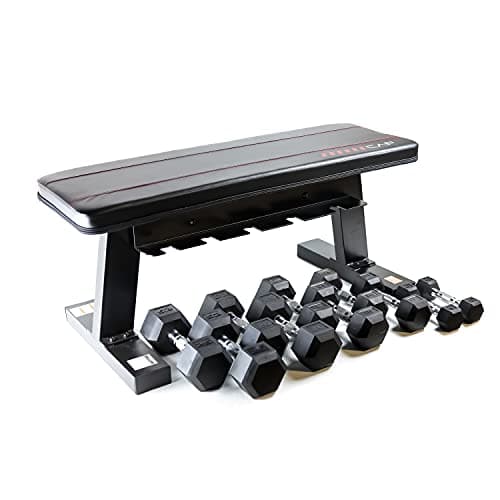
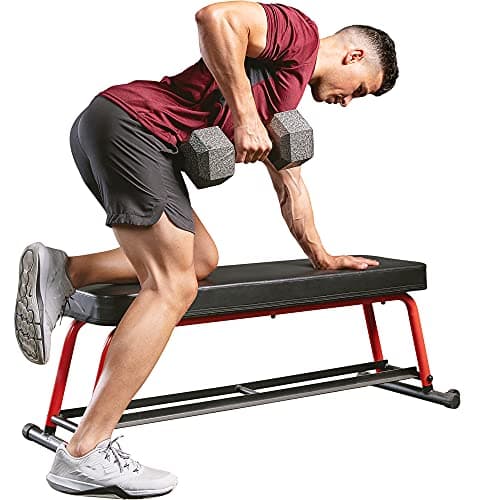
The Sunny Health Power Zone SF-BH6996 is the flat bench to buy: it is the only one here that publishes everything — 49.6 x 16.1 in of floor, a 550 lb maximum user weight, a 17 in seat height, a 300 lb dumbbell rack on the frame, 35.6 lb of bench and transport wheels so you can tilt and roll it out of the way. Our budget pick is the Marcy flat utility bench, which is the cheapest 600 lb-rated flat bench on this site and small enough to slide against a wall. The Finer Form is the pick if the bench has to be stored rather than shifted — it folds, and it has the most planted feel of the four. The CAP FMS-103S150 is a 600 lb-rated flat bench that arrives with five pairs of hex dumbbells and trays to hold them, which makes it a whole gym rather than a bench.
A flat bench is the cheapest useful object in strength training, and the reason to choose one over an adjustable is not price — it is stiffness. There is no hinge, no gap between the seat and the back pad, and no mechanism to creak at the bottom of a heavy press. What you give up is the entire incline half of the exercise list, which is why we argue the trade separately in flat vs adjustable weight bench. If you are not sure yet, buy an adjustable.
Who each bench is for
- Sunny SF-BH6996 — for the person who wants one bench with the dumbbells racked on it, and who wants to roll it aside rather than lift it.
- Finer Form flat bench — for the room where the bench must go away: it folds, and it is the heaviest-feeling of the four in use.
- Marcy flat utility bench — for the smallest budget that still buys a published 600 lb rating; our budget pick.
- CAP FMS-103S150 — for someone starting from nothing who wants the bench and the 150 lb of dumbbells to arrive together.
What we ranked on
Published maximum user weight. Flat benches are where the honest numbers live, and three of these four publish one: 550 lb for the Sunny, 600 lb including the user for the Marcy and 600 lb including the user for the CAP bench. Finer Form publishes no rated load, describing the frame as heavy-duty instead — which is the one gap on an otherwise excellent bench.
Published footprint. The Sunny publishes 49.6 x 16.1 in, which is 5.5 sq ft, and the CAP publishes a 42.91 x 18.7 in bench at 19.09 in high. Those are the two assembled figures in this group, and both are small enough to sit along a wall in a bedroom. Neither Marcy nor Finer Form publishes dimensions, so plan for roughly 4 x 1.5 ft and confirm on the listing.
Seat height. The Sunny publishes 16.9 in, which Sunny itself describes as a 17 in seat, and the CAP bench is 19.09 in tall overall. Seat height decides whether your feet plant flat, which decides whether you can press heavy at all — and it is the spec most makers omit.
Whether it moves. Two answers, both valid. The Sunny has transport wheels: you lift one end, tilt and roll. The Finer Form folds for storage. The Marcy does neither but is light and small enough to slide, and the CAP bench is a fixed flat frame that stays where you build it.
How the four compare
| Bench | Published footprint | Published load | Seat height | Moves / stores |
|---|
| Sunny SF-BH6996 | 49.6 x 16.1 in (5.5 sq ft) | 550 lb max user; 300 lb rack | 16.9 in (Sunny calls it 17 in) | Transport wheels |
| Finer Form | Not published | Not published | Not published | Folds for storage |
| Marcy flat utility | Not published | 600 lb (listing) | Not published | No — but slides aside |
| CAP FMS-103S150 | 42.91 x 18.7 x 19.09 in | 600 lb incl. user; trays 200 lb | 19.09 in overall height | No — fixed flat frame |
One honest note on the CAP bundle: the trays are stated to hold five pairs up to 200 lb and to fit 5 to 30 lb dumbbells, and the set it ships with is 5, 10, 15, 20 and 25 lb pairs. So the storage is sized for exactly what is in the box and nothing heavier — if you plan to grow past 25 lb per hand, you are buying a second storage solution later.
What a flat bench actually trains
More than people expect. Flat barbell and dumbbell pressing, dumbbell rows, chest-supported work, hip thrusts, step-ups, box squats, seated shoulder presses with a wall for the back, and almost all of the single-arm work that keeps a small gym interesting. What it does not do is incline pressing, and there is no safe improvised substitute — propping a flat bench on plates is the one piece of home gym advice we will not give.
Stiffness is the reason to choose flat
An adjustable bench carries its load through a hinge and a ladder of pin positions. Under a heavy press that joint is where the flex and the creak come from, and it is why the gap between the seat pad and the back pad exists on almost every adjustable. A flat bench is a welded frame with a pad on it, so the whole object is as stiff as its tubing — which is also why the cheapest flat bench here publishes a higher load number than most adjustables twice its price.
Pad width, not pad thickness
Thickness sells benches; width makes them usable. A pad under about 10 in feels like a balance beam under a heavy dumbbell press, and a pad over about 12 in starts to limit shoulder-blade retraction. The Sunny publishes a 3 in high-density PU pad and the CAP bench is built on 1.5 x 3 in tubular steel; neither publishes pad width, and nor do the other two, so this is a spec to confirm on the listing photographs before you buy.
Where the bench goes, and what sits under it
A flat bench is low, heavy and stable, so the storage question is simpler than with an adjustable: slide it against a wall, roll it on the Sunny's wheels, or fold the Finer Form. On an upper floor, put something under it — not for the bench, which does not move, but for the dumbbells that get set down beside it. Best home gym mats has the thickness answer, and small-space weight storage covers where the iron lives when the bench has no rack on it.