Skip to content
RACK:RATIO

HUB 01 · Compact Racks & Squat Stands

The Best Power Racks for Small Spaces

A cage doesn't fold. That's the whole trade — so we ranked these by how much gym you get back for the floor you give up.

By Stephen V.Reviewed Published How we research
#ad

We earn a commission when you buy through our Amazon links, at no extra cost to you. It never changes our rankings, and we say so when the cheaper product is the better buy. How this works.

If you're going to give a power rack a permanent square of your floor, the best one for a small space is the cage that does the most jobs in that square — which is why the SPORTSROYALS cage with the built-in lat pulldown and low row is our top pick. The Sunny Health cage is the simpler, cleaner four-post option when you already have cables covered, and the CAP Barbell rack is the budget way into an enclosed cage with real catch bars. But read the next two paragraphs before you buy any of them.

A power rack is not a small-space product in the way the rest of this site's picks are. It does not fold, it does not hinge, and it does not slide under anything. Four uprights own their rectangle of floor twenty-four hours a day, and the pull-up bar owns the ceiling above it. That is a genuinely different proposition from a folding rack that flattens against a wall between sessions, and we're not going to blur the two. A cage has to earn that footprint on the days you don't train, not just the days you do. If floor space isn't genuinely your binding constraint — a garage bay, a basement, a room that is only ever a gym — then you're shopping the full-size field rather than this one, and a general roundup of the best power racks is a more useful starting point than a small-space list.

So what does it buy? Three things, and they matter more than the spec sheet suggests. First, independence from your wall: a freestanding cage needs no studs, no lag bolts and no conversation with a landlord, which makes it the heavy-rack answer for anyone who can't drill. Second, four-sided catch geometry — safety bars set at the height you choose, catching a failed squat or bench from a rack that is not relying on anything you installed. Third, attachment points. Four uprights with hole patterns are a mounting surface, and that is why a cage can absorb a lat tower, dip bars, a landmine and band pegs without adding another machine to the room.

That third point is what drives our ranking. In a small room, the honest measure of a cage is not its rated load — every cage here is rated far past what a home lifter will ever put on the bar — it is how many separate machines the footprint replaces. A cage that only holds a barbell is asking for the same floor as a cage that also does pulldowns, rows and pull-ups. When the floor is the scarce resource, the more capable frame wins on the only metric that counts.

The second ranking factor is ceiling. Every rack here has an overhead pull-up bar, and every one of them assumes a room you can hang in. Basements with ducting, apartments with low clearance and rooms with a ceiling fan directly overhead are the three situations where a cage simply does not fit, no matter how good the price is. Measure from the floor to the lowest obstruction before you order, not after. This is the single most common reason a rack goes back in the box.

The third factor is how straight the manufacturer is about its numbers. The SPORTSROYALS frame publishes a 1,200 lb rating; the Sunny and CAP cages don't publish a clear figure on their listings, which is worth knowing rather than worth panicking about — both are conventional full-size frames, and neither is going anywhere under a home-gym load. We just won't print a number a maker hasn't stated, and we'd rather tell you the rating is unpublished than invent confidence you didn't ask for.

If, having read all that, the permanent footprint is the deal-breaker — you need the room back for a bed, a desk or a car — stop here and go to the folding racks instead. And whichever way you go, put something between the frame and the floor: a loaded cage foot concentrates a lot of weight into four small squares, which our apartment flooring guide covers in detail.

The short answer

Quick picks

#ProductBest forScorePrice
01
SPORTSROYALS SPORTSROYALS Squat Rack Power Cage with Lat Pulldown
SPORTSROYALS Squat Rack Power Cage with Lat Pulldown

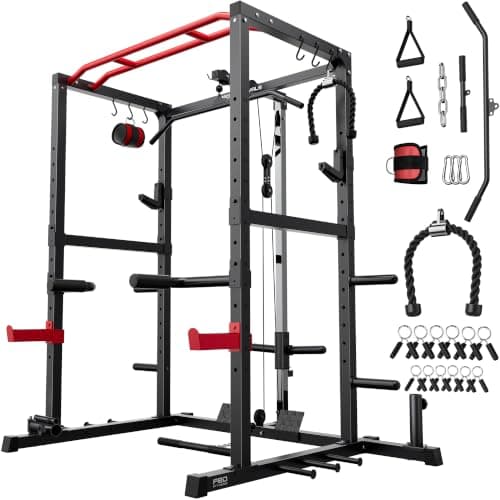
A 1,200 lb-rated cage with a lat pulldown and low-row attachment built in, so one footprint covers squats, presses, pull-ups and cable back work. If you can commit a permanent square of floor, this is the most gym per square foot here.

Most capability per square foot
8.3
$319.99Amazon
02
Sunny Health & Fitness Sunny Health Power Rack
Sunny Health Power Rack

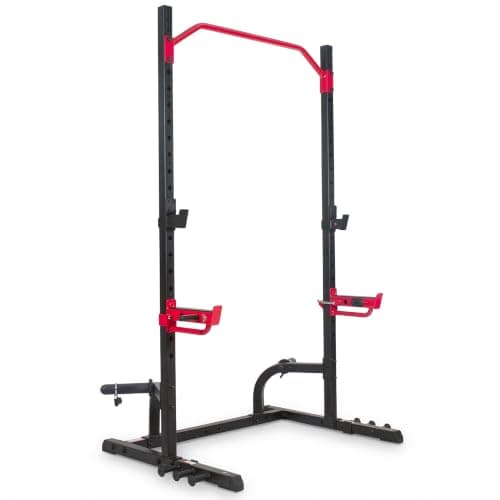
A full four-post cage for the small-space lifter who has a dedicated corner and wants the safety of catch bars. It doesn't fold, so it's the pick only when a square of permanent floor is available.

If you have the floor for a cage
8.0
$249.99Amazon
03
CAP Barbell CAP Barbell Power Rack with Pull-Up Bar
CAP Barbell Power Rack with Pull-Up Bar

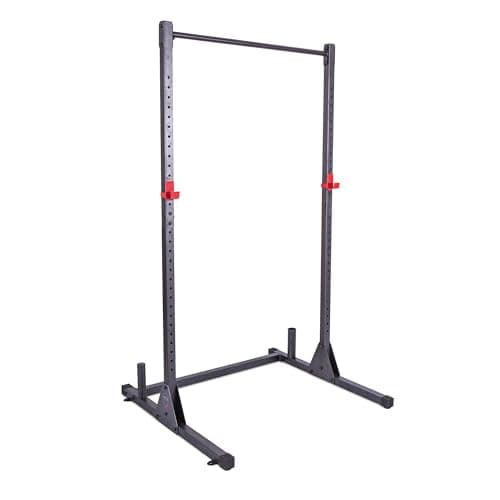
The budget way into an enclosed rack: catch bars, a pull-up bar and safety pins for a fraction of what a premium cage costs. The steel is lighter than pricier cages, but the safety geometry is the part that matters most for a solo lifter.

Cheapest real cage
7.8
$119.99Amazon

#ad · Live prices from the Amazon Product API, as of Sep 9, 2026. Where we have no verified live price, we show none — we would rather leave a gap than print a number that has rotted.

In detail

The picks, in full

01
SPORTSROYALS SPORTSROYALS Squat Rack Power Cage with Lat Pulldown

Most capability per square foot

SPORTSROYALS Squat Rack Power Cage with Lat Pulldown

1,200 lb ratedLat pulldown incl.Four-post cagePlate-loaded
8.3/10

A 1,200 lb-rated cage with a lat pulldown and low-row attachment built in, so one footprint covers squats, presses, pull-ups and cable back work. If you can commit a permanent square of floor, this is the most gym per square foot here.

Good

  • Cage safety plus cable work in one unit
  • 1,200 lb rating is well beyond home loads
  • No drilling despite being a full cage

Trade-offs

  • Owns its floor permanently — no fold
  • Needs real ceiling height for the pull-up bar
Fit
6
Value
9
Install
9
Build
9

Skip this if…

you need the floor back between sessions — a folding wall rack reclaims the space this one keeps for good.

Spec sheet

Type
Freestanding power cage + lat tower
Folded depth
Does not fold — permanent footprint
Rated load
1,200 lb (per listing)
Install / renter
Freestanding — no drilling
Ceiling needed
Tall — cage uprights + pull-up bar
Cable stack
Plate-loaded lat pulldown / low row
$319.99View on Amazon

$389.9918% off

Price as of Sep 9, 2026. Prices change — Amazon's is the one that counts.

#ad · we may earn a commission from this link to SPORTSROYALS Squat Rack Power Cage with Lat Pulldown

02
Sunny Health & Fitness Sunny Health Power Rack

If you have the floor for a cage

Sunny Health Power Rack

Four-post cageCatch barsPull-up barFreestanding
8.0/10

A full four-post cage for the small-space lifter who has a dedicated corner and wants the safety of catch bars. It doesn't fold, so it's the pick only when a square of permanent floor is available.

Good

  • Enclosed cage with catch bars — safest for solo heavy lifts
  • No drilling despite being a full cage
  • Integrated pull-up bar

Trade-offs

  • Doesn't fold — it owns its footprint permanently
  • Needs real ceiling height
Fit
6
Value
8
Install
9
Build
9

Skip this if…

you can't give up a permanent square of floor and ceiling — a folding wall rack reclaims the space this one keeps.

Spec sheet

Type
Freestanding power cage
Folded depth
Does not fold — fixed footprint
Rated load
Not published — full-size frame
Install / renter
Freestanding — no drilling
Ceiling needed
Tall — clears an overhead pull-up bar
Unit weight
Heavy — a permanent fixture
$249.99View on Amazon

$349.9929% off

Price as of Sep 9, 2026. Prices change — Amazon's is the one that counts.

#ad · we may earn a commission from this link to Sunny Health Power Rack

03
CAP Barbell CAP Barbell Power Rack with Pull-Up Bar

Cheapest real cage

CAP Barbell Power Rack with Pull-Up Bar

Budget cagePull-up barSafety catchesFreestanding
7.8/10

The budget way into an enclosed rack: catch bars, a pull-up bar and safety pins for a fraction of what a premium cage costs. The steel is lighter than pricier cages, but the safety geometry is the part that matters most for a solo lifter.

Good

  • By far the cheapest enclosed cage here
  • Catch bars make solo lifting safer
  • Simple, proven design from a long-standing brand

Trade-offs

  • Lighter gauge steel than premium cages
  • Published capacity is unclear — verify before loading heavy
Fit
6
Value
10
Install
9
Build
6

Skip this if…

you plan to load near four figures and want a published, warrantied capacity — spend up for a clearly rated cage.

Spec sheet

Type
Freestanding power rack
Folded depth
Does not fold
Rated load
Not published — confirm on listing
Install / renter
Freestanding — no drilling
Ceiling needed
Tall — includes pull-up bar
Includes
J-hooks, safety bars, pull-up bar
$119.99View on Amazon

Price as of Sep 9, 2026. Prices change — Amazon's is the one that counts.

#ad · we may earn a commission from this link to CAP Barbell Power Rack with Pull-Up Bar

How to choose a power rack when floor space is the constraint

Work in this order: ceiling, then footprint, then capability, then price. Reversing that order is how people end up with a cage they can't stand up inside. Measure the vertical clearance first because it is the one dimension you cannot negotiate with — you can shuffle a rack sideways, you cannot raise a basement joist. Then measure the floor rectangle you are genuinely willing to lose, and be honest about it: a cage needs its own footprint plus room to walk a loaded bar out and rack it back, plus bench space if you press inside it.

Ask whether the cage has to carry your cables too

This is the decision that separates the picks. If the rack is the only strength station the room will ever hold, a cage with an integrated lat tower is doing the work of two machines in one footprint, and that is worth real money and real inches. If you already own — or plan to add — a separate compact cable machine, the integrated tower is redundant weight and depth, and a plain four-post cage is the tidier choice. Decide this before you compare prices, because the two configurations aren't comparable products.

Don't buy the rating, buy the geometry

Rated capacity is the number every listing leads with and the number that matters least to a home lifter. What actually keeps you safe is where the catch bars sit relative to your working depth, whether they're quick to move between exercises, and whether the frame is stable enough not to shuffle when you re-rack. The same logic applies to wall racks, where the rating is even more misleading — how much weight a wall-mounted rack really holds explains why.

Consider whether you need a cage at all

A meaningful number of people shopping for a small-space power rack are really shopping for pull-ups, dips and a place to press. If that describes you, a power tower takes a fraction of the floor and costs a fraction of the money. And whatever frame you land on, budget for the bench that goes inside it — a cage without a bench is half a station, and a bench that folds is the part of the setup that can still disappear.

How we picked

We don't run a testing lab

We compiled published specifications, manufacturer documentation and aggregated owner reviews, then scored each product against a published rubric that weights fit-for-small-space, value, install reversibility and build. The scores are judgments from documented research — they are notmeasurements we took, because we don't have a lab and we're not going to pretend we do. Every dimension is cited in Sources.

Questions

Frequently asked

Can a full power rack really fit in a small room?
Yes, if the ceiling allows it — the floor rectangle a cage takes is usually smaller than people expect, roughly the size of a large armchair. The catch is that the space is gone permanently, and you need clearance around it to walk a bar out. A cage suits a garage corner, a spare bedroom or a basement bay far better than a living room you also have to live in.
Is a power rack better than a folding wall rack for a small space?
Only if you can't drill, or if you want the four-sided catch bars and attachment points a cage gives you. Purely on space, a folding wall rack wins outright — it hands the floor back between sessions. A cage wins on flexibility, since it needs no studs and can be moved or sold without patching a wall. See our folding racks roundup for the other side of that trade.
What ceiling height do I need for a power rack?
Enough to stand under the pull-up bar with room to hang and pull, which in practice means a standard 8-ft ceiling is comfortable and anything approaching 7 ft is marginal. Also check for the things below the ceiling: light fixtures, ceiling fans, ductwork and garage door tracks all count as your real clearance. Measure to the lowest obstruction, not to the drywall.
Do I need to bolt a power rack to the floor?
For home loads, generally no — full-size cages are heavy and wide enough to stay planted, and most home lifters never bolt one down. Bolting adds stability for very heavy work or for kipping pull-ups on a lighter frame, but it converts a movable rack into a permanent installation, which defeats one of the main reasons to choose freestanding in the first place.
Can I add a lat pulldown to a power rack later?
Sometimes, but attachment compatibility is brand- and hole-pattern-specific, so it is not safe to assume. If cable work matters to you, buying a cage with the tower already integrated is the more reliable route than planning an upgrade. The alternative is a separate wall or freestanding cable station — see our racks with cables comparison.
Are cheap power racks safe?
A budget cage with proper catch bars and a stable base is safe for the loads a typical home lifter uses; the money mostly buys heavier gauge steel, better finish and clearer published ratings. The real safety variables are whether you set the safeties at the right height and whether the frame sits level and doesn't rock. If a listing won't state a capacity at all and you plan to load heavy, that's a reason to spend up.

Keep reading

Receipts

Sources

We don't run a testing lab, and we don't pretend to. Every dimension and rating traces to a manufacturer spec sheet or manual, named and linked above. Where a maker doesn't publish a number, the spec reads "Not published" rather than a guess. Read our full method.