There is no real market for a wall-mounted folding weight bench, and searching for one wastes weeks. What exists — and solves the same problem better — is a pair of wall brackets that hang a normal fold-flat bench off the floor, for under twenty dollars. Buy a bench that folds, then buy the brackets.
This page exists because people keep looking for a product that is not being made. Search "wall mounted weight bench" and you get three things: wall-mounted squat racks, ordinary folding benches, and folding workbenches for a garage workshop. The actual object people have in mind — a padded bench on a hinge that flips down out of the wall for a set of presses and flips back up afterwards — is close to nonexistent as a consumer product in the US market.
That is not an accident. A bench takes load in an awkward place: a person plus a heavy pair of dumbbells, applied a couple of feet out from the wall, is a serious leverage problem for a hinge and a set of drywall anchors. A folding wall squat rack works because the load runs vertically down the uprights into the studs. A folding wall bench would run it horizontally out from them. The engineering is possible; the liability and the price are why almost nobody ships it.
The good news is that the underlying goal — get the bench off the floor when you are not using it — is completely solvable, and cheaper than the product you were looking for.
What people actually want, and what solves it
| What you wanted | What to buy instead | Floor reclaimed |
|---|
| A bench that folds into the wall | A fold-flat bench plus wall brackets | All of it — the bench hangs |
| A bench that disappears between sets | A bench that folds upright and leans | Most of it — about 1 sq ft |
| A wall station you press from | A folding wall rack plus a flat bench | The rack folds; the bench still stores |
| Bench and rack in one wall unit | Not available — buy the two separately | — |
The bracket answer, in detail
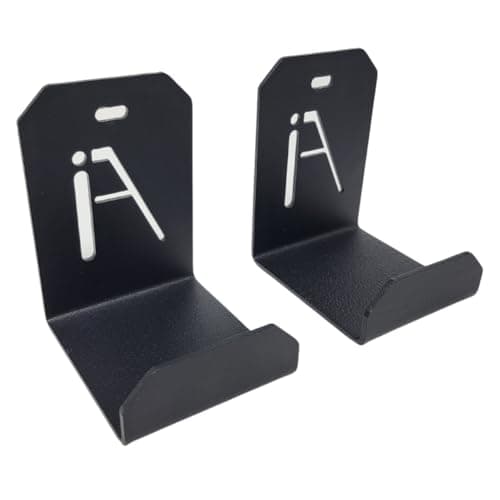
Wall bench brackets are two steel hooks that screw into studs at whatever height you choose. You fold the bench flat, lift it, and hang it. It takes about five seconds, the bench sits two or three inches off the wall, and roughly six square feet of floor comes back — more than most folding equipment reclaims, because a folded bench leaning against a wall still occupies floor.
The IRON AMERICAN pair above publishes a 100 lb rating and is 12-gauge steel, which is well beyond any home bench weight. Two hard requirements: they go into studs, not drywall anchors, and the bench has to be one that folds reasonably flat. The maker also notes they take barbells, hex bars and folded rowing machines, which makes them one of the highest-value twenty-dollar purchases in a small gym.
If you cannot drill at all, this is not your solution and the honest answer is a bench that folds upright and stands in a corner. Our folding weight bench roundup ranks those by folded footprint.
Which benches actually hang well
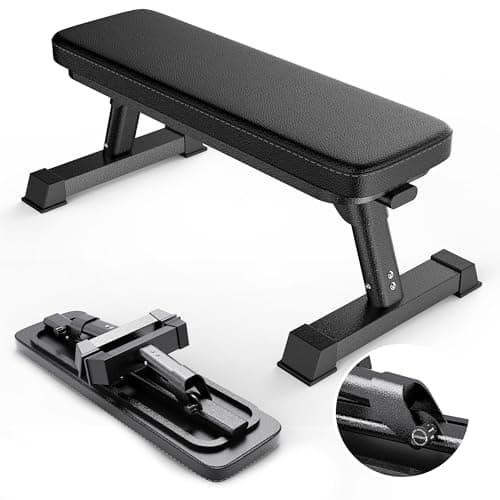
A bench that folds to a genuinely flat profile hangs cleanly; a bench with a wide tripod base and a fixed backrest does not. Look for:
- A flat folded profile. The Finer Form flat bench above folds down and has no protruding uprights, which is exactly the shape a bracket wants.
- A weight you can lift overhead. Benches run from about 20 to 60 lb. Hanging a 60 lb bench above shoulder height every session gets old fast.
- No exposed adjustment hardware on the underside. That is the face that ends up against the wall.
The wall rack that people are really describing
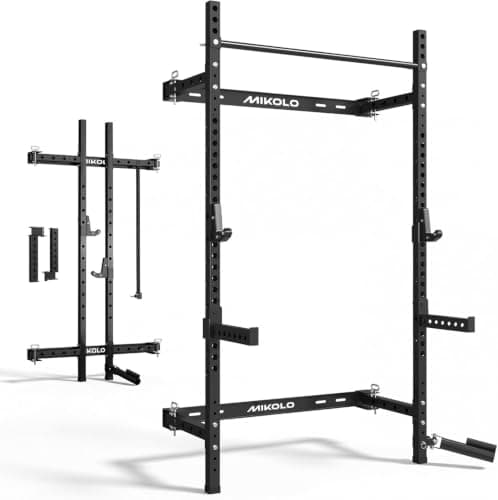
A sizeable share of "wall mounted weight bench" searches are actually looking for a folding wall-mounted squat rack — the thing that does fold into the wall, does carry catch bars, and does turn a wall into a pressing station. You still bring your own bench, but the rack is the part that becomes invisible.
If that is the picture in your head, read our wall-mounted squat rack roundup instead — it is the product category that actually delivers what the search implies. The Mikolo above is our benchmark for it.
Doing it safely if you drill
Everything on this page that mounts to a wall goes into studs. Not drywall anchors, not toggle bolts, not hollow-wall plugs. A stud finder costs about fifteen dollars and is non-optional. Mark both edges of the stud and drill the center; if your bracket holes do not line up with stud spacing, mount a horizontal length of timber across two studs first and bracket into that.
Our installation guide walks through stud finding, pilot holes and lag bolts step by step — the same process applies to brackets at a much lower load.
What renters should do instead
If drilling is off the table, the sequence is: buy the bench that folds smallest, store it upright rather than flat, and put it somewhere it is not in the way — behind a door, in the gap beside a wardrobe, under a bed if it folds thin enough. Our under-bed storage guide covers the dimensions that actually fit under a standard bed frame, and renter-friendly home gym ideas covers the wider no-drill approach.