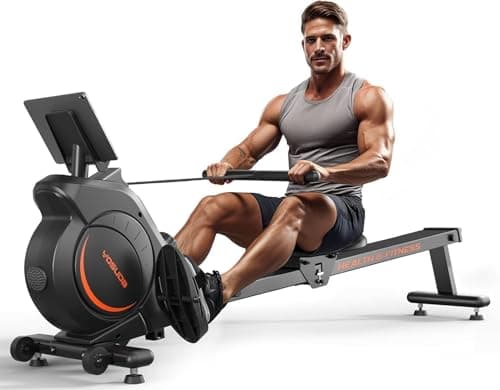
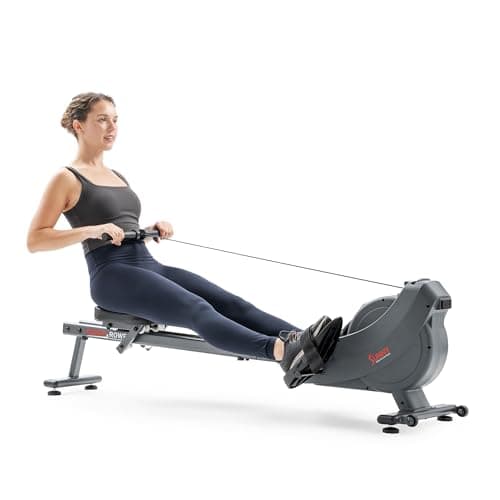
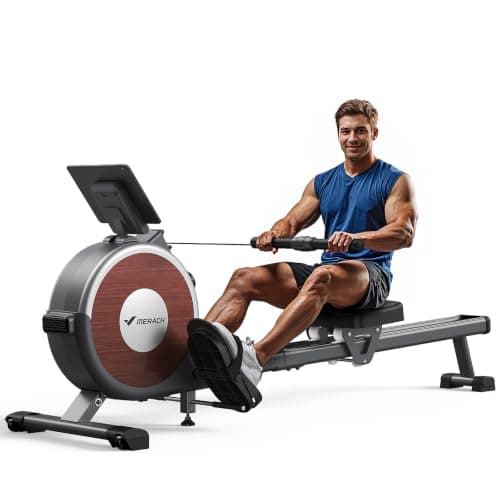
The best compact rowing machine for a small space is a magnetic one that folds upright: the Merach is our top pick because sixteen resistance levels and a quiet belt drive give you real room to progress, and the frame stands up in a corner the moment you step off it. The YOSUDA is the close alternative — same quiet magnetic drive, a more padded seat for long sessions — and the Sunny Health smart rower is the one to take if brand support and getting a replacement part in two years matter to you.
Rowing looks like the perfect small-space cardio and then arrives in a very long box. That contradiction is the entire category, and it's why "compact" means so little on a rower listing unless you pull it apart. Every rower has twofootprints: the floor it needs while you're moving on it, and the floor it needs for the other twenty-three hours of the day. Only the second one folds. A machine that stands vertically in a corner can be genuinely apartment-friendly and still demand a clear lane through your living room every time you use it.
So we rank on three things, in this order. First, how it stores — an upright fold is the single feature worth paying for here, because it converts a long horizontal object into a narrow vertical one and hands the floor back. Second, rail length in use, the number that decides whether the machine fits your room at all. Third, resistance type, which in an apartment is really a noise question in disguise. All three of our picks are magnetic and all three fold, which is not a coincidence: those are the two traits that make a rower survivable in a small home.
Rail length is where listings get slippery. None of these three publish a rail measurement, so we mark it "Not published" on the Spec Block rather than guessing — but every listing publishes assembled dimensions, and that is the number to hold against your room before you order. Add clearance behind the flywheel end and, more importantly, behind you: at the catch your seat is at one end of the rail, and at the finish your back needs somewhere to go. People measure the machine and forget they also have to fit.
The noise story is simpler than the marketing makes it. A magnetic rower is quiet because nothing is being thrashed through air or water to create resistance — a magnet moves nearer a flywheel, the belt runs, and that's it. Air rowers roar under load by design, water rowers make a pleasant swoosh that is still a real sound through a shared wall, and both are heavier objects to fold. What actually reaches the apartment below on any rower is the seat rolling and the light impact of the catch, which a mat handles — see the apartment flooring guide, and our quietest cardio machines ranking if noise is the constraint that decides your purchase.
How to choose a compact rower for a small room
Start with the storage plan, because it's the part people improvise and regret. A rower that folds upright needs a wall it can lean against, a ceiling tall enough for it to stand under, and enough clear floor in front of that wall for you to tip it up without hitting a lamp. If you can't picture the exact corner it goes into, you don't have a storage plan — you have a very long piece of furniture arriving on Thursday. A folding rower that never gets folded is strictly worse than a non-folding one, because you paid for the hinge and still lost the floor.
Measure the rail, then measure the room
The assembled length on the listing is the honest number, and it's the one to run a tape measure against. Lay the tape on the floor where the machine will live and stand in the space at both ends of the stroke. You need clearance at the flywheel end so the machine isn't jammed against a baseboard, and clearance behind the seat so you can lean back at the finish without meeting a coffee table. In a narrow room, check the diagonal — plenty of rowers fit a studio apartment corner-to-corner when they don't fit wall-to-wall.
Magnetic, air or water — the noise decides it
If you share a wall or a ceiling, magnetic is the answer and the other two are compromises you will hear about. Magnetic resistance is near-silent under load, needs no water tank to fill, drain or treat, and is lighter to stand upright. Air rowers give the most authentic on-water stroke feel and the resistance scales with your effort, which is genuinely better training — and they are loud, permanently, by mechanism rather than by fault. Water rowers split the difference on both counts and add real weight. For a compact home setup with neighbors, we think the trade-off is one-sided.
Buy resistance range, not resistance numbers
Sixteen magnetic levels sounds like a spec-sheet flex, and to some extent it is — but the useful version of that number is headroom. A rower with fine, well-spaced steps lets you add a little difficulty every few weeks instead of jumping from "easy" to "grim" with nothing usable in between. That's the difference between a machine you progress on for two years and one you plateau on in two months. Where two rowers are otherwise equal, more steps is the tiebreaker, which is exactly how the Merach edges the YOSUDA here.
Then budget for the mat
A rower is low-impact, not no-impact: the seat rolls, the catch lands, and the frame sits on a few small feet that concentrate all of it into the floor. A dense mat under the rails protects the floor you may not own, stops the machine walking across a hard surface, and takes the edge off what the unit below hears. It's the cheapest part of this purchase and the one that most affects whether rowing at home stays uncomplicated — the apartment noise playbook applies just as much to cardio as it does to weights.
Still torn between a rower and a treadmill? We compared them on the numbers a small room cares about — in-use lane, stored shape, ceiling and what each sends through the floor — in rowing machine vs treadmill for small spaces.