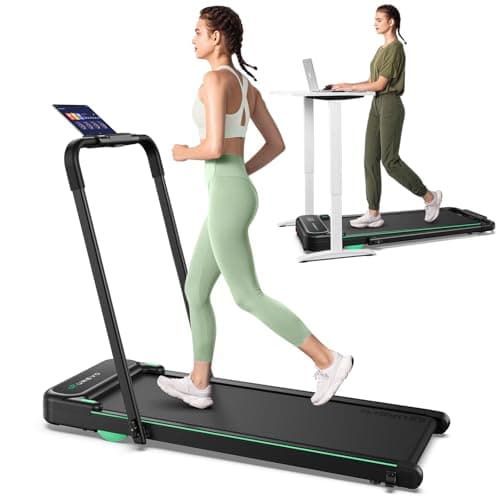
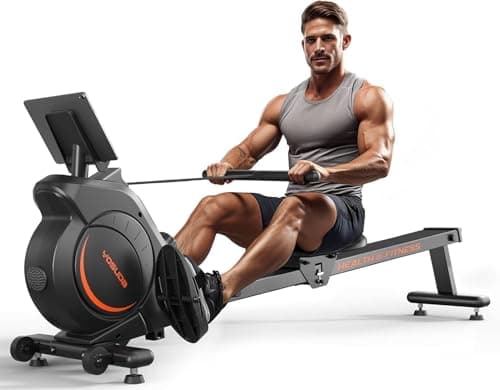
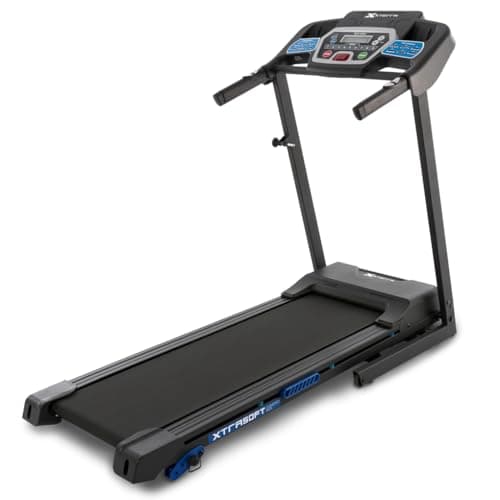
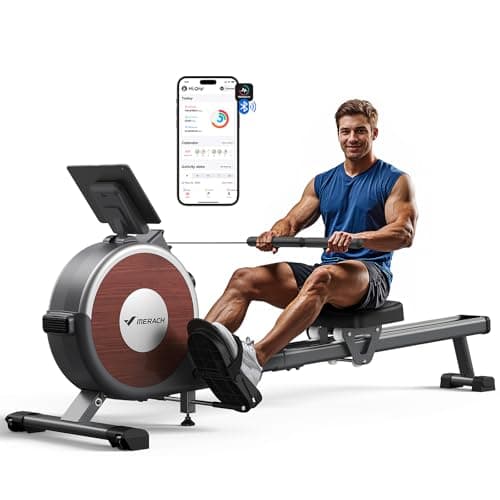
For most apartments the rower wins: a magnetic rower is quieter through the floor than any treadmill under load, it stands upright in a corner when you are done, and it works the upper body a treadmill never touches. The treadmill wins when what you want is walking under a desk for hours — a rower cannot do that — or when running is the point and you have a floor that can take it. The Merach is our compact rower pick; the UREVO Strol 2E is the small-space treadmill answer; the YOSUDA and the XTERRA are the alternates on each side.
Most versions of this comparison argue about calories. This one does not, because the calorie difference between a hard rowing session and a hard run is small compared to the difference between a machine you use and one you stop using, and in a small apartment that is decided by footprint and noise. So the argument here is about the room.
Footprint in use: the rower is longer than you think
A rowing stroke needs the seat to travel the length of the rail, and your legs extend beyond the front of it. In use, a compact rower occupies a strip roughly as long as a tall adult lying down, plus the stroke. None of the rowers we rank publishes its rail length, which is a real gap in the category, so the practical rule is to plan a lane seven feet long and a little wider than your hips, and to check the listing dimensions against it before buying.
A walking pad is shorter in use than a rower and needs no lane beyond itself; a folding treadmill like the XTERRA needs its deck plus a clear zone behind it. Treadmills also need something rowers do not: ceiling. Your height, plus the deck height, plus a bit of bounce has to fit under the ceiling — and a low-ceiling room can rule out a treadmill for a tall runner while a rower never cares. Our ceiling-height guide has the arithmetic.
Footprint stored: the rower stands, the pad lies down
This is where the two diverge completely. Both the Merach and the YOSUDA fold and stand upright, so their stored footprint is a tall, narrow column in a corner. A walking pad stores as a slab under a couch or bed. A run-capable folding treadmill like the XTERRA folds its deck vertically and leans against a wall — tall, heavy, and not a closet item.
So the question is which shape of empty space you have. A corner with nothing in it favors the rower. A bed or couch with clearance beneath it favors the walking pad. A wall you can lean a heavy machine against favors the folding treadmill, and if you have none of those, the mini stepper is the machine that fits where nothing else does.
Noise: the rower is quieter through the floor
Every treadmill sends impact into the joists, because that is what running is. Walking on a pad is far gentler, but it is still footfall on a belt over a frame over the floor. A magnetic rower has no impact at all — the seat rolls, the handle pulls against a magnetic brake, and the loudest part is the seat on its rail. That is why our quietest-cardio roundup keeps ending up with rowers near the top.
The one caveat: the rower's noise is a rhythmic rolling sound in your own room, which some people notice more than a hum. The treadmill's noise goes downstairs. If you share a wall, either is fine; if someone lives below you, the rower is the safer buy and this page explains why a mat only partly fixes the treadmill.
The comparison in one table
| Compact rower | Walking pad / folding treadmill |
|---|
| In-use footprint | A long lane — rail plus leg extension | Deck plus a clear zone behind (treadmill) or just the deck (pad) |
| Stored footprint | Upright column in a corner | Flat slab under furniture (pad); tall, heavy lean-to (treadmill) |
| Ceiling needed | None beyond standing height | Your height + deck height + bounce |
| Noise to the floor below | Lowest — no impact | Low walking; moderate to high running |
| Muscles | Legs, back, arms, trunk | Legs, primarily |
| Desk use | No | Yes (pad) — the one thing a rower cannot do |
Which one for which room
- Studio with a bed and no free corner. Walking pad. The bed is the storage. A rower needs a corner to stand in and a lane to row in, and a studio often has neither at the same time.
- Apartment with a spare corner and a neighbor below. Rower. It stands in the corner, rows in front of it, and sends nothing meaningful through the floor.
- You work from home and want to move while you work. Walking pad, without a debate. A rower is a workout; a pad is a way to not sit for eight hours. The under-desk roundup covers the seated alternatives too.
- You want to run, and you have a hard floor and a ground floor. A folding treadmill, and the XTERRA is the one on this page you can actually run on.
- You want the most fitness per square foot. Rower. It trains more of you, and it disappears afterward.
Where each pick sits
The Merach is the rower we rank first for small rooms: sixteen magnetic levels, a belt drive, and a frame that folds upright. The YOSUDA is its near-twin and the swap if one is out of stock; the differences are the seat and the resistance granularity, and the full rower roundup goes through both.
On the treadmill side, the UREVO Strol 2E is here rather than a pure walking pad because it is the only small-space machine that does both jobs: handle down, it is a pad under a desk; handle up, it jogs. The XTERRA is the honest running machine — a deck you can genuinely run on, a hydraulic vertical fold — and its presence is a reminder that “treadmill” in a small space means choosing between running and storing, because the one that does both well does not exist at a small-space size.
What about the bike?
The third machine in this conversation is a folding exercise bike, and it splits the difference: quieter than a treadmill, smaller in use than a rower, and no lane needed. We compared it to the treadmill directly in treadmill vs exercise bike for small spaces, and against the rower the bike loses on upper-body work and wins on stored size. If the rower's lane is the problem, the folding bikes are the next page to read.
Floor and mat
Both machines want something underneath. For the treadmill it is about impact and carpet fibers in the motor; for the rower it is about the seat rail and the foot stretcher scuffing a floor. A thin rubber mat handles both, and the home-gym mat roundup covers what goes under cardio versus what goes under a rack.