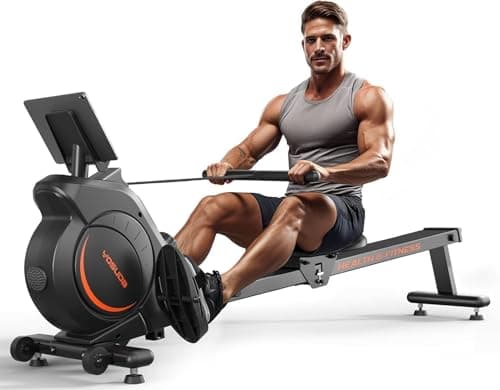
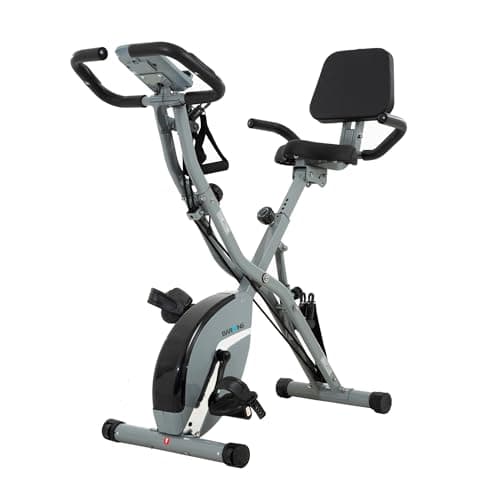
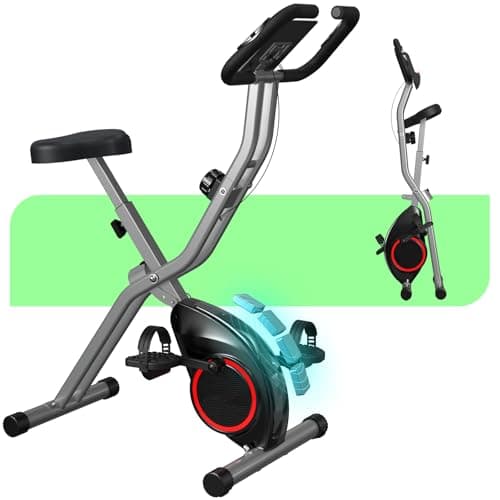
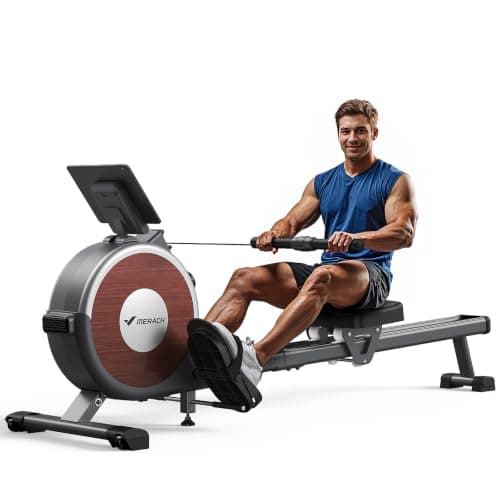
If the room has to go back to being a room, buy the bike. The LINBOLUSA 816 is our pick for the smallest spaces because it publishes the number that matters — a 33 lb frame — which means one person can fold it and walk it to a closet without help. If you can keep a clear lane roughly seven to eight feet long, buy the rower instead: the Merach magnetic rower is the better machine of the two, because one stroke moves your legs, back and arms rather than your legs alone. Everything else on this page is the arithmetic behind that split.
We already rank each category on its own — the compact rowers and the folding exercise bikes — and this page is the decision above both of them. It is deliberately not a calories comparison. We have no lab, we are not going to invent one, and the honest truth is that in an apartment the machine you can actually set up and store is the machine that gets used.
The geometry, which is the whole answer
A rowing machine is a long, thin object you sit inside. The frame is a rail; your seat travels along it; your legs extend past the end of the stroke. That means the floor area a rower occupies while you are on it is far larger than the frame, and it has to be a continuous rectangle — you cannot row with a coffee table halfway down the rail. Plan on seven to eight feet of clear length for an adult, which in most small rooms means moving furniture before every session unless the lane already exists.
A folding exercise bike is the opposite shape: a compact X-frame roughly the footprint of a dining chair, used sitting still. Nothing extends. Nothing travels. When you are done it folds and rolls, and the floor is yours again. If you are choosing between these two categories in a one-room apartment, that difference decides it more often than anything in the spec sheets below.
The test: put a tape measure on the floor where the machine would go, and see whether you can lay out a clear strip eight feet long without moving anything. If you can, a rower is live. If you cannot, the bike is the machine that will still be in use in six months.
What neither category publishes
We print "Not published" rather than filling a gap, and in this matchup the gaps are symmetrical and annoying. Neither the Merach nor the YOSUDA rower publishes a rail length, so the lane figure above comes from the mechanics of the stroke, not from a spec sheet — measure your own legs extended and add the seat travel. On the bike side, none of the three folding bikes in our registry publishes a folded size either, which is exactly the number you want before you commit a closet to one. The one exception is weight: the LINBOLUSA publishes a 33 lb frame, and for a machine that has to be folded and carried, weight is a better proxy for "can I store this" than a folded depth you cannot verify.
Capacity disclosure is better on the bikes and worse on the rowers. BARWING publishes 350 lb and LINBOLUSA publishes 260 lb plus a 5 ft 0 in to 6 ft 1 in rider height range, which is unusually forthcoming for the money and also a real constraint: if you are taller than 6 ft 1 in, that listing has told you to buy something else. Neither rower publishes a rated load. Our capacity guide has the longer version of why these three different numbers get used interchangeably.
How the four compare
| Machine | Type | Resistance | Published capacity | Storage |
|---|
| Merach magnetic rower | Magnetic rower | 16 levels | Not published | Folds upright into a corner |
| YOSUDA magnetic rower | Magnetic rower | Adjustable, steps not published | Not published | Folds for storage |
| BARWING 5-in-1 | Folding upright / recumbent bike | 16 levels | 350 lb | Folds; folded size not published |
| LINBOLUSA 816 | Folding X-frame bike | 16 levels | 260 lb, riders 5 ft 0 in to 6 ft 1 in | Folds; 33 lb frame |
Two things stand out in that table. First, resistance granularity is a tie — three of the four publish sixteen magnetic levels, so neither category wins on progression. The rowers are not the "serious" option by virtue of being rowers. Second, the only machine here that tells you who it does not fit is the cheapest one, and that is a point in its favor, not against it.
Noise: a near-tie, for an unusual reason
Both categories here use magnetic resistance, which is the quietest mechanism in home cardio: a magnet moves nearer a flywheel, nothing rubs, nothing spins air. There is no fan roar, no water slosh, no belt slap. If you are choosing between these two because of a neighbor below, the honest answer is that it is close to a draw, and both are quieter than any treadmill we rank — see the quietest cardio ranking for the whole field.
The tiebreaker is contact noise rather than mechanism noise. A rower's seat carriage runs along a rail and its handle returns to a stop on every stroke, and both of those transmit a rhythmic tap into the floor if the frame sits on bare boards. A bike does not touch anything but the four feet it stands on. Put a mat under either one and the difference closes — our mat guide works through what a mat does and does not fix.
What each one actually trains
No health or fat-loss claims here; what follows is mechanics. A row is a hinge and a pull: you drive with your legs, open at the hips, then pull with your back and arms, so one stroke involves most of the body and your grip gets a say in how long you last. That has a practical consequence for a small-space gym — a rower overlaps with the pulling work a room without a pull-up bar is usually short of.
A bike is a seated leg press, repeated. Your upper body does nothing, which is a limitation and also the reason a bike is the easier machine to use while reading, working or watching something — and the easier one to use when you are tired. If your plan is "move every day without thinking about it," that matters more than the muscle count.
Who should buy which
- Buy the rower if you have a lane you can leave clear, you want one machine that covers pulling as well as legs, and you would rather own the better machine than the smaller one. Start with the compact rower ranking.
- Buy the bike if the room is shared, the floor has to be clear, you are over 250 lb or under 5 ft 2 in and need a published fit range, or you want the cheapest honest way into daily cardio. The folding bike ranking has all three.
- Buy neither if what you actually want is step count during the work day. That is a walking pad or an under-desk machine, and both are a better answer to that question than either machine on this page.
The three measurements to take first
The lane. For a rower: a clear strip about eight feet long and three feet wide, measured on the floor, with no furniture in it. Mark it with tape before you order. If the only eight-foot strip in the room runs through a doorway, it is not a lane.
The stored slot. For both: where it goes when you are done. A rower that folds upright needs floor-to-ceiling clearance in a corner; a folded bike needs a closet or a gap beside a wardrobe. Neither category publishes folded dimensions reliably, so measure the gap you have and compare it to the unfolded frame plus a margin.
You. Weight against the published capacity, height against the published rider range. Two of the four machines here publish both; the other two publish neither, which is a reason to prefer the ones that do if you are near either limit.
Where this page sits in the rest of the cardio set
This is the third of our machine-type head-to-heads and the one with the clearest geometric answer. The others: rower versus treadmill is decided by impact and by what the neighbor below hears; treadmill versus bike is decided by whether you need to run or only to move; elliptical versus bike is decided by ceiling height, which surprises people. If you want the whole field ranked rather than a fork, the low-impact ranking covers four categories at once.
One honest note about price
The cards above carry live prices and nothing on this site types a price into prose, because the number on the card is the only one that is current. What we can say about the shape of the field: the rowers in our registry cluster together, the folding bikes sit below them, and the gap is not large enough to be the deciding factor for most people. Choose on the floor plan, then check the card.