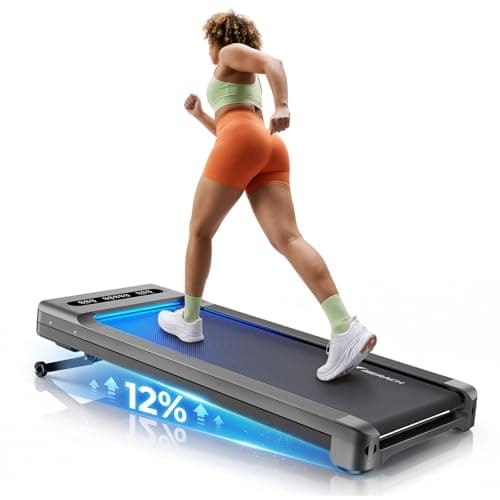
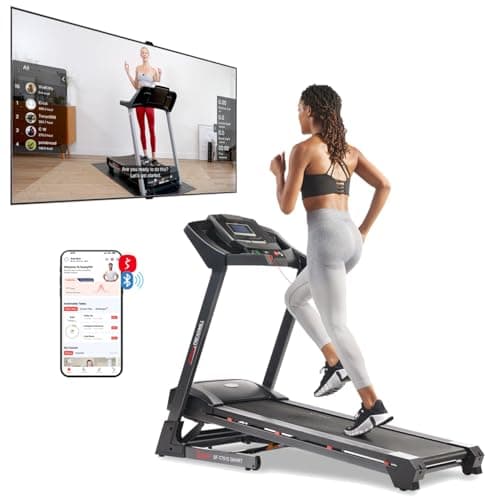
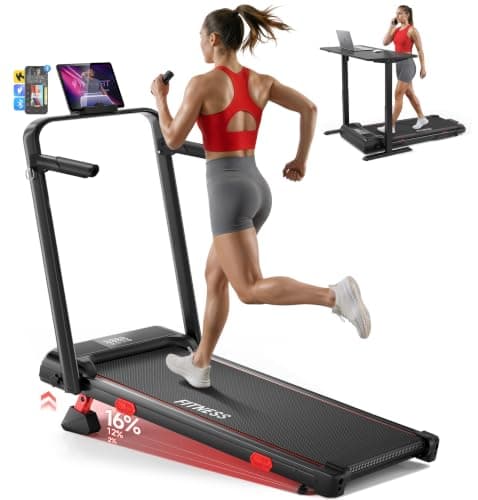
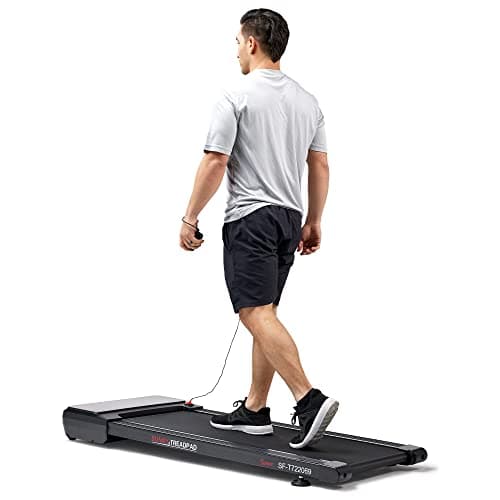
If you are tall and want a walking pad, buy the Sunny SF-T722069 Treadpad: its 45.7 by 16 inch belt is the longest walking surface of any pad in our registry, and Sunny publishes the figure rather than leaving it blank. If a wider foot placement matters more than the last four inches of length, the MERACH UltraWalk W60 is the one — 41.3 by 16.5 inches, the widest belt here, with motorized incline. And if you intend to jog rather than walk, stop looking at pads: the Sunny SF-T7515SMART folding treadmill has a 48.8 by 16.5 inch running deck, which is longer than every pad on this page.
This is the one walking-pad question the category refuses to answer. Not one maker in our registry publishes a maximum user height, and several do not publish a belt dimension either — the WalkingPad C2, the UREVO Smart Walking Pad, the Sunny Wi-Fi Treadpad and the DeerRun incline pad all leave the belt size blank, which is exactly the number a tall walker needs. Our general walking pad ranking is still the right starting point for most buyers. This page is for the specific case where your stride is the constraint, and it ranks on the one spec that speaks to it.
Why belt length is the number
Step length grows with height, and it grows again with speed. At a slow amble most people fit on anything; at 3.5 mph a tall walker covers noticeably more belt per step than a shorter one, and the failure mode is specific — your lead foot lands nearer the front roller than you expected, you shorten your stride to compensate, and twenty minutes later you are walking in a way you would not walk outdoors. A longer belt does not change your gait. It just stops the deck from changing it for you.
Width matters second, and for a different reason: a wider belt forgives lateral drift. On a 15 inch belt your feet have to track straight; at 16.5 inches there is margin. Nothing on this page is wide by treadmill standards — a commercial deck is 20 inches or more — so this is a comparison of narrow against slightly less narrow, and we would rather say that than pretend otherwise.
What we are not going to do is invent a height-to-belt formula. No maker publishes a user height limit for a pad, so any "6 ft needs 45 inches" rule you read online was made up by somebody. Buy the longest published belt your room and budget allow, and treat the number as margin rather than as a promise.
What to look for, in order
- A published belt length.If the listing does not state one, the category's most important spec for you is missing, and that is a reason to pass rather than to guess. Four machines in our registry publish it. They are the four on this page.
- Belt width, if published. 16 to 16.5 inches is the top of the pad category. Below 15.5 inches, lateral drift becomes your problem to manage.
- Whether there is a handrail, and where. Most pads have none, which is better for a tall walker — nothing to clip a hip on, nothing sized for someone else. The RHYTHM FUN has 8.5 inch side handlebars, which is something to hold at grade without a full upright rail.
- Top speed. A longer stride at a given pace means a higher cadence requirement if the machine caps low. Two pads here cap at 3.7 and 4.0 mph; one runs to 6.2 mph with the handle raised.
- Then the room. Belt length is bought with footprint: the longest belt here sits in a 58.2 inch frame. Our treadmill clearance guide has the working rectangle, including the gap you need behind the deck.
The four machines, measured
| Machine | Belt (published) | Footprint | Top speed | Incline | Published max user |
|---|
| Sunny SF-T722069 Treadpad | 45.7 x 16 in | 58.2 x 24.9 x 5.9 in, 73.9 lb | 3.7 mph | 7%, auto, 6 presets | Not published |
| MERACH UltraWalk W60 | 41.3 x 16.5 in | 51.4 x 22 x 6.5 in, 67.7 lb | 4.0 mph | 12 levels, auto | 400 lb peak / 330 lb sustained |
| Sunny SF-T7515SMART | 48.8 x 16.5 in running deck | 64.17 x 28.35 in, 123.5 lb | 8.0 mph | 2.5-12%, 12 motorized levels | 300 lb |
| RHYTHM FUN CP03 | 37.5 in long; width not published | 43.5 x 21 in, 40 lb | 6.2 mph | 2% / 12% / 16%, manual | 300 lb |
The table makes the trade obvious. Belt length tracks footprint and weight almost perfectly: the longest walking surface is also the longest, heaviest and most expensive pad of the group, and the lightest machine here has the shortest belt and does not publish a width at all. There is no free length in this category.
The treadmill question, answered honestly
If stride length is your binding constraint, a folding treadmill deserves a look before you buy a pad — and we would rather say that on a page titled "walking pads" than sell you the wrong shape. The Sunny SF-T7515SMART is on this page for that reason: 48.8 by 16.5 inches of running deck, 12 motorized incline levels, a 300 lb user rating and a soft-drop hydraulic fold. It is also 123.5 lb and 55 inches tall folded, which makes it a stand-against-the-wall object rather than a slide-under-the-couch one. That is the whole difference between the categories, and our walking pad versus folding treadmill page works through it in full.
If you want the deck but not that mass, the folding treadmill ranking has the lighter options, and the sub-$300 folding treadmills cover the budget end. Prices on every card here come from our live price layer, with the as-of date printed beside them — if a listing has drifted since the last check, the card will say so rather than this paragraph.
What a longer belt does not buy you
Three things, so the expectation is set. It does not raise the speed cap: the longest belt on this page tops out at 3.7 mph, which is a brisk walk and nothing more. It does not make the machine quieter — belt length is unrelated to motor noise, and only the MERACH publishes a figure at all (about 54 dB average, which is its number and not our measurement). And it does not raise capacity: the pad with the longest belt is the one that publishes no maximum user weight at all, which is an odd omission at the highest price in the group. Our capacity guide covers how to read that blank.
If the pad goes under a desk
Measure the desk clearance before the belt. The two motorized-incline pads here are 5.9 and 6.5 inches tall at their lowest setting, and raising the deck raises your head by the same amount plus the grade. A tall walker under a fixed-height desk runs out of headroom before anyone else does. If the desk does not adjust, the RHYTHM FUN at 3.9 inches folded or the flat pads on our under-desk ranking are the safer buy, and you trade belt length for clearance.
If the pad has to disappear afterward
Belt length is the enemy of storage. 45.7 inches of belt sits in a 58.2 inch frame weighing 73.9 lb, which is a two-handed lift and a stand-it-upright-in-a-closet object. The RHYTHM FUN folds to a published 3.9 inches and weighs 40 lb; the DeerRun pad on our incline pad ranking is 3.94 inches and 36.6 lb, and genuinely slides under a low couch — but publishes no belt dimension, so it is not on this page. Pick the constraint that actually governs your room, because you cannot have both.
Floor protection is not optional at this size
A 70 lb machine with a motor running under it concentrates both weight and vibration on four small feet. On a hard floor that transmits; on carpet it also traps heat under the deck. Our mat guide is the honest version of what a mat fixes, and using a walking pad on carpet covers the case where the floor is already soft. If a downstairs neighbor is the real constraint, the neighbor question is the page to read first.
What we did not do here
We did not measure a belt, time a stride or test a machine with a tall walker on it. Every dimension on this page is the maker's published figure, read off the listing or the spec sheet and printed as-is — including the blanks, which we leave as "not published" rather than filling in. There are no ratings, awards or test results on this site that we did not derive from documented specifications, and our methodology page says so in those words.