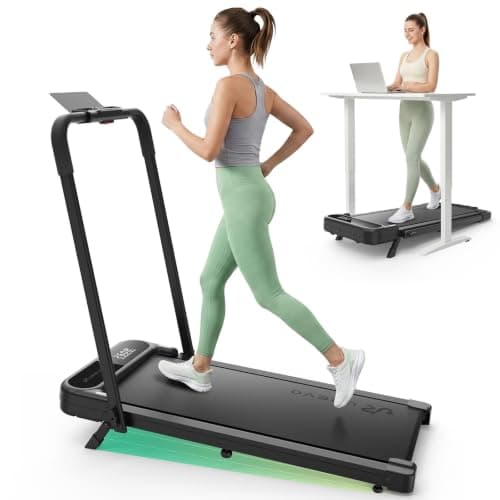
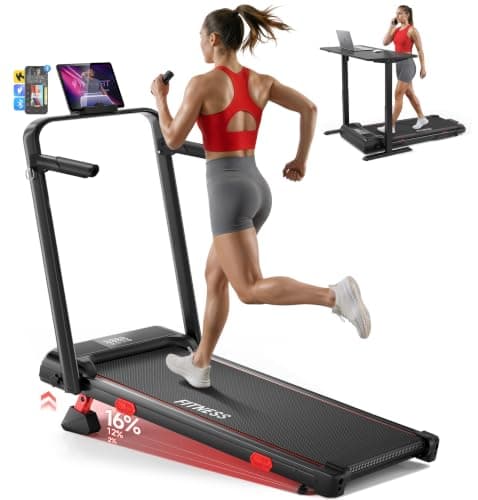
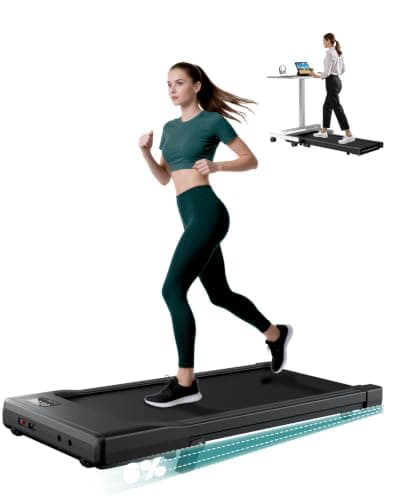
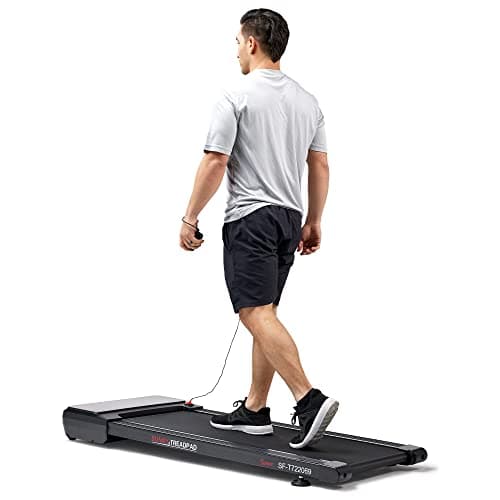
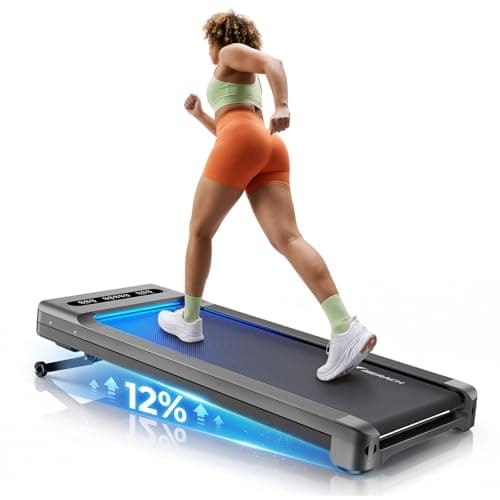
The MERACH UltraWalk W60 is our pick, because it is the one pad here that raises its deck under power across 12 levels — you change the grade from the remote while you are still walking, which is the only way incline intervals actually happen. The UREVO Strol 2E Pro is the value pick, reaching a 12% grade for well under half the money, and the RHYTHM FUN CP03 is the steepest grade on the page at 16%. Both set that grade by hand. If you need the pad to vanish under a low couch, the DeerRun is 3.94 in tall; if you want a multi-year warranty behind a motorized incline, the Sunny Treadpad is the only one that offers it.
This is a different page from our best walking pads roundup on purpose. Every pad on that page is flat, and the page says so in the first paragraph — a classic walking pad gives up incline, handrails and run speed in exchange for being thin. The machines below are a newer sub-category that adds one of those things back, and they add it with a trade-off the listings do not advertise. If you only want steps under a desk and the smallest stored object possible, start on the flat roundup. If the hill is the point, you are in the right place.
The trap in every incline walking pad listing
Read any of these titles and you will see a confident number: 12% incline, 15% incline, 16% incline. What almost none of them say is how you get there. On three of the five pads below, the grade is a mechanical setting — flip-out legs under the front feet, or a block you slide into place. To change it you stop the belt, step off, bend down, move the feet and step back on. The pad is genuinely at 12% once you are done. It is simply not something you can do mid-session.
On the other two, a motor lifts the deck while you walk. That is the entire difference between "a pad that can be set to a hill" and "a pad you can do hill intervals on," and it is worth roughly double the money. Neither is wrong. What is wrong is finding out which one you bought after it arrives, so the Spec Block on every pick below states AUTO or MANUAL on the Incline row before it states the percentage.
A second thing the numbers hide: a percentage is not a comparable figure across these machines unless you also know the belt length. A 16% grade over a 37.5 in belt is a steeper, shorter ramp than the same grade over a 45.7 in belt, and the shorter one runs out of deck sooner for a long stride. We publish both numbers on every pick, and where a maker refuses to publish belt width — two of the five do — the spec row says "Not published" rather than filling the gap with a guess.
The five things we ranked on
- How the grade changes, then how steep it goes. Motorized first, percentage second. A 7% auto incline is more useful to most people than a 16% grade you have to kneel down to set, and we ranked it that way.
- Stored thickness and weight. The constraint that actually decides whether a pad lives in your apartment. Incline hardware adds height and mass to the front of the machine, so the thinnest pads here are the shallowest ones. That is not a coincidence; it is the trade.
- Belt length and width. At a grade your stride lengthens and your foot lands further back. The pads with the longest decks are the ones a tall walker can use at 12% without clipping the rear roller.
- The speed ceiling. Three of these cap at a brisk walk. Two raise a handle and open a 6.2 mph run range. That changes what the machine is, what it does to the floor, and who should buy it.
- Published noise, and what is missing. Only one pad here publishes a decibel figure. We say so on the other four rather than inventing a comparison, and the downstairs-neighbor question is about footfall through the floor regardless of what the motor does.
How the five compare
| Machine | Incline | Speed | Belt | Stored height / weight |
|---|
| MERACH UltraWalk W60 | 12 levels, auto | 0.6-4.0 mph | 41.3 x 16.5 in | 6.5 in / 67.7 lb |
| UREVO Strol 2E Pro | 12%, manual | 0.6-6.2 mph (handle up) | 36.2 x 15.2 in | 4.2 in folded / 43.4 lb |
| RHYTHM FUN CP03 | 2 / 12 / 16%, manual | 0.6-6.2 mph (handle up) | 37.5 in long, width not published | 3.9 in folded / 40 lb |
| DeerRun 6% pad | 6%, manual | 0.6-3.8 mph | Not published | 3.94 in / 36.6 lb |
| Sunny Treadpad SF-T722069 | 6 presets to 7%, auto | 0.5-3.7 mph | 45.7 x 16 in | 5.9 in / 73.9 lb |
Read that table as a single trade running left to right: the further up the incline column you go, the heavier and taller the machine gets, until the two motorized pads at 67.7 lb and 73.9 lb are no longer objects you slide anywhere. Every price on this page comes from the live price layer on each card and is refreshed daily — we never type a number into copy, because a stale price is worse than no price.
How to choose an incline walking pad for a small room
Work through this in order. The first question eliminates more than half the market, and the second one is the one people skip and then regret.
1. Motorized or hand-set — decide before you compare percentages
If you want to walk at a steady grade for forty minutes while you work, a hand-set incline is completely adequate and saves you real money. Set it once, leave it, done. If the appeal is intervals — three minutes up, two minutes flat, repeat — then a hand-set pad cannot do it and no amount of advertised percentage changes that. There are only two motorized pads on this page because there are not many at any sane price, and the cheaper of the two is the MERACH. That is the whole decision, and it comes before you look at a single other spec.
2. Check your head height, not just the floor
This is the small-space failure mode nobody warns about. An incline works by lifting the front of the deck, which lifts you. Under a standing desk that was set up for a flat pad, raising the deck several inches can put your elbows above the keyboard and your shoulders into a shrug — and on a fixed-height desk there is no adjustment to make. If your desk does not raise, measure the clearance you have above your head while standing on the pad flat, and treat anything less than a few inches of slack as a problem at grade. The same goes for a basement or an attic room with a sloped ceiling; our ceiling height guide covers how to measure the rest of the room while you are at it.
3. Then let stored shape make the final call
Incline hardware lives under the front of the deck, so it costs thickness and weight. That is why the thinnest pad here is also the shallowest, and why the two motorized pads are the two heaviest. Be honest about where the machine goes between sessions:
- Under a low couch or bed.You need the DeerRun's 3.94 in or the folded RHYTHM FUN's 3.9 in. Measure the actual gap first — published pad heights do not include a mat.
- Upright in a closet. The MERACH is designed for this and has transport wheels, but at 67.7 lb you are tilting it, not lifting it.
- It lives out permanently.Then stored size stops mattering and the Sunny's 45.7 in belt and 3-year frame warranty become the strongest argument on the page. Our storage guide walks the measuring step properly.
4. Budget for a mat, and know what incline does to the floor
Walking at a grade means more force through the forefoot, which means slightly more energy going into your floor than the same pace flat. In a house that is irrelevant. Above an occupied unit it is the only thing that matters, and the fix is the same as it always is: a firm dense mat under the machine, not a soft foam one. Our apartment flooring guide covers what works, and it is worth buying at the same time rather than after the first complaint. Every maker here also specifies a hard, level surface — if your room is carpeted, read can you use a walking pad on carpet before you buy, because carpet plus a raised front foot is less stable than either problem alone.
5. Do not buy incline as a substitute for running
Three of these five cap at a brisk walk. The two with handles reach 6.2 mph, which is a jog on a short, narrow belt rather than a run — if running is the goal, a folding treadmill with a full deck is the honest answer, and walking pad versus folding treadmill is where that line gets drawn. What incline genuinely buys you is a harder session at a speed you can hold while working or watching something, which is exactly the use case a pad is for. If you are still deciding whether any of this earns the floor space, start with is a walking pad worth it.