Yes, you can build a home gym on carpet, and it will be quieter than the same gym on hardwood. What you must add is a firm layer between the carpet and anything with feet — a rack, a bench or a treadmill on bare carpet rocks, and that instability is a safety problem rather than a comfort one.
Carpet is the flooring most bedroom gyms actually sit on, and almost nothing written about home gym flooring acknowledges it — the entire category assumes a concrete garage slab. The result is that people either avoid building a gym at all, or put a rack straight onto carpet and discover the problem mid-set.
Carpet does three things to a home gym. It helps with noise, which is genuinely useful in an apartment. It hurts stability, which is the serious one. And it takes permanent damage from point loads, which is a deposit problem. This guide handles each in turn.
What carpet does well
Impact noise. Carpet plus underlay is a compliant layer with mass, which is precisely what damps the mid- and high-frequency component of a dumbbell being set down or a foot landing. A bedroom gym on carpet is meaningfully quieter to the room below than the same gym on laminate.
That does not extend to dropped loaded barbells, which transmit as structure-borne sound through the joists regardless of what is on top. The rules in lifting in an apartment still apply.
What carpet does badly
| Problem | Why it happens | Fix |
|---|
| Racks and benches rock | Feet sink unevenly into pile and underlay | A rigid mat layer underneath |
| Treadmills creep and vibrate | Frame is not level; belt tension shifts | Equipment mat, and re-level after a week |
| Permanent compression marks | Point loads crush pile fibers flat | Spread the load with a mat |
| Plates snag and fray pile | Plate edges catch loops | Never set plates directly on carpet |
| Dust and fiber in machine bearings | Carpet sheds constantly | Mat under the machine; vacuum regularly |
The layer that fixes stability
The fix for almost everything above is the same: put a rigid layer between the carpet and the equipment, so the load spreads across a wide area rather than concentrating on four small feet.
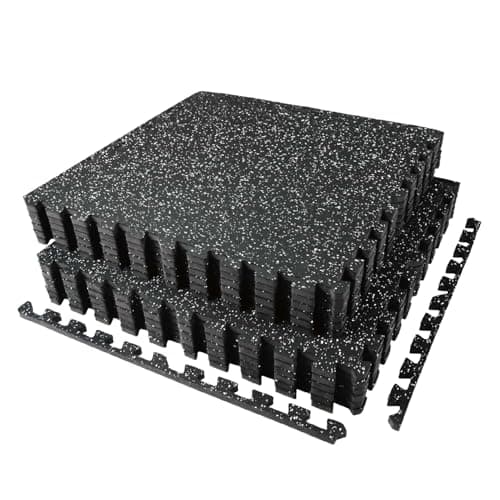
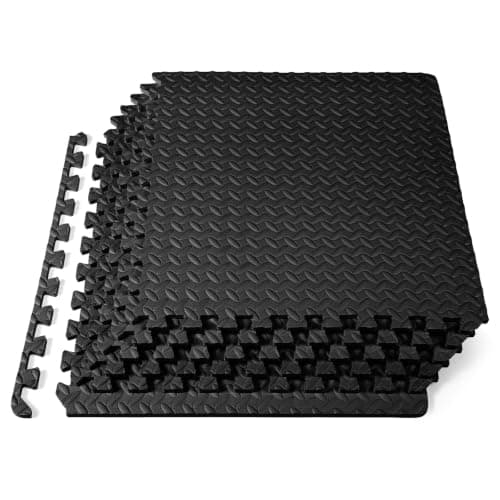
For a bench or a light rack, half-inch interlocking foam tiles are usually enough — they are firm enough to spread the load and cheap enough to cover a training area. For a power rack, a Smith machine or loaded plate storage, use rubber-top tiles instead, because plain foam dents under steel feet and a dented mat is a wobbly mat.
For a genuinely heavy rack on thick carpet, add a rigid board — a sheet of plywood or MDF under the mats — so the whole footprint bears on one plane. That is the setup that turns a carpeted bedroom into a usable lifting space. Our gym mat roundup covers the mat layer.
The underlay problem nobody mentions
Modern carpet underlay is often 8 to 11 mm of foam, and it is deliberately soft. That means the give under your equipment is not mostly the carpet — it is the underlay. Two consequences:
- Thicker mats do not fix it. Adding softness on top of softness makes the rocking worse, not better. Rigidity is what you need, not thickness.
- Test before you buy heavy equipment. Stand on one foot on the carpet and rock. If you can feel meaningful compression, plan for the plywood layer.
Cardio machines on carpet
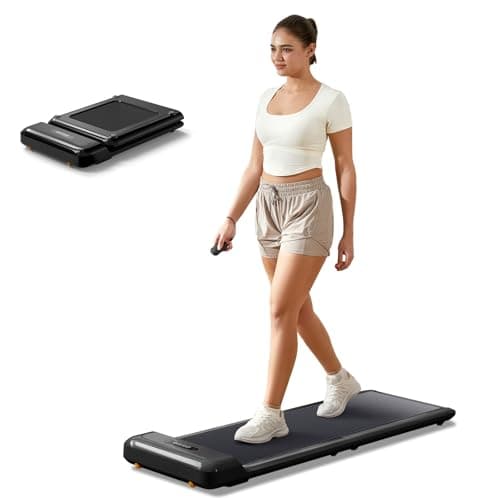
Treadmills and walking pads are the machines most affected. Three specifics:
- They need a level base. A treadmill that is not level wears its belt unevenly and tracks off-center. Mat first, then level the feet, then re-check after a week of use as the carpet compresses.
- They ingest carpet fiber. Motors and rollers pull dust in. A mat between machine and carpet cuts that substantially, and vacuuming under the machine monthly finishes the job.
- Walking pads are the easiest case. Low, light and often slid under furniture, they suffer less from leveling issues than a full-frame treadmill. We covered the specifics in can you use a walking pad on carpet.
Protecting the carpet itself
Carpet damage from a home gym is nearly always one of three things, and all three are preventable.
- Compression from feet. Spread the load with a mat. Marks that do form often lift with damp heat — a wet cloth and a warm iron held above the fibers.
- Snagging from plate edges. Never set a plate down directly on carpet. This is the damage that does not come out.
- Sweat and moisture. Carpet holds it, and it smells. A mat you can wipe is the answer; a towel under the bench is the cheap version.
What actually cannot go on carpet
Very little, honestly — but two things are worth naming. Deadlifting from the floor with a loaded bar, because a bar sitting on carpet is not on a stable, level surface and the plates will mark it permanently. And any freestanding rack on thick carpet without a rigid layer, because the rocking is a safety issue under load rather than an annoyance.
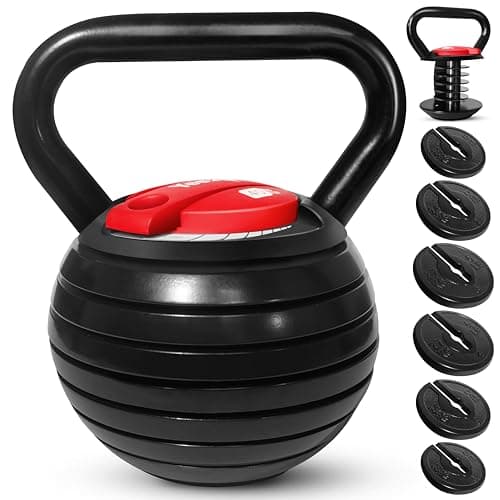
Everything else — dumbbells, kettlebells, benches, bodyweight work, cardio, bands — works fine on carpet with a mat. If your room is carpeted and you were treating that as a reason not to build a gym, it is not. Start with the essentials guide and put mats down first.
The carpeted room this comes up in most is a bedroom, where the soft floor arrives together with an upstairs joist span and a bed taking most of the square footage. If that is the room you are planning, the bedroom home gym guide works through the layout and the noise side; this page is the layer underneath it.