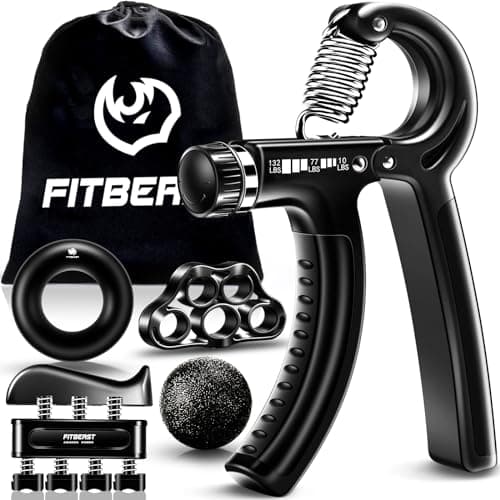
For most people the best grip trainer is a multi-piece kit with an adjustable gripper, because grip is not one movement — the FitBeast five-piece is our pick. If you want a number to train against, fixed-resistance grippers with published steps are the serious route. And if you already own plates, a wrist roller loads your forearms harder than either for under twenty dollars.
Grip is the one strength quality small-space lifters can train without negotiating with the room. Every other page on this site is ultimately about square footage: what folds, what bolts to a wall, what slides under a bed. Grip equipment fits in a bedside drawer, makes no noise, needs no install, and cannot bother anyone below you. That combination does not exist anywhere else in strength training.
It is also the thing most likely to be limiting your pulling. Deadlifts, rows, pull-ups and farmer's carries all stop when the hands stop, and in a home gym you are far less likely to have straps and chalk than someone training in a commercial facility. Ten focused minutes a week on the sofa moves that ceiling. Below, three tools that train genuinely different things.
Grip is three separate jobs, not one
Most people buy a gripper, squeeze it a few hundred times, and conclude grip training does not do much. The problem is coverage. The hand does at least three distinguishable jobs, and a crush gripper only trains one:
- Crush — closing the hand around something. This is what a gripper trains, and it is what most people mean by grip strength.
- Support — holding on to a load over time, which is what actually fails on a heavy deadlift or a set of carries. Wrist rollers and simply hanging from a bar train this; grippers barely touch it.
- Extension — opening the hand against resistance. Nobody trains it, and it is the balance to all the closing you do. Rubber bands or the finger stretcher in a kit cover it in about ninety seconds.
This is why the multi-piece kit takes the top spot despite the fixed grippers being the more serious training tool. If you only own one thing, own the one that covers more than a third of the picture.
Adjustable or fixed resistance?
An adjustable gripper spans a wide range from one object, which is efficient and cheap. The catch is that the dial setting is not a calibrated number — you cannot reliably compare "setting 4" this month with "setting 4" in six months, and you certainly cannot compare it to anyone else's.
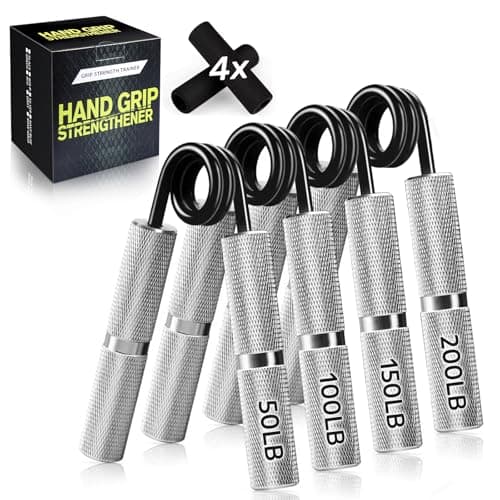
Fixed-resistance grippers are sold in published steps — 50, 100, 150, 200 lb in the set we rank — and each one is either closed or not closed. That binary is what makes progress real: you work the 100 until it shuts, then you start on the 150. If you want grip training to feel like the rest of your program, buy the fixed set.
The wrist roller is the best value in the category
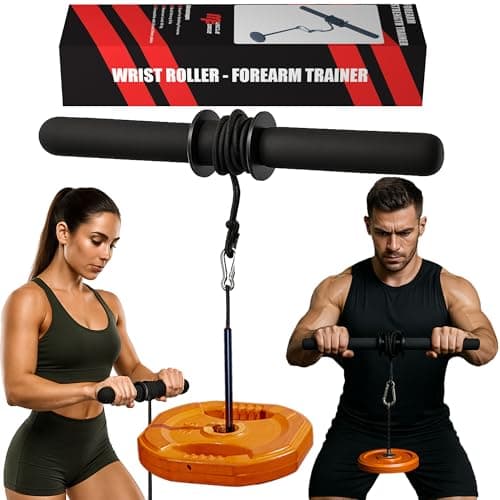
A wrist roller is a handle, a rope and a hook for a plate. Because it loads from the plates you already own, its resistance ceiling is whatever your plate collection is — which for anyone with a weight plate set is far beyond what any gripper offers. It trains flexion and extension in the same set, it hangs on a hook, and it costs less than a single Olympic plate.
The one requirement is plates. If you train exclusively with adjustable dumbbells and own no loose plates, this pick does nothing for you and the gripper sets are the answer.
How to actually program it
Grip recovers quickly and responds to frequency, so short and often beats long and rare. Three to five short sessions a week — a few sets of crush work, a couple of minutes of extension, one wrist roller ladder — is more than most people ever do and enough to change your deadlift. Train it after your pulling, never before, or you will sabotage the lifts you are trying to improve.
The other free upgrade costs nothing at all: stop using straps on your working sets, and hang from your pull-up bar for time at the end of a session. Dead hangs are the highest-return grip exercise available, and if you own a doorway bar you already have the equipment.