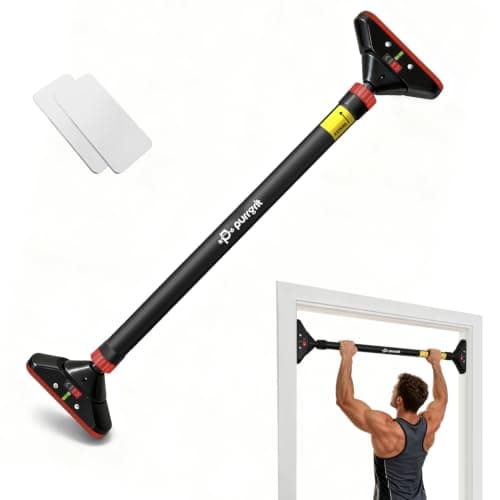
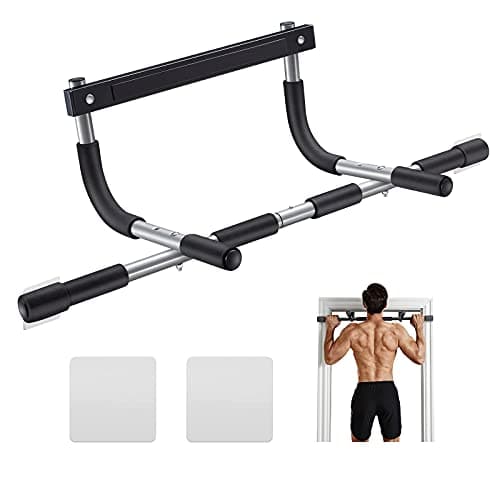
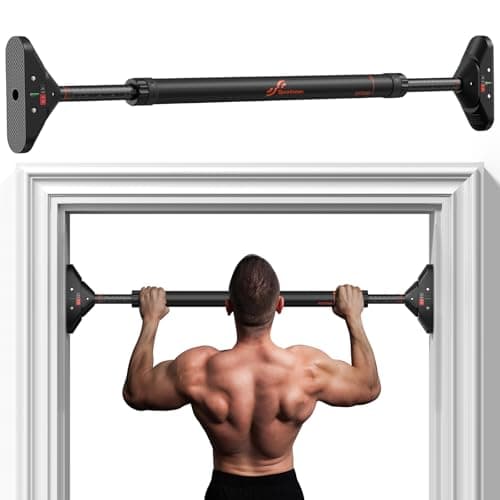
A doorway pull-up bar is the single highest-value purchase in a small home gym: it costs about thirty-five dollars, occupies zero floor space, needs no drilling, and covers the movement pattern that is hardest to train any other way. The Sportneer is our pick for its published 440 lb rating and stated 29.5 to 37 inch range. The PURRGRIT matches the rating for less. The ALLY PEAKS is the cheapest and adds neutral grips, at the cost of a published capacity.
Vertical pulling is the gap in almost every apartment gym. Dumbbells cover pressing and rowing. A folding bench and a stand cover squats. Cardio folds under a bed. But pull-ups need something above your head that will hold your bodyweight, and in a rented apartment there is usually nothing you are allowed to attach to. A power tower solves it and takes a permanent square of floor. A wall-mounted rack solves it and needs studs and a drill. A doorway bar solves it and needs a door frame.
There are three mounting types and it is worth knowing which you are buying. Leverage bars — all three picks here — brace against the wall above the door and the trim, using your own weight to hold them in place. Telescoping tension bars screw outward against the door jamb sides; they are cheaper and considerably less trustworthy, and we do not rank one. Screw-mounted bars bolt permanently into the frame, which is a different product for a different living situation.
Measure the door frame before you order anything
Two numbers decide whether a leverage bar works in your home, and neither is your ceiling height:
- Door opening width. Most bars adjust across a range — the Sportneer states 29.5 to 37 inches. Measure the opening itself, not the door.
- Trim depth (the reveal). A leverage bar hooks over the door frame and rests against the wall above it. If your doorway has no proud trim — a flush, trimless opening, which is common in modern builds and in some converted spaces — a leverage bar has nothing to brace on and will not work at all. There is no workaround; check first.
Also look at what is above the door on the far side. The bar's upper arm presses against that wall, and if there is a light switch, a picture, or nothing at all because you are in a wide opening, you have a problem.
Will it damage the paint?
Yes, if you do nothing about it. A leverage bar concentrates your bodyweight through foam pads onto a small area of wall and trim. Over months, that compresses and marks paint, especially in a rental with a single thin coat.
The fix takes two minutes: cut a piece of thin cardboard, felt, or an old mousepad to sit between each contact pad and the wall, and spread the load over a larger area. This is the single most useful tip in this entire article and it appears in almost no listing. If the bar lives in the frame permanently, check underneath it every month or so.
Published capacity, and why one pick does not have it
Two of the three bars here publish 440 lb. That is not a number you will approach, and that is the point — a large margin over your bodyweight is what you want on the one piece of equipment where failure means falling backward through a doorway. The ALLY PEAKS does not publish a rating, which is why it ranks third despite being the cheapest and having the best grip variety. We do not invent numbers to fill a gap a manufacturer left, so the Spec Block for that pick reads "not published," and you should weight that accordingly.
Grip options matter more than they look
A plain straight bar gives you pronated wide and pronated narrow. That is enough to get strong, but neutral grips — palms facing each other — are noticeably easier on most people's shoulders and let you keep training through the phases where wide pronated pull-ups start to ache. A multi-grip bar hangs a little lower, which is a real cost in a room with a short ceiling, but for most people the shoulder benefit is worth it.
If you cannot use a doorway bar
Trimless doors, very wide openings, and hollow-core frames all rule out leverage bars. Your options in that case, roughly in order of footprint:
- A power tower — freestanding, adds dips and knee raises, but owns a permanent square of floor.
- A wall-mounted folding rack with an integrated pull-up bar, if you can drill into studs.
- A ceiling-mounted bar, which is genuinely the most solid option and the least reversible. We rank both kinds — wall and ceiling — in the best wall-mounted pull-up bars, where projection and stud spacing decide the pick.
And if pulling is only half of what you are missing, look at dip stations — a doorway bar plus a set of dip bars covers vertical push and pull for under a hundred dollars combined, which is the cheapest complete calisthenics setup that exists.
Getting to your first pull-up in a small space
The bar itself is only useful if you can use it, and most people cannot do a pull-up when they buy one. The progression that works in a doorway costs nothing extra: dead hangs for time, then negatives from the top with a chair or bench to step onto, then band-assisted reps with the band looped over the bar. Dead hangs are also the best grip exercise there is, which pairs neatly with our grip strength roundup.