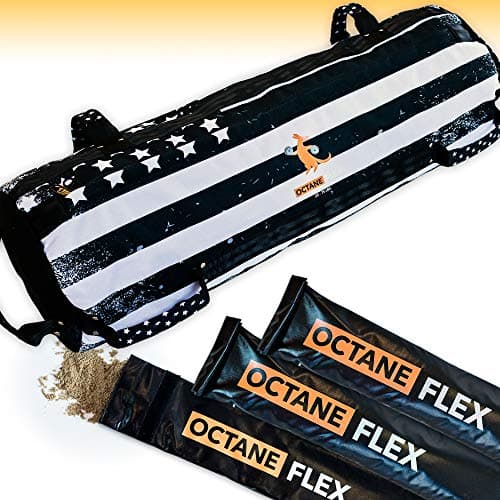
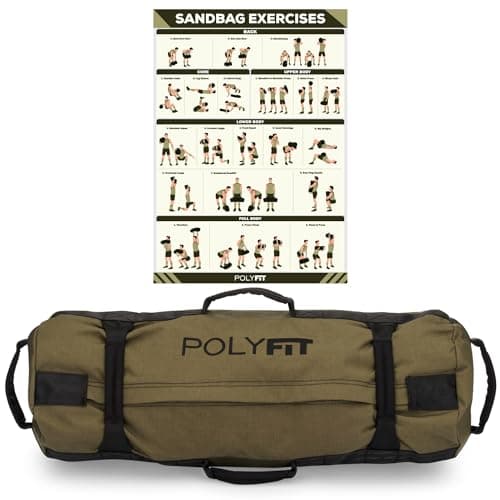
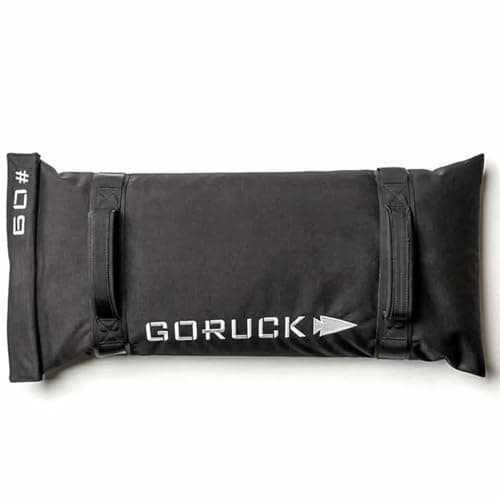
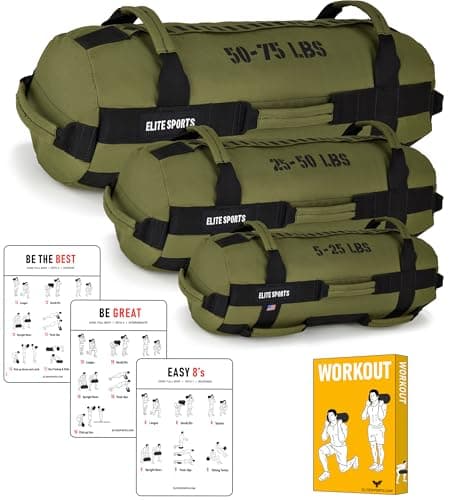
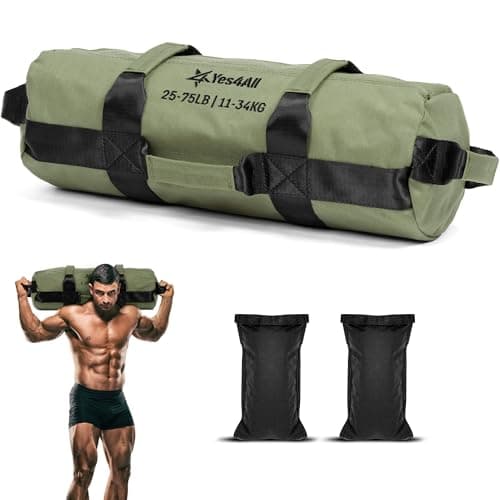
For most small rooms the Yes4All medium is the pick: seven rubber handles, a 25 to 75 lb range out of one shell, and a 1000D nylon body that folds flat and weighs under three pounds until you fill it. The Octane Flex is the cheapest way in and still includes the three filler bags that make it adjustable on day one. The Polyfit has eight handles, the most grip positions here. The GORUCK is the one that will outlast the lease, and it costs accordingly.
A sandbag is the strangest recommendation on this site and, for an apartment, one of the most defensible. Every other way of owning heavy things has the same two problems: the weight arrives heavy, and it stays heavy in the corner of your room forever. A sandbag arrives as about two and a half pounds of folded nylon. You fill it once, and when you move it goes back to being two and a half pounds of folded nylon.
The second argument is quieter, and it is the one that matters if someone lives below you. A sandbag has no metal in it. Set it down hard and it makes a dull thump and stops; there is no ring, no bounce, no plate rattle, and nothing that dents a floorboard. For the training you can actually do at 6 am in a rented apartment, that puts it in a category of one.
The catch, before anything else: none of these come with sand
Every bag on this page ships empty. That is not a defect and it is not hidden — it is the design, because shipping sand is what makes every other weight expensive to deliver. But it means the number in the product title is a capacity, not what arrives at your door, and it means one trip to a hardware store is part of the purchase.
Filler is cheap — a bag of ordinary play sand costs a few dollars, which is the least expensive pound-for-pound loading in strength training by a wide margin. It is also the one part of this purchase that is heavy: if you want a 60 lb bag, you are carrying 60 lb of sand from the car to the door exactly once. In a third-floor walk-up, plan that trip rather than discovering it.
Two makers here are specific about what to put in. GORUCK says its bags are built for standard all-purpose hardware store sand, and Yes4All says to fill to about 80 percent of capacity so the load still shifts. Take both seriously: a bag packed solid stops being a sandbag and becomes an awkward brick.
The five things we ranked on
- Filled weight range from one shell. This is the whole replaces-a-rack argument. A shell rated 25 to 75 lb covers most of what a home lifter needs from a carry implement; one rated to 25 lb is a conditioning tool.
- Handle count and placement. The single biggest driver of how many exercises the bag can do. Two handles gives you deadlifts, cleans and a bear hug. Eight gives you rows, shoulder carries, presses and everything in between.
- Whether inner filler bags are included. A bag with filler bags is adjustable on arrival — add or remove a bag and the load steps. A bag without them is one fixed pour, or a trip back out for your own bags.
- Shell material and stitching. 1000D nylon or Cordura is the standard worth having. This is an implement you throw on the floor, so seams and closures are where it fails first.
- Stored size when empty. Every bag here folds flat. Where they differ is the filled footprint, which is the one that lives in your room the other twenty-three hours a day.
How the five compare
| Sandbag | Filled range | Handles | Filler bags | Shell |
|---|
| Yes4All M | 25-75 lb | 7 rubber | Inner bag included | 1000D nylon |
| Octane Flex 75 | 25-75 lb | Not published | 3 x 25 lb included | 1050D nylon |
| Polyfit Small | 10-50 lb | 8 foam-filled | Included, leak-proof | Cordura + PU |
| GORUCK 60 lb | 60 lb size | 2 padded | Included, triple-lock | 1000D CORDURA |
| Elite Sports | 5-25 lb | Not published | Not mentioned | Ballistic nylon |
Two of the five publish no handle count at all, which for this category is like selling a dumbbell without saying what it weighs — handles are the feature. Where a maker is silent the spec sheet says so rather than guessing from a photograph.
What weight to actually buy
Sandbag weight does not translate to barbell weight, and everyone gets this wrong in the same direction. The load shifts while you move, so it fights you: a 60 lb sandbag carried on one shoulder is harder work than 60 lb of iron held still, and a 60 lb bag cleaned from the floor is harder again because it has no bar to grip and no fixed center.
A workable rule for a first bag: pick a shell whose capacity is roughly half to two-thirds of what you deadlift for reps, then fill it to about half that at first. Most people in small apartments land on a 25 to 75 lb shell filled somewhere between 30 and 50 lb, which is why three of the five picks here center on that band.
If you already own adjustable dumbbells, buy the sandbag for what they cannot do — carries, over-the-shoulder work, bear-hug squats — not as a heavier version of what you have. That is the honest reason to own both.
Filling it: the hour you spend once
The job is simple and messy, and it goes far better outside or in a garage than on a carpet:
- Buy more sand than you think. Sand settles and you will want to top the bags up. Play sand from a hardware store is the standard fill; pea gravel is coarser, drains better and is a common substitute where sand is damp.
- Fill to about 80 percent. Yes4All puts a number on it and the advice generalizes: a bag filled to the brim is rigid, and rigidity is the opposite of the point.
- Double-bag if you are nervous. A contractor bag or a heavy zip bag inside the maker's filler bag costs almost nothing and means a seam failure is a contained mess rather than fifty pounds of sand in a rented living room.
- Weigh it on a bathroom scale. Stand on the scale holding the filled bag, subtract yourself. It is the only way to know what you are actually lifting, and it takes thirty seconds.
What a sandbag does that dumbbells cannot
The unstable load is the feature. Because the sand moves, your trunk and grip work continuously to control something that is trying to reorganize itself mid-rep. That makes a sandbag genuinely good at carries, cleans, over-the-shoulder throws, bear-hug squats and anything where the goal is whole-body control rather than isolating a muscle.
What it is bad at is precision. You cannot add five pounds without opening it up, you cannot press it overhead with any exactness, and you cannot log a sandbag session the way you log a barbell one. If linear progression matters to your training, the sandbag is a supplement and adjustable dumbbells are the main course.
Against a kettlebell, the split is cleaner than it looks: a bell is a precise, fixed, swingable implement with a handle, and a sandbag is an imprecise, adjustable, carryable one without. Both are quiet. If you only buy one and your room is genuinely tiny, our kettlebell roundup for small spaces makes the case for the bell; the sandbag wins on adjustability and on the fact that it packs away to nothing.
Noise, floors and the neighbor below
This is where a sandbag genuinely beats every other loaded implement. There is no metal to ring, no plate to rattle, no bar to bounce, and the sand itself absorbs a good deal of the impact when you set the bag down. Dropped from height it still puts a thud into the joists — mass is mass — but the sharp, carrying part of the noise is simply absent.
You still want something underfoot, mostly for your floor rather than for the neighbor. A bag of sand dragged across hardwood scuffs it, and grit tracked out of a seam is worse. See rubber gym flooring for apartments for what stands up to it, and lifting in an apartment without annoying neighbors for the wider noise picture — a sandbag is the closest thing to a cheat code that page has.
Storage, which is the whole point
Filled, a sandbag is a soft object roughly the size of a duffel bag that can live under a bed, behind a door, or in the bottom of a closet — and unlike a rack of dumbbells it does not need a footprint at all, because it can be stood on end or shoved into a gap. Empty, it folds into a drawer.
That makes it the single most storable heavy implement we cover, which is worth saying plainly next to the other options in how to store dumbbells in a small apartment and the closet home gym. It is also the only weight on this site that you can empty into a garden bed and fly across the country with.
Who should buy something else instead
- You want measurable progression. Adjustable dumbbells move in known increments and a sandbag does not.
- You want to press and swing. A kettlebell has a handle and a fixed center of mass, which is what those movements need.
- You want zero setup and zero mess. A sandbag needs a fill day. Resistance bands need nothing at all and store in a shoebox.
- You want a complete apartment kit rather than one implement. Start with the compact weight set for an apartment and add the bag afterward.
If none of those apply — if what you want is heavy, quiet, adjustable, storable and cheap to load, and you can live without knowing the exact number — then a sandbag is the best value in this entire hub, and the five above are the ones whose published specs we can stand behind.