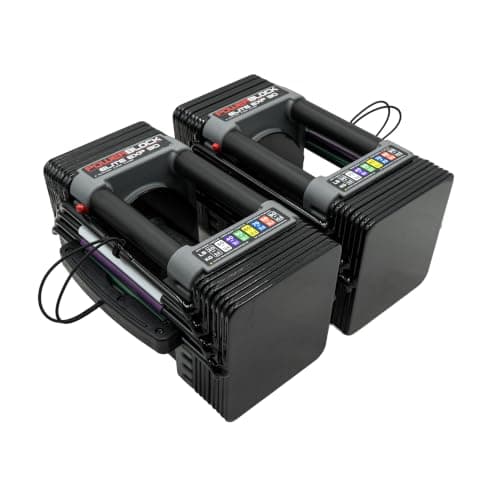
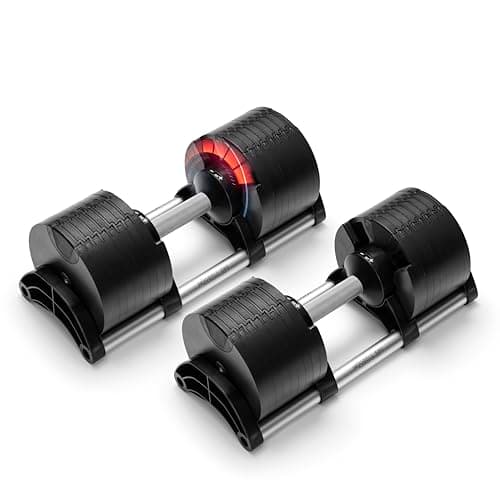
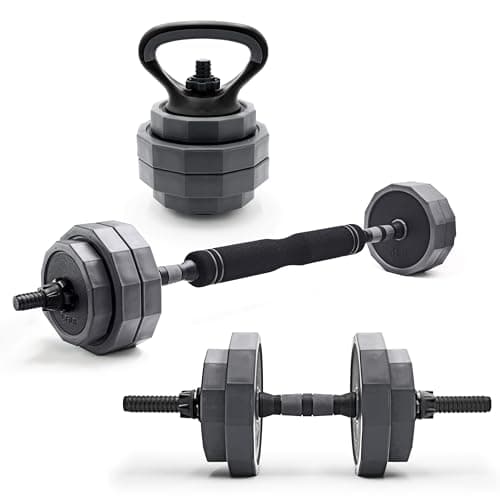
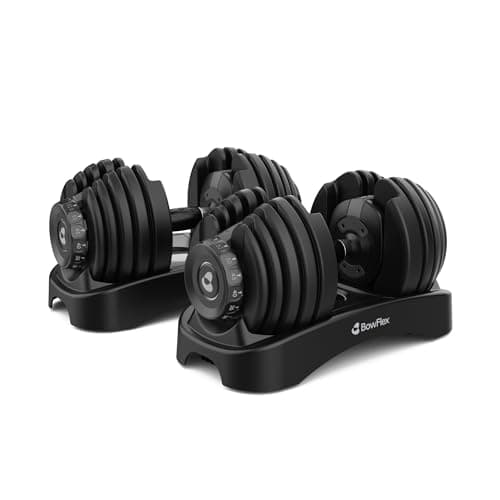
Buy a dial if you change weight between sets and train on a floor you will not drop anything on — the Bowflex SelectTech 552 is the pick, with 15 settings from 5 to 52.5 lb per hand and 2.5 lb steps up to 25 lb, which is the finest granularity in this category. Buy a selector pin if floor space or durability is the binding constraint: the PowerBlock Elite EXP is about 12 by 6 inches per hand, has almost no plastic in the load path, and takes expansion kits to 70 or 90 lb without a second purchase. Buy spinlock collars only if budget rules and you accept the friction — the CAP 66 lb set is a third the price and converts into a barbell or a kettlebell, and it will slow every weight change you make.
This site already runs the brand fights — Bowflex versus PowerBlock, Nuobell versus Bowflex and PowerBlock versus Nuobell. Every one of those pages is, underneath, an argument about the mechanism, so this page separates it out. If you know which mechanism you want, the main ranking will pick the model.
The three mechanisms, mechanically
A dial keeps a stack of plates in a cradle and uses a selector at one or both ends of the handle. Turn it and the handle picks up the plates it is pointed at; lift and the rest stay behind. Bowflex uses a dial at each end; Nuobell uses a twist of the handle itself inside the cradle. One motion per dumbbell, and the weight you selected is the weight you lift.
A selector pin is the PowerBlock approach: nested rectangular shells with a pin that drops through the stack at the depth you want. Pull the pin, move it down a hole, push it back. The shape is the consequence — a block rather than a cylinder, which is why it is the shortest adjustable in our registry at every weight.
Spinlock collars are the oldest mechanism in the building: a threaded bar, loose plates, and a collar you screw on at each end. Nothing is clever and nothing is proprietary. The CAP set adds four double safety collars on top of the two spinlocks, which is more secure and also more to undo.
How the four compare
| Model | Mechanism | Range per hand | Increments | Actions per change | Published footprint |
|---|
| Bowflex SelectTech 552 | Dial at each end | 5-52.5 lb (15 settings) | 2.5 lb to 25 lb, then 5 lb | One dial turn per end | 16.9 x 8.3 in each |
| PowerBlock Elite EXP | Selector pin | 5-50 lb; 70 or 90 lb with kits | Stepped; 2.5 lb needs adder weights | One pin move | About 12 x 6 in each |
| Nuobell 580 | Twist handle in cradle | 5-80 lb | 5 lb steps only | One handle twist | Not published; shorter body at heavy loads |
| CAP 66 lb set | Spinlock collars | Up to about 33 lb per hand (66 lb total) | 5 lb and 2.75 lb plates | Unscrew, swap plates, re-screw, both ends | Not published; stores as a pile |
The actions column is the one people underestimate. A dial or a pin keeps a weight change inside a normal rest period. Spinlock collars turn it into a job — our card for the CAP set says so in its own words, because that friction is what stops home training more often than any missing feature. Prices on all four cards come from our live price layer with the as-of date beside them; we do not type prices into prose.
What fails first, by mechanism
This is the part the brand comparisons skip. Dials fail at the plastic: the tray and selector parts are the components that crack if a dumbbell is dropped on a hard floor, and the plates themselves are not rated for drops. Selector pinshave the least to break — the PowerBlock's load path is essentially metal, and the common complaint is the grip shape rather than a failure. Spinlock collarsdo not really fail; they loosen, which is a different and more immediate problem. Check them every set, and use the safety collars the set comes with.
None of these is a drop-tolerant tool. If you bail reps, read can you drop adjustable dumbbells before you spend anything — the honest answer there applies to all three mechanisms, and a mat is not a substitute for setting the weight down.
Handle length is a mechanism problem, not a brand problem
A dial dumbbell carries the full plate stack in its cradle, so the handle assembly is the length of its heaviest setting even when you have selected 10 lb. On the Bowflex 552 that is a published 16.9 inches per dumbbell at every weight. In practice this matters in two places: pressing on a narrow bench, where long dumbbells clash near the top, and any movement where the ends come close to your torso.
A selector-pin block is shorter at every weight — about 12 inches on the PowerBlock — which is the real reason it keeps winning our space-constrained recommendations. The Nuobell sits between the two: a twist-handle body that is shorter than most dials at heavy loads, which is what you are paying its premium for. Spinlock bars are as long as the bar you bought, regardless of load. If a narrow bench is part of your setup, this paragraph outranks the price column — our bench ranking has the pad widths.
Increment granularity, and who it actually matters to
The Bowflex's 2.5 lb steps to 25 lb are the finest in this group, and that matters for small-muscle work where a 5 lb jump is a 20% increase. The Nuobell moves in 5 lb steps throughout — a real limitation at the light end and irrelevant at the heavy end. PowerBlock gets to 2.5 lb jumps only with adder weights, which are a separate purchase, and the CAP set gives you 2.75 lb plates that can go on one end at a time if you are willing to do the arithmetic.
If you are starting out and will spend a year under 30 lb per hand, granularity is the spec to buy on. If you already press 50 lb, ceiling matters more and the heaviest adjustables page is the better list.
Choose by the constraint that actually binds
- Narrow bench or tight floor plan? Selector pin. The block shape is shorter at every weight and that is a geometry fact, not a preference.
- Change weight between every set? Dial. One motion, inside a rest period.
- Train to 60 lb or beyond per hand? Twist-handle at 80 lb, or a PowerBlock with the 90 lb expansion kit. Dial models in our registry stop at 52.5 lb and there is no heavier version of that model.
- Budget is the whole decision? Spinlock, and go in knowing the friction is real. Our under-$300 ranking has the cheaper dial options if you would rather save differently.
- Hard floor, no mat, and you occasionally drop? None of these. Fixed hex dumbbells are the honest answer, and adjustable versus fixed makes that case properly.
The one thing all three mechanisms share
They all store in the footprint of one pair, which is the entire reason this category exists. Fifteen pairs of fixed dumbbells is a rack; one pair of adjustables is a cradle on the floor. If storage is the problem you are solving, that is the win, and our dumbbell storage guide covers where the cradle actually goes.
What a mechanism cannot fix
The weight ceiling. Every adjustable has one, and no mechanism changes that you will reach it eventually if you keep training — 33 lb per hand on the CAP set, 50 on the PowerBlock without kits, 52.5 on the Bowflex, 80 on the Nuobell. When the ceiling arrives, the next step is a barbell and a rack rather than a heavier pair, and the dumbbells versus barbell page is the arithmetic on that fork.
No tests, no ratings we made up
Everything above comes from published specifications, manufacturer documentation and the mechanical consequence of how each mechanism is built. We have not timed a weight change, we have not dropped a dumbbell to see what breaks, and we are not going to pretend otherwise — our methodology page states exactly what our scores are and are not.