Skip to content
RACK:RATIO

HUB 05 · Cable, All-in-One & Power Towers

All-in-One Home Gym Buying Guide

Resistance type decides the feel, the footprint decides whether you keep it. The three things to settle before you buy a single-frame gym.

By Stephen V.Reviewed How we research
#ad

We earn a commission when you buy through our Amazon links, at no extra cost to you. It never changes our rankings, and we say so when the cheaper product is the better buy. How this works.

Choose an all-in-one home gym on resistance type first, footprint second, and station count last. Rod resistance is the quietest and most self-contained but feels least like a barbell; a selectorized stack feels most like a commercial machine but is a heavy permanent fixture; plate-loaded is the cheapest and most expandable but you supply and store the iron. Expect a good one to cover most of the machine work you would do in a commercial gym — pressing, pulling and isolation — and none of the free-weight barbell work.

The appeal of an all-in-one is simple: the resistance travels with the machine. There is no rack of plates lining the wall, nothing to drop on a floor a neighbor lives under, and no assembling a gym one purchase at a time. For a small space that is a real advantage, and it is why these machines have outlasted a lot of fitness trends. The cost is that you are buying one fixed set of movement paths, and you should know exactly what those are before the box arrives.

Resistance type: the decision that decides everything else

Rod resistance uses composite rods that bend to create load. It is nearly silent, there is nothing to drop, the weight stores itself inside the machine, and the whole unit is lighter than the alternatives. The trade-offs are honest ones: the resistance curve rises as the rod bends further, so the load feels different through the range compared with a barbell, and there is a ceiling on how heavy you can go. For an apartment lifter who cares about noise and floor loading, that is often a very good deal.

Selectorized stacks are the pin-select towers you know from a commercial gym. You move a pin, you get that weight, and the load stays even throughout the movement because it is just gravity acting on a stack of plates. It feels the most familiar and it changes weight fastest. It is also the heaviest and least movable option, it never folds, and the stack sets a hard ceiling on how heavy you can ever go on that machine. If you want the most gym-like feel in a corner and you can commit that corner for good, this is the format.

Plate-loaded machines have no built-in weight at all — you hang standard plates on loading pins. They are the cheapest for a given frame quality and the most expandable, since the ceiling is however much iron you own. But they are slow to change between exercises, and the real footprint includes plate storage, which quietly undoes some of the space you thought you were saving. Most compact cable stations use this format, which we cover in our compact cable machine roundup.

Footprint: measure the working area, not the machine

The dimensions on a listing describe the frame. What you actually need is the frame plus the space you occupy while using it — the bench travel, the seat pull-back, the room to stand and press. That working area is usually noticeably larger than the frame footprint, and it is the number that determines whether the machine is livable. Measure it in your actual room, mark it on the floor with tape, and walk around it for a day before you order.

Then accept the second truth: almost none of these fold. "All-in-one" and "stows away" are rarely the same machine. If the floor has to come back every evening, a folding rack plus adjustable dumbbells reclaims more space than any single-frame gym will, and a power tower claims the smallest permanent square of anything in this category.

How much of a real gym do they replace?

Honestly: most of the machine work, and none of the barbell work. A good all-in-one covers chest press, lat pulldown, rows, leg extension and curl, plus a pulley for arms and shoulders. That is a large fraction of what most people actually do in a commercial gym, and if it is the fraction you use, the machine replaces the membership. What it will not do is a loaded back squat, a deadlift or a barbell bench — the lifts where a bar sits on your body and you have to stabilize it. It also has a resistance ceiling that a barbell does not, so strong lifters outgrow the pressing stations before they outgrow the pulling ones. If that trade is worth weighing against the alternative, our home gym vs gym membership guide runs the comparison, and the ranked picks live in our best all-in-one home gyms roundup.

What we can't tell you

We have not put these machines through a lab — we do not have one. Everything above comes from manufacturer specifications and how each resistance format works mechanically, which is enough to choose between formats but not enough to promise you how a specific rod or pulley will feel in your hands. The reliable rule stands regardless: the machine you use beats the machine that looks the most complete, and in a small room the one you resent for taking the floor is the one that stops getting used.
The short answer

Quick picks

#ProductBest forScorePrice
01
Bowflex Bowflex PR1000 Home Gym
Bowflex PR1000 Home Gym

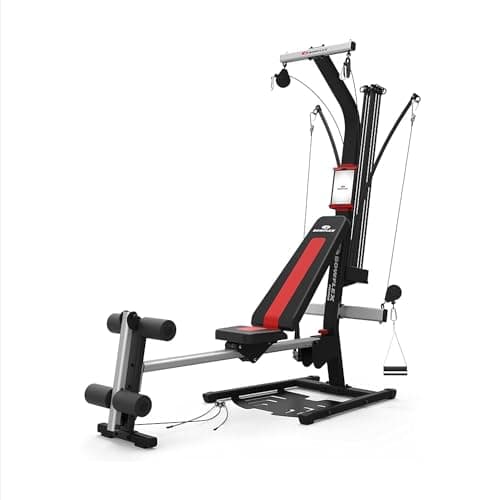
The classic apartment all-in-one: Bowflex's Power Rod resistance means no plates to store or drop, a rowing station folds into the mix, and the whole thing needs a defined but modest footprint. Quiet, self-contained resistance.

All-in-one, no loose weights
7.8
$795.04Amazon
02
Marcy Marcy MWM-988 Home Gym
Marcy MWM-988 Home Gym

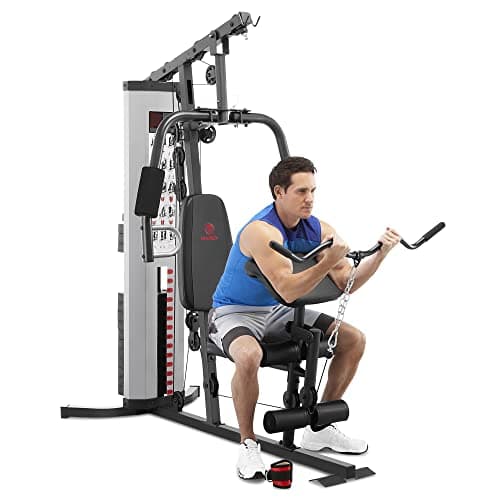
A 150 lb selectorized stack machine that puts a chest press, lat pulldown, leg developer and pulley work in one corner unit. Pick your weight with a pin — no loose plates — for classic multi-station training.

Selectorized stack in a corner
7.8
$499.99Amazon

#ad · Live prices from the Amazon Product API, as of Sep 9, 2026. Where we have no verified live price, we show none — we would rather leave a gap than print a number that has rotted.

In detail

The picks, in full

01
Bowflex Bowflex PR1000 Home Gym

All-in-one, no loose weights

Bowflex PR1000 Home Gym

Power Rod resistanceNo platesRowing stationFolds partly
7.8/10

The classic apartment all-in-one: Bowflex's Power Rod resistance means no plates to store or drop, a rowing station folds into the mix, and the whole thing needs a defined but modest footprint. Quiet, self-contained resistance.

Good

  • No plates to store, buy or drop on the floor
  • Rowing station adds cardio to a strength unit
  • Quiet — ideal for apartments

Trade-offs

  • Rod resistance feels different from free weights
  • Occupies a defined area even if it doesn't fully fold
Fit
7
Value
8
Install
9
Build
7

Skip this if…

you want a barbell-style free-weight feel or plan to lift genuinely heavy — rod resistance tops out and doesn't replicate a bar.

Spec sheet

Type
All-in-one home gym (rod resistance)
Resistance
Up to 210 lb Power Rods (no plates)
Footprint
Defined workout area needed
Install / renter
Freestanding — no drilling
Noise / floor
Low — nothing to drop
Ceiling needed
Standard room height
$795.04View on Amazon

Price as of Sep 9, 2026. Prices change — Amazon's is the one that counts.

#ad · we may earn a commission from this link to Bowflex PR1000 Home Gym

02
Marcy Marcy MWM-988 Home Gym

Selectorized stack in a corner

Marcy MWM-988 Home Gym

150 lb stackMulti-stationPin-selectCorner unit
7.8/10

A 150 lb selectorized stack machine that puts a chest press, lat pulldown, leg developer and pulley work in one corner unit. Pick your weight with a pin — no loose plates — for classic multi-station training.

Good

  • Pin-select stack — change weight in a second, no plates
  • Several stations in one machine
  • Enclosed stack is quiet and safe

Trade-offs

  • Doesn't fold — permanent footprint
  • 150 lb ceiling limits heavy pressing
Fit
6
Value
8
Install
9
Build
8

Skip this if…

you need to clear the space daily — this is a fixed installation, not a fold-away.

Spec sheet

Type
Selectorized multi-station gym
Resistance
150 lb weight stack (pin-select)
Footprint
Corner unit — fixed footprint
Install / renter
Freestanding — no drilling
Noise / floor
Low — stack, nothing dropped
Ceiling needed
Standard — includes high pulley
$499.99View on Amazon

Price as of Sep 9, 2026. Prices change — Amazon's is the one that counts.

#ad · we may earn a commission from this link to Marcy MWM-988 Home Gym

How we picked

We don't run a testing lab

We compiled published specifications, manufacturer documentation and aggregated owner reviews, then scored each product against a published rubric that weights fit-for-small-space, value, install reversibility and build. The scores are judgments from documented research — they are notmeasurements we took, because we don't have a lab and we're not going to pretend we do. Every dimension is cited in Sources.

Questions

Frequently asked

Are all-in-one home gyms worth it?
They are worth it if you want a self-contained setup with no loose plates and you can commit a defined footprint to it permanently. They are poor value if you need the space back daily, or if barbell lifting is your goal, since none of them replicate a free bar. Match the machine to the training you will actually do rather than to the station list on the box.
Power Rod resistance vs a weight stack — which is better?
Neither is better; they solve different problems. Rods are quieter, lighter and store their own resistance, with a load that changes through the range. A stack feels like a commercial machine and changes weight instantly, at the cost of a heavy, permanent fixture. Pick rods for apartments and portability, a stack for familiarity and feel.
How much space do I need for an all-in-one home gym?
More than the frame dimensions suggest. Add the bench travel and the room you need to stand, sit and pull around the machine — that working area is the real requirement. Tape the outline on your floor before ordering and live with it for a day. It is the cheapest way to avoid a return that costs you shipping on something very heavy.
Do all-in-one home gyms fold up?
Very few do in any meaningful sense. Some fold a bench or a leg station, but the frame itself stays where you put it. If reclaimable floor is your priority, a folding wall rack or a set of adjustable dumbbells will serve you better than any single-frame gym, and a power tower is the smallest permanent footprint in the machine category.
Can you get strong on an all-in-one home gym?
Yes, up to the machine's resistance ceiling, which most beginners and intermediates will not reach quickly on the pulling stations. Pressing is where people top out first. Beyond that point you either add free weights alongside the machine or move to barbell training — which is why many small-space lifters pair a machine with adjustable dumbbells from the start.
Are all-in-one home gyms quiet enough for an apartment?
Generally yes, and that is one of their real strengths. Rod resistance is close to silent, and a selectorized stack makes a soft clack when the plates return rather than the crash of dropped weight. Nothing gets dropped on the floor, which is the noise that actually travels through a building. A mat under the frame handles the rest.

Keep reading

Receipts

Sources

We don't run a testing lab, and we don't pretend to. Every dimension and rating traces to a manufacturer spec sheet or manual, named and linked above. Where a maker doesn't publish a number, the spec reads "Not published" rather than a guess. Read our full method.