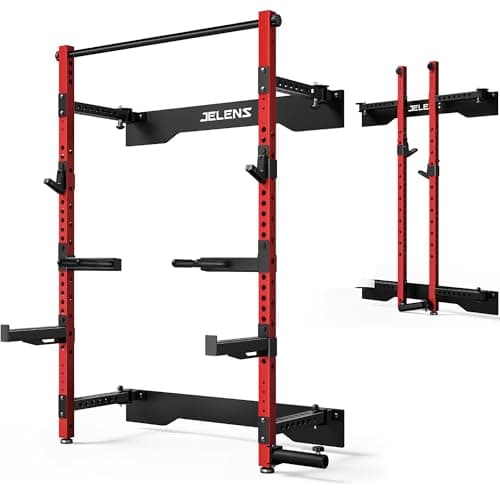
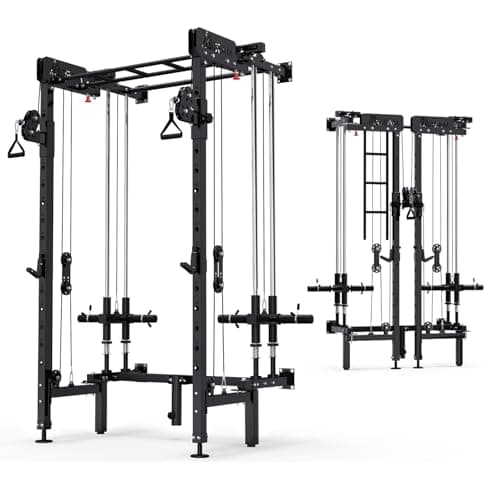
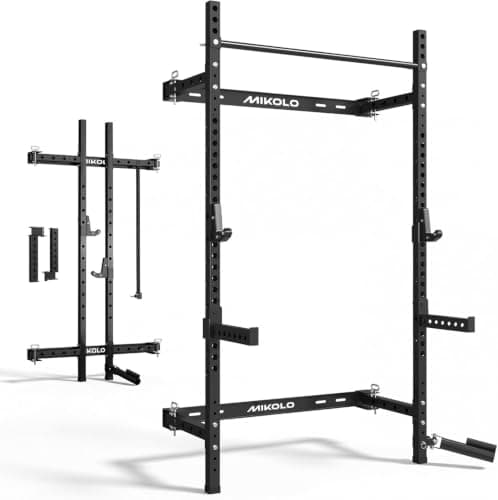
A folding squat rack is worth it when the room it lives in has to be something else the rest of the time — a bedroom, a living room, a garage you park in — and when you can bolt into studs. In that situation it is the single best small-space purchase in strength training. It is not worth it if the rack has a permanent corner anyway, because then you are paying for a hinge you never use; and it is the wrong answer entirely if you cannot drill, because every real folding rack is stud-mounted.
We answer this question more carefully than most because it is the purchase this site was built around, and because “worth it” has a specific meaning here: not whether the rack is good, but whether the fold — the thing you pay extra for over a fixed rack — earns its money in your room. That depends on four things, and they are the four things to check before you buy.
Check one: does the floor have a second job?
This is the whole case. A folding wall rack collapses to a few inches of depth, so the floor in front of it goes back to being floor. If that floor is where the car parks, where the bed is, where you walk to the kitchen, the fold is worth every dollar. If the rack is going into a corner that will only ever be a rack corner, a freestanding cage is the better buy: no drilling, catch bars on four posts, and the same money spent on steel instead of a hinge.
Be honest about whether you will actually fold it. Folding takes a minute — remove the bar, pull the pins, swing the uprights in — and if a minute is a barrier the rack will stay open and the hinge will be decoration. People who fold theirs daily are the ones whose room genuinely needs it.
Check two: can you drill into studs?
Every folding wall rack we rank bolts into wall framing with lag bolts. Not drywall anchors, not a stringer you improvise — studs, located and drilled. If you rent, that is a landlord conversation, and the answer is often yes for a patchable set of holes; our installation guide covers how to ask and how to make good on move-out. If the answer is no, stop here: the fold-flat rack does not exist in a no-drill version. The no-drill rack is a freestanding stand, which breaks apart rather than folds and gives up stability to do it.
Check three: are the studs where the rack needs to be?
The rack's uprights bolt at a fixed spacing, and the studs in your wall are at whatever spacing the builder used. Most racks are designed around common stud spacing, but corners, windows and closets interrupt it, and a rack that lands on one stud and one gap is not installed. Find the studs first, then check the rack's mounting width on the listing, then buy. The wall also has to be long enough for the folded rack plus the bar, which is longer than most people expect.
Check four: the ceiling, unfolded
A folding rack with a pull-up bar needs the ceiling a pull-up bar needs. Folded, the rack is short; unfolded, the uprights are full height and the bar is above them. In a basement or a garage with a low beam that can be the constraint that decides, and squat racks for low ceilings is where to go if yours is under eight feet.
The renter's third answer: no rack
If you cannot drill and cannot spare a permanent corner, the honest answer is often to not buy a rack at all. A landmine pins one end of a bar to the floor and gives you pressing, rowing and squatting patterns without a rack or a ceiling; a pair of adjustable dumbbells and a folding bench cover most of a strength program on a shelf and a wall. That kit costs less than a rack, needs no holes, and moves out in one trip. The barbell back squat and the heavy bench press are what you give up, and for a lot of apartment lifters that is a trade worth naming rather than avoiding.
What to look for if the answer is yes
- A published rated load. Some folding racks publish one, some do not. A number on the listing is worth paying for if you lift heavy.
- Safeties in the box. Catch bars are what make a rack safe to squat in alone. If the listing does not show them, budget for them.
- What else it does. A pull-up bar is common; a landmine mount or a pulley turns one wall into most of a gym.
- The mounting width against your studs. The check above, in one line: measure first.
The three racks below are the folding racks we would put a bar in: one with a published 1,000 lb rating and everything in the box, one that gets the same fold for less, and one that adds a plate-loaded pulley so the rack is also the cable machine. Every one of them needs studs; none of them is the answer for a hard no on drilling.
Safety, briefly
The question after “worth it” is usually “is it safe,” and the short version is that a folding wall rack anchored correctly into studs is as safe as the wall it is bolted to. The failure modes are a bad install, drywall anchors and ignoring the rated load — not the hinge. We wrote are wall-mounted squat racks safe and how much weight can a wall-mounted rack hold as the long versions.
Cost against the alternatives
We do not type prices into copy — the cards carry the live numbers — but the shape of the comparison is stable: the folding racks we rank sit in the same band as a budget freestanding cage and well under a premium fixed rack. So the fold is not a premium feature at this end of the market; you are not paying much for the hinge. What you are paying for is the install, in time and in the landlord conversation, and that is the cost to weigh. Our squat racks under $500 roundup puts the folding and freestanding options side by side at the same cap.
When people regret buying one
- They never fold it. The rack had a corner all along, and a cage would have been steadier for the same money.
- The studs were wrong. The rack arrived, the wall did not cooperate, and it went back or got mounted somewhere worse.
- They wanted to drop the bar. A folding rack in an apartment is a controlled-lowering rack. If your training involves dropping a loaded bar, that is a platform and a garage, not a wall in a rented bedroom — lifting in an apartment without annoying neighbors is the honest read.
- The ceiling was too low. The pull-up bar was the reason to buy it, and it did not fit.
None of those is a flaw in the rack. All of them are a mismatch between the rack and the room, which is exactly why this page is four checks and not a verdict.