Skip to content
RACK:RATIO

HUB 01 · Compact Racks & Squat Stands

Squat Racks for Low Ceilings

A power cage is about 84 inches tall. A finished basement is often 84 inches tall. That is the entire problem, and it has three real solutions.

By Stephen V.Reviewed How we research
#ad

We earn a commission when you buy through our Amazon links, at no extra cost to you. It never changes our rankings, and we say so when the cheaper product is the better buy. How this works.

Under a low ceiling, buy a squat stand or a folding wall rack, not a power cage. Most cages are 82 to 84 inches tall because of the overhead pull-up bar, and a finished basement is frequently 84 inches or less. A stand has no overhead bar, so it fits where a cage cannot — and you can add pull-ups separately at door height.

Low ceilings are the constraint nobody writes about, because the people writing rack reviews train in garages with 9-foot ceilings. But a huge share of home gyms live in finished basements, converted attics, and 1970s apartments — rooms where the ceiling is genuinely 7 feet or a little under. In those rooms the usual advice, "buy the cage, it is safer," is not conservative advice. It is advice to buy something that does not fit.

This guide runs the actual numbers: what height a rack needs, what height your lifts need, and which of those two is the binding constraint. Then it covers the three rack types that work in a short room, with picks for each. The short version is that you can absolutely train a barbell under a 7-foot ceiling — you just cannot do it under a pull-up bar.

The height math, in order

Work through these four numbers in this sequence. The first one that fails is your answer.

What needs the heightTypical requirementFails when
Power cage frame with pull-up barAbout 82–84 inCeiling under about 7 ft 6 in
Standing overhead press, bar overheadYour height + about 24 inCeiling under about 7 ft 6 in for a 6 ft lifter
Squat rack uprights (no overhead bar)About 60–72 inAlmost never — this is why stands win
Racking a bar at shoulder heightAbout 48–56 inNever in a habitable room

Notice which row fails first. It is not squatting — the bar sits on your back, well under five feet, and no ceiling in a room a person can stand in interferes with that. It is the pull-up bar and the overhead press. Those two are what a low ceiling actually takes from you, and both have workarounds.

Measure this, not the room

Measure floor to ceiling at the exact spot the rack will stand, then subtract the thickness of whatever flooring you are putting down — half-inch mats are half an inch of ceiling you no longer have. In a basement, also check for the lowest obstruction in the rack's footprint: ducting, a soffit, a joist that drops below the rest of the ceiling, a light fixture. Basements are rarely flat overhead, and the duct run is usually exactly where you wanted to squat.

The short answer

Quick picks

#ProductBest forScorePrice
01
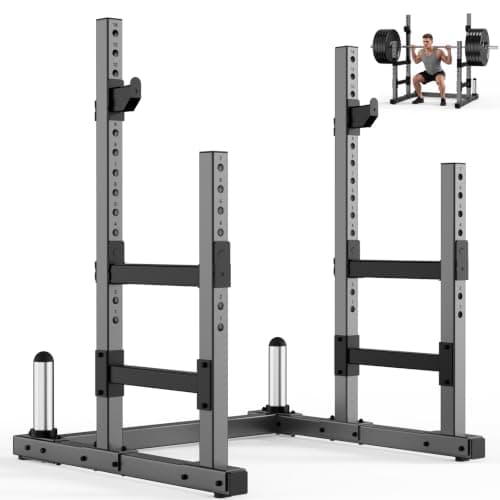
PASYOU PASYOU Adjustable Squat Rack Stand
PASYOU Adjustable Squat Rack Stand

Two independent freestanding uprights you can set to any width, then move or store when done — no wall, no drilling, no landlord conversation. The rack for people who can't put a hole in anything.

Renters who can't drill
8.0
$209.99Amazon
02
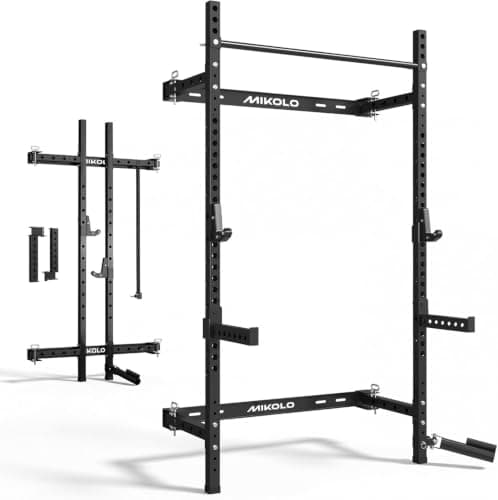
Mikolo Mikolo Folding Wall-Mounted Squat Rack
Mikolo Folding Wall-Mounted Squat Rack

The small-space rack answer: it bolts to your studs and folds flat against the wall when you're done, giving the whole floor back. 1,000 lb rated with safeties, a pull-up bar and J-hooks — a real rack that disappears.

Reclaiming the floor completely
8.0
$279.99Amazon
03
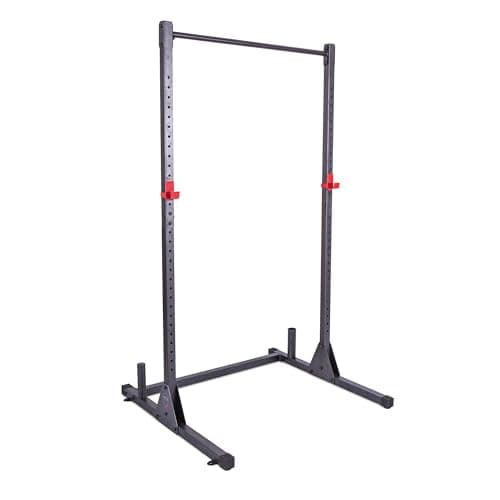
CAP Barbell CAP Barbell Power Rack with Pull-Up Bar
CAP Barbell Power Rack with Pull-Up Bar

The budget way into an enclosed rack: catch bars, a pull-up bar and safety pins for a fraction of what a premium cage costs. The steel is lighter than pricier cages, but the safety geometry is the part that matters most for a solo lifter.

Cheapest real cage
7.8
$119.99Amazon

#ad · Live prices from the Amazon Product API, as of Sep 9, 2026. Where we have no verified live price, we show none — we would rather leave a gap than print a number that has rotted.

In detail

The picks, in full

01
PASYOU PASYOU Adjustable Squat Rack Stand

Renters who can't drill

PASYOU Adjustable Squat Rack Stand

FreestandingNo installAdjustable heightMoveable
8.0/10

Two independent freestanding uprights you can set to any width, then move or store when done — no wall, no drilling, no landlord conversation. The rack for people who can't put a hole in anything.

Good

  • Zero install — the true renter rack
  • Set to any rack width
  • Can be moved out of the way or stored

Trade-offs

  • Less stable than a bolted or four-post cage
  • No built-in pull-up bar or safeties
Fit
8
Value
8
Install
10
Build
6

Skip this if…

you lift heavy and want the security of a full cage with catch bars — freestanding stands are less forgiving of a failed rep.

Spec sheet

Type
Freestanding squat stand (pair)
Folded depth
Uprights move / store apart
Rated load
Not published — confirm on listing
Install / renter
Freestanding — no drilling, renter-safe
Ceiling needed
Standard — no overhead bar
Unit weight
Moderate — two separate posts
$209.99View on Amazon

$219.995% off

Price as of Sep 9, 2026. Prices change — Amazon's is the one that counts.

#ad · we may earn a commission from this link to PASYOU Adjustable Squat Rack Stand

02
Mikolo Mikolo Folding Wall-Mounted Squat Rack

Reclaiming the floor completely

Mikolo Folding Wall-Mounted Squat Rack

Folds flat to wall1,000 lb rated2×2 uprightsPull-up bar
8.0/10

The small-space rack answer: it bolts to your studs and folds flat against the wall when you're done, giving the whole floor back. 1,000 lb rated with safeties, a pull-up bar and J-hooks — a real rack that disappears.

Good

  • Folds flat — the floor is fully usable between sessions
  • 1,000 lb rating is real rack territory, not a stand
  • Comes with safeties and a pull-up bar

Trade-offs

  • Must bolt into studs — not for renters who can't drill
  • Fixed to one wall location
Fit
10
Value
8
Install
5
Build
9

Skip this if…

you can't drill into the wall, or your studs aren't where you need the rack — a freestanding stand is your path instead.

Spec sheet

Type
Folding wall-mounted rack
Folded depth
Folds flat to the wall
Rated load
1,000 lb (per listing)
Install / renter
Wall-anchor (studs) — landlord OK needed
Ceiling needed
Not published — clears a pull-up bar
Includes
Safeties, J-hooks, pull-up bar, landmine
$279.99View on Amazon

$299.997% off

Price as of Sep 9, 2026. Prices change — Amazon's is the one that counts.

#ad · we may earn a commission from this link to Mikolo Folding Wall-Mounted Squat Rack

03
CAP Barbell CAP Barbell Power Rack with Pull-Up Bar

Cheapest real cage

CAP Barbell Power Rack with Pull-Up Bar

Budget cagePull-up barSafety catchesFreestanding
7.8/10

The budget way into an enclosed rack: catch bars, a pull-up bar and safety pins for a fraction of what a premium cage costs. The steel is lighter than pricier cages, but the safety geometry is the part that matters most for a solo lifter.

Good

  • By far the cheapest enclosed cage here
  • Catch bars make solo lifting safer
  • Simple, proven design from a long-standing brand

Trade-offs

  • Lighter gauge steel than premium cages
  • Published capacity is unclear — verify before loading heavy
Fit
6
Value
10
Install
9
Build
6

Skip this if…

you plan to load near four figures and want a published, warrantied capacity — spend up for a clearly rated cage.

Spec sheet

Type
Freestanding power rack
Folded depth
Does not fold
Rated load
Not published — confirm on listing
Install / renter
Freestanding — no drilling
Ceiling needed
Tall — includes pull-up bar
Includes
J-hooks, safety bars, pull-up bar
$119.99View on Amazon

Price as of Sep 9, 2026. Prices change — Amazon's is the one that counts.

#ad · we may earn a commission from this link to CAP Barbell Power Rack with Pull-Up Bar

Option one: a squat stand

Two independent uprights, typically 60 to 72 inches tall, with no overhead bar. This is the default answer for a low room and it is not a compromise on the lifts you can actually do there. You squat, you bench, you rack and unrack, and the ceiling is never in the conversation. The PASYOU stand above adjusts in height and comes apart entirely, which also makes it the pick for a room that has another job.

The honest downside is safety. A stand has no catch bars in the way a cage does, so if you train alone and push to failure you are managing that risk yourself. Our power rack versus squat stand comparison goes through exactly how to lift safely on a stand, and when it is genuinely not enough.

Option two: a folding wall rack

A wall-mounted folding rack bolts into studs at whatever height you choose, which is the detail that makes it interesting here — you set the top of the uprights, not the manufacturer. Many wall racks are sold at heights that suit a garage, but they mount lower if your studs and your ceiling say so, and the fold-flat depth means the floor comes back between sessions.

The catch is permission: this drills into structure, so it is an owner-or-permissive-lease option. If that is you, it is the strongest answer in a short basement, because you get catch bars — real ones — at a height that fits. Read are wall-mounted squat racks safe and our installation guide before you drill anything.

Option three: a short cage, if you measured

Some cages are shorter than the class average. The CAP rack above is the cheapest real cage we cover and it is worth measuring against your ceiling rather than assuming. If you have 84 inches or more of genuinely clear height and no ducting in the way, a cage remains the safest object here and you should take it. Below that, do not force it — a cage you cannot stand inside is not a safety device.

Getting pull-ups back

This is the loss people mind most, and it is the easiest to solve. A doorway pull-up bar hangs in a door frame, which in a low-ceiling room is the one place with guaranteed clearance, because the door is shorter than the ceiling by definition. It costs about thirty dollars and needs no drilling. Our doorway pull-up bar roundup ranks the no-drill options for renters.

You will have to bend your knees at the bottom of every rep. That is all. It is a smaller compromise than buying a cage that does not fit.

Getting overhead pressing back

Standing overhead press with a barbell needs your standing height plus roughly two feet of arm and bar travel, which is the second thing a 7-foot ceiling takes. Three genuine substitutes, in order of how close they get:

  • Seated overhead press. Sitting drops your shoulder height by roughly a foot and a half, which is usually more than enough. A bench with an upright back and a pair of dumbbells solves this completely.
  • Landmine press. The bar travels on an arc rather than straight up, so it never approaches the ceiling. It is also easier on shoulders that dislike a strict vertical path. See our landmine roundup.
  • Incline press. Not a substitute for overhead work, but it trains the same front-shoulder pattern at a fraction of the height.

The bar length problem that comes with it

Low-ceiling rooms are often small rooms, and a 7-foot barbell needs about 9 feet of clear wall to rack and unrack without knuckling the drywall. If that is also a constraint, a 6-foot Olympic bar takes the same plates and fits a narrower room — see best barbells for small spaces for the length math.
How we picked

We don't run a testing lab

We compiled published specifications, manufacturer documentation and aggregated owner reviews, then scored each product against a published rubric that weights fit-for-small-space, value, install reversibility and build. The scores are judgments from documented research — they are notmeasurements we took, because we don't have a lab and we're not going to pretend we do. Every dimension is cited in Sources.

Questions

Frequently asked

What is the minimum ceiling height for a squat rack?
For a squat stand with no overhead bar, about 6 ft 6 in is workable — the uprights are typically 60 to 72 inches and the bar sits on your back well below head height. For a power cage with an integrated pull-up bar, you need roughly 7 ft 6 in as a practical minimum, because most cages are 82 to 84 inches tall. Standing overhead press, not the rack, is usually the first thing a low ceiling takes away.
Can you squat in a basement with a 7-foot ceiling?
Yes. A back squat puts the bar below your shoulders, so a 7-foot ceiling has ample room for the lift itself even for a tall lifter. What a 7-foot ceiling removes is the overhead pull-up bar and the standing overhead press. Use a squat stand rather than a cage, add a doorway pull-up bar, and press seated or with a landmine.
Can you cut down a power rack to fit a low ceiling?
We would not, and we would not recommend it. Cutting an upright removes the manufacturer's rated load path, voids any warranty, and leaves an unfinished edge where the pull-up bar hardware was engineered to sit. Buy a rack designed for the height you have — a stand or an adjustable wall rack — rather than modifying one that was not.
Do I lose anything training under a low ceiling?
Two lifts, and both have close substitutes: standing overhead press becomes seated or landmine pressing, and bar pull-ups move to a doorway bar with bent knees. Squats, benching, rows, deadlifts, and every dumbbell movement are unaffected — none of them approaches the ceiling. It is a much smaller loss than it feels like when you first measure the room.

Keep reading

Receipts

Sources

We don't run a testing lab, and we don't pretend to. Every dimension and rating traces to a manufacturer spec sheet or manual, named and linked above. Where a maker doesn't publish a number, the spec reads "Not published" rather than a guess. Read our full method.