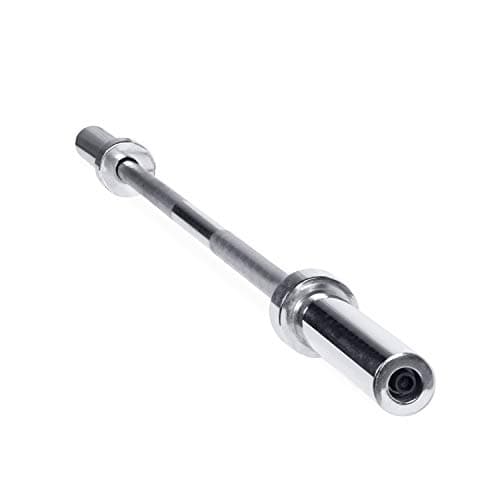
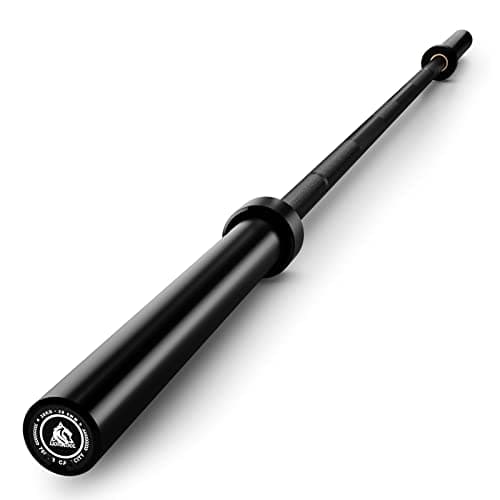
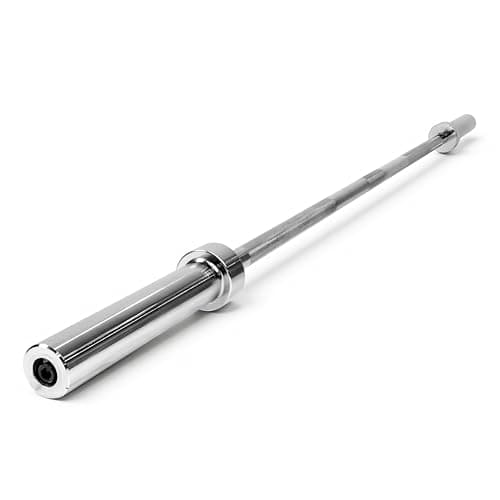
For most small rooms the right barbell is a 6-foot Olympic bar: it keeps the standard 2-inch sleeves and every plate you own, but it needs roughly a foot less clear wall than a competition bar and fits between narrow squat-stand uprights. The CAP 28 lb 6-footer is our pick for that job. Go to 5 feet if the room is under about 8 feet wide, and go to 7 feet only if you measured and it truly fits — length buys sleeve room and stability you cannot get back.
Barbell length is the most under-discussed dimension in home gym buying, and it is the one that quietly ruins small setups. Nobody tells you that a 7-foot bar does not need 7 feet of room — it needs the bar plus the space to walk it out of the rack, plus knuckle clearance at each end so you are not scraping drywall on every rep. In practice that is close to 9 feet of clear wall. Plenty of spare bedrooms are 10 by 11 feet, and once you put a rack against one wall the usable width is gone.
The good news is that shorter Olympic bars are real bars, not toys. A 6-foot bar has the same 2-inch sleeves, takes the same plates, and sits in the same J-hooks as its longer sibling. What you give up is sleeve length — the loadable part at each end — and some published capacity. For the loads most home lifters use, that trade is completely fine. Below the bars are ranked by which room each one belongs in.
How to pick a barbell length for your room
Measure the clear wall-to-wall width of where you will actually lift, then subtract the space occupied by your rack, bench, or anything else against the walls. What is left is your working width. Then apply this:
- Under 7 ft of working width: a 5-foot bar, and check that it still spans your uprights.
- 7 to 9 ft: a 6-foot bar. This is the sweet spot for apartment and spare-bedroom gyms and where most people should land.
- 9 ft and up: a 7-foot bar, and enjoy the sleeve room.
The rack-width trap
Here is the failure nobody warns about: a barbell must be longer than the distance between your rack uprights, with enough overhang to sit securely in the J-hooks. A 5-foot bar in a full-size power cage can end up barely spanning the hooks, which is not a comfort issue — it is how a bar gets dropped. If you own a cage, check the outside width of the uprights before you buy a short bar. If you own a folding rack or adjustable stands, you can usually set the width to suit the bar instead.
Sleeve length is the hidden cost of a short bar
Sleeve length is how much plate you can physically fit on each end. A shorter bar has shorter sleeves, and rubber bumper plates are thick, so a short bar plus bumpers fills up faster than the numbers suggest. If you are running a 5 or 6 foot bar, thin cast iron plates get meaningfully more weight onto the same sleeve — which is exactly the trade our weight plate guide covers.
Bar weight matters more than you think in a small setup
A competition bar is 45 lb before you add anything. The 6-foot CAP here is 28 lb and the 5-footer is 25 lb. For overhead pressing, for lighter lifters, and for anyone easing back into barbell work, a lighter bare bar is a feature: it makes the first working weight achievable instead of aspirational. It also means the bar itself is easier to move and store, which in a room that has a second job is not a small thing.
Where the bar lives when you are done
A barbell is 5 to 7 feet of steel that has to go somewhere, and leaning it in a corner is how bars get bent and walls get gouged. The two workable answers in a small space are a vertical bar holder in a corner, or horizontal wall hooks above head height. Both are covered in our small-space weight storage guide, alongside where the plates go.