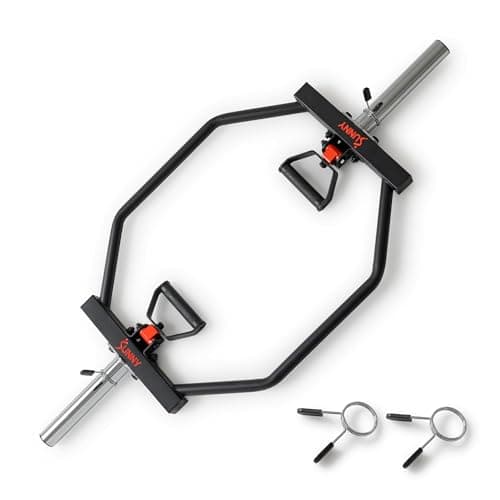
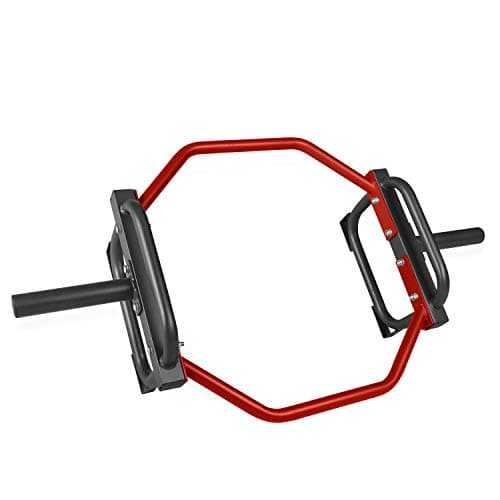
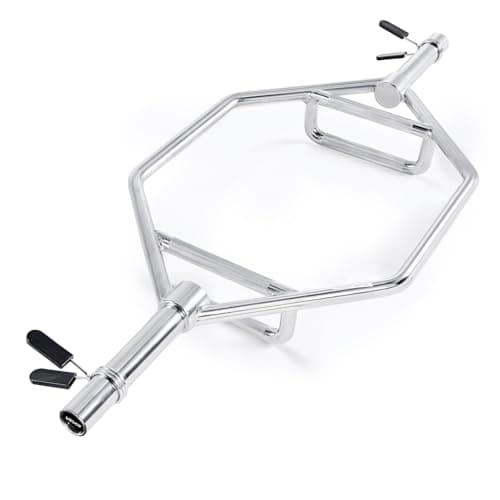
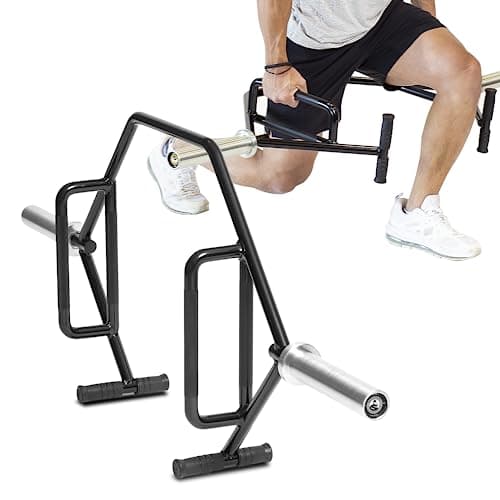
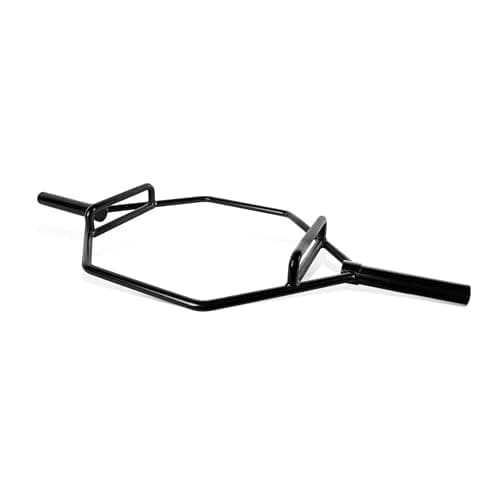
The CAP OBIS-89HB is our pick, because it is the cheapest bar here rated to 750 lb and the only budget bar with two grip heights — flip it over for a lower start — with a 25 in interior opening and 9 in loadable sleeves. The Sunny OB-TRAP is the one to buy if storage is the problem: 22 lb and 11 in sleeves, the lightest bar and the most loadable length on the page. The CAP OB-93RD is the shortest bar at about 50 in and the cheapest way in, as long as you do not own bumper plates. The VEVOR carries the highest published rating at 800 lb, and the Bells of Steel HB1 is the only open-ended frame, which is the one feature that lets you walk out of the bar and lunge.
A trap bar belongs on a small-space site for one reason that nothing else in the racks hub can match: it loads a heavy pull with no rack at all. A barbell squat needs uprights, and uprights need wall, ceiling and a permanent footprint — that is what our folding rack roundup and power rack versus squat stand pages exist to sort out. A hex bar sits on the floor, you step inside it, and the heaviest lift in a small gym happens with nothing bolted to anything. When you are done it leans against a wall.
The three numbers all called "size"
Trap bar listings are unusually careless about dimensions, and the three figures that matter get used interchangeably. They are not interchangeable:
- Overall length is the floor you must clear, end to end. On this page it runs from about 50 in to 59 in — a nine-inch spread, which in a narrow room is the difference between the bar sitting parallel to a wall and pointing at one.
- Interior opening is the space you stand in. CAP publishes 25 in on the combo-grip bar; most makers publish nothing. A narrow opening is a problem for a wide stance or a larger lifter, and it is the spec nobody thinks to check.
- Loadable sleeve length is how much plate actually fits. The spread here is 9 in to 11 in where it is published at all — and two of the five bars do not publish it, including the one with the highest capacity claim on the page.
That last gap is worth sitting with. A bar rated to 800 lb with an unpublished sleeve length is a rating you cannot verify you can reach, because eight hundred pounds of cast iron is a lot of plate and the sleeve is where it has to go. Where a maker does not publish the number, the Spec Blockbelow says "not published" rather than estimating from a photo.
One more listing artifact we flag instead of repeating: two of these five report an Amazon frame height of 0.1 in and 0.04 in. No hex bar is a tenth of an inch tall. Those are flat-pack data errors, and where the maker publishes a real figure — Bells of Steel states 4.8 in — we cite the maker and say which is which.
The five things we ranked on
- Overall length against a real room. This is a dimension-first site, so the shortest bar gets credit for being short. Fifty inches versus fifty-nine is a genuine difference in a spare bedroom.
- Bar weight, because you carry it. The spread here is 22 lb to 52 lb for objects that do the same job. The heavy bar is more stable under load; the light bar is the one you will actually put away rather than leave in the middle of the floor.
- Loadable sleeve length and plate compatibility. Bumper plates are thick and one bar here explicitly excludes them. If your plates are rubber, that single line decides the purchase before any other spec.
- Published capacity, read honestly.One maker says "500 lb suggested maximum" and one says "800 lb". Those are different kinds of statement and we print them in the makers' own words.
- Grip options. Two heights on one bar is the most useful feature a trap bar can have in a small gym, because it is the only adjustment the bar has — one bar gives you a high-handle start and a low-handle start without owning two bars.
How the five compare
| Bar | Length | Bar weight | Capacity | Loadable sleeve |
|---|
| CAP OBIS-89HB (combo grip) | 55.71 in | 52 lb | 750 lb | 9 in |
| Sunny OB-TRAP | 57.5 in | 22 lb | 400 lb | 11 in |
| CAP OB-93RD | 50.39 in | 28 lb | 500 lb suggested | 9.5 in |
| VEVOR 800 lb | 56.3 in | 22.71 lb | 800 lb | Not published |
| Bells of Steel HB1 (open) | 59 in | 47 lb | 700 lb | Not published |
Read the bar-weight column next to the capacity column and a pattern appears that the listings never mention: the two lightest bars carry the lowest and the highest ratings on the page. Bar weight tells you how the thing feels to carry and how much of your total comes free; it is not a proxy for how strong the frame is.
How to choose a trap bar for a small room
1. Measure the floor run first, then the walk-out
Lay a tape on the floor where the bar will actually sit and check you have the overall length plus about two feet at one end — you load plates from the side and you need to get past the sleeve to do it. Then check what is behind you when you stand up: a hex bar puts you inside the frame, so stepping out of it is part of every set. The practical minimum for the shortest bar here is a clear strip about five feet long and three feet wide, with room to stand up in. Our how much space do you need guide has the measuring method for the rest of the room, and garage corner home gym is the layout most trap bar owners end up with.
2. Decide where it goes between sessions, honestly
This is the spec nobody plans for and the reason trap bars end up living in the middle of a room. A 7 ft straight bar stands in a corner on its end; a hex bar does not — the frame is wide and the sleeves stick out, so your options are leaning it flat against a wall or hanging it on wall hooks. That makes bar weight a storage spec, not just a lifting one:
- Wall hooks. Practical with the 22 lb Sunny or the 22.71 lb VEVOR — most people can put those up one-handed. The 52 lb CAP combo bar at shoulder height at the end of a deadlift session is a different proposition.
- Leaned flat against a wall. Works with any of them, and costs you the wall rather than the floor. Measure the frame width, not the length: a 26 in wide bar leaning flat is a 26 in wide obstruction.
- Under a bed or a couch. Only plausible for the flat-profile bars, and only if you measure the gap first — the frame height figures on two of these listings are plainly wrong, so measure the bar when it arrives rather than trusting the field.
Our small-space weight storage guide covers wall-hook anchoring properly, and it is worth reading before you drill for a bar you are going to lift down twice a week.
3. Check your plates before anything else
Every bar here takes 2-inch Olympic plates — and the cheapest one, CAP's OB-93RD, explicitly states it is for cast iron plates and NOT for bumper plates. If your plates are rubber bumpers, that bar is out, full stop. The underlying issue is thickness: bumpers are far fatter per pound than cast iron, so a 9 in sleeve that holds five cast iron 45s might hold two bumpers. Our weight plate guide covers the trade, and in a small gym cast iron usually wins on sleeve length for exactly this reason.
4. Pick the grip height you will use, or buy both
A trap bar has one adjustment and it is the handles. "Combo grip" or "dual-height" bars have raised handles on one face and flush handles on the other, so flipping the bar changes where the pull starts: raised handles shorten the range of motion, flush handles lengthen it. In a small gym that is the closest thing you have to a rack with adjustable J-hooks, and it is why the dual-grip CAP bar is our pick over bars that cost more. The Sunny takes a different approach — fixed-height handles that swivel 360 degrees, which lets your wrists rotate under load instead of locking.
5. Protect the floor, and know what the neighbors hear
A loaded hex bar comes down on two plate stacks, which is the single heaviest point load most small gyms ever create. On a slab or a garage floor it is a non-issue. Anywhere above an occupied unit it is the whole question, and no mat makes a heavy drop quiet — what works is setting the bar down under control, onto a firm dense mat rather than soft foam. Read can your apartment floor hold a home gym before you buy plates to go with it, and lifting in an apartment for the honest version of what carries through a building. Our flooring guide covers what to put underneath.
6. What a trap bar does not replace
It is a pulling and carrying bar. Deadlifts, shrugs, farmer's carries, rows and — on the open-ended frame — lunges and split squats all work. What it cannot do is replace a rack: there is no version of a hex bar that lets you squat under load or bench, and if those are the lifts you want, a squat rack under $500 or a wall-mounted rack is the purchase and the trap bar is the accessory. It also will not press overhead from the floor the way a straight bar does; our barbell roundup covers the short and 6 ft bars that fit a small room if that is what you are missing. For the other end of the scale — load with no bar and no floor at all — see adjustable kettlebells and weighted vests.