Skip to content
RACK:RATIO

HUB 01 · Compact Racks & Squat Stands

Power Rack vs Squat Stand

One gives you catch bars and takes a permanent square of floor. The other gives the floor back and asks you to be careful. Here is how to pick.

By Stephen V.Reviewed How we research
#ad

We earn a commission when you buy through our Amazon links, at no extra cost to you. It never changes our rankings, and we say so when the cheaper product is the better buy. How this works.

Choose a power rack if you have a permanent square of floor roughly 4 ft by 4 ft and a ceiling near 8 ft, and you lift alone — the catch bars are the entire argument. Choose a squat stand if the room has to go back to being a room, or you cannot commit the floor. The stand is lighter, cheaper and movable; it is also less forgiving of a failed rep, and that trade is the whole decision.

This is the first real fork in a small-space strength build, and most of the advice written about it was written for a garage. In a garage, the answer is easy: buy the cage, it is safer, you have the room. In an apartment or a shared garage corner, the cage may not fit under the ceiling, may not fit through the door in one piece, and may not be a thing you are allowed to leave standing in the living room. So the question stops being "which is better" and becomes "which one can you actually own."

We rank both sides on the same four numbers we use everywhere on this site: the floor it holds when you are not lifting, the ceiling it needs, whether install is reversible, and what happens on the rep you fail. Below is the head-to-head, then the picks on each side — plus the folding wall rack, which is a genuine third answer people forget exists.

Head to head

FactorPower rack (cage)Squat stand
Floor held when idleIts full footprint, permanentlyTwo posts you can move or store
Ceiling neededTall — the pull-up bar sets the heightStandard — usually no overhead bar
Failed repCatch bars take the loadYou dump the bar, or you do not fail
InstallFreestanding, but assembly is a projectMinimal — often two pieces out of the box
Renter friendlyYes, but it is furniture you cannot hideYes, and it disappears into a closet
Pull-ups includedAlmost alwaysRarely
Typical priceHigher — you are buying four uprightsLower — you are buying two

The row that decides it for most people is the second one. A power cage is usually 82 to 84 inches tall before you stand on anything, and the pull-up bar lives at the top. An 8-foot ceiling clears it; a 7-foot 6-inch basement ceiling does not, and no amount of wanting it to work changes that. Measure before you shop — this is the single most common reason a rack gets returned. Our ceiling height guide runs the math for every lift, not just the rack.

The short answer

Quick picks

#ProductBest forScorePrice
01
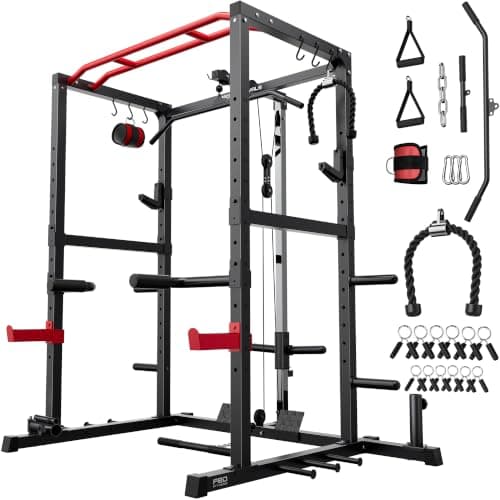
SPORTSROYALS SPORTSROYALS Squat Rack Power Cage with Lat Pulldown
SPORTSROYALS Squat Rack Power Cage with Lat Pulldown

A 1,200 lb-rated cage with a lat pulldown and low-row attachment built in, so one footprint covers squats, presses, pull-ups and cable back work. If you can commit a permanent square of floor, this is the most gym per square foot here.

Most capability per square foot
8.3
$319.99Amazon
02
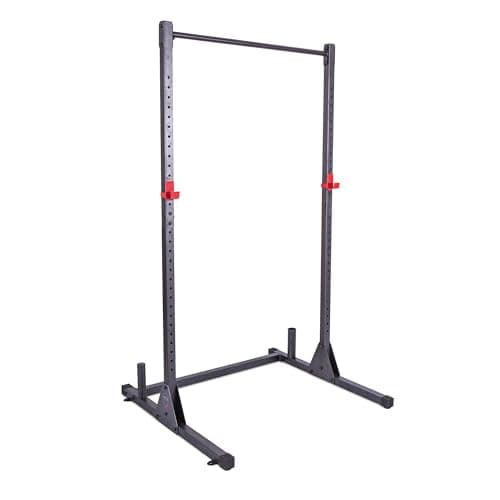
CAP Barbell CAP Barbell Power Rack with Pull-Up Bar
CAP Barbell Power Rack with Pull-Up Bar

The budget way into an enclosed rack: catch bars, a pull-up bar and safety pins for a fraction of what a premium cage costs. The steel is lighter than pricier cages, but the safety geometry is the part that matters most for a solo lifter.

Cheapest real cage
7.8
$119.99Amazon
03
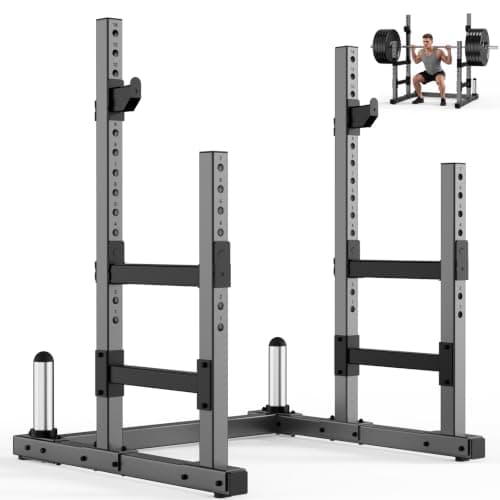
PASYOU PASYOU Adjustable Squat Rack Stand
PASYOU Adjustable Squat Rack Stand

Two independent freestanding uprights you can set to any width, then move or store when done — no wall, no drilling, no landlord conversation. The rack for people who can't put a hole in anything.

Renters who can't drill
8.0
$209.99Amazon
04
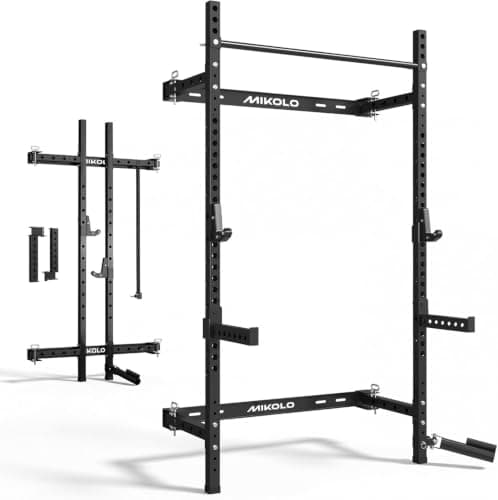
Mikolo Mikolo Folding Wall-Mounted Squat Rack
Mikolo Folding Wall-Mounted Squat Rack

The small-space rack answer: it bolts to your studs and folds flat against the wall when you're done, giving the whole floor back. 1,000 lb rated with safeties, a pull-up bar and J-hooks — a real rack that disappears.

Reclaiming the floor completely
8.0
$279.99Amazon

#ad · Live prices from the Amazon Product API, as of Sep 9, 2026. Where we have no verified live price, we show none — we would rather leave a gap than print a number that has rotted.

In detail

The picks, in full

01
SPORTSROYALS SPORTSROYALS Squat Rack Power Cage with Lat Pulldown

Most capability per square foot

SPORTSROYALS Squat Rack Power Cage with Lat Pulldown

1,200 lb ratedLat pulldown incl.Four-post cagePlate-loaded
8.3/10

A 1,200 lb-rated cage with a lat pulldown and low-row attachment built in, so one footprint covers squats, presses, pull-ups and cable back work. If you can commit a permanent square of floor, this is the most gym per square foot here.

Good

  • Cage safety plus cable work in one unit
  • 1,200 lb rating is well beyond home loads
  • No drilling despite being a full cage

Trade-offs

  • Owns its floor permanently — no fold
  • Needs real ceiling height for the pull-up bar
Fit
6
Value
9
Install
9
Build
9

Skip this if…

you need the floor back between sessions — a folding wall rack reclaims the space this one keeps for good.

Spec sheet

Type
Freestanding power cage + lat tower
Folded depth
Does not fold — permanent footprint
Rated load
1,200 lb (per listing)
Install / renter
Freestanding — no drilling
Ceiling needed
Tall — cage uprights + pull-up bar
Cable stack
Plate-loaded lat pulldown / low row
$319.99View on Amazon

$389.9918% off

Price as of Sep 9, 2026. Prices change — Amazon's is the one that counts.

#ad · we may earn a commission from this link to SPORTSROYALS Squat Rack Power Cage with Lat Pulldown

02
CAP Barbell CAP Barbell Power Rack with Pull-Up Bar

Cheapest real cage

CAP Barbell Power Rack with Pull-Up Bar

Budget cagePull-up barSafety catchesFreestanding
7.8/10

The budget way into an enclosed rack: catch bars, a pull-up bar and safety pins for a fraction of what a premium cage costs. The steel is lighter than pricier cages, but the safety geometry is the part that matters most for a solo lifter.

Good

  • By far the cheapest enclosed cage here
  • Catch bars make solo lifting safer
  • Simple, proven design from a long-standing brand

Trade-offs

  • Lighter gauge steel than premium cages
  • Published capacity is unclear — verify before loading heavy
Fit
6
Value
10
Install
9
Build
6

Skip this if…

you plan to load near four figures and want a published, warrantied capacity — spend up for a clearly rated cage.

Spec sheet

Type
Freestanding power rack
Folded depth
Does not fold
Rated load
Not published — confirm on listing
Install / renter
Freestanding — no drilling
Ceiling needed
Tall — includes pull-up bar
Includes
J-hooks, safety bars, pull-up bar
$119.99View on Amazon

Price as of Sep 9, 2026. Prices change — Amazon's is the one that counts.

#ad · we may earn a commission from this link to CAP Barbell Power Rack with Pull-Up Bar

03
PASYOU PASYOU Adjustable Squat Rack Stand

Renters who can't drill

PASYOU Adjustable Squat Rack Stand

FreestandingNo installAdjustable heightMoveable
8.0/10

Two independent freestanding uprights you can set to any width, then move or store when done — no wall, no drilling, no landlord conversation. The rack for people who can't put a hole in anything.

Good

  • Zero install — the true renter rack
  • Set to any rack width
  • Can be moved out of the way or stored

Trade-offs

  • Less stable than a bolted or four-post cage
  • No built-in pull-up bar or safeties
Fit
8
Value
8
Install
10
Build
6

Skip this if…

you lift heavy and want the security of a full cage with catch bars — freestanding stands are less forgiving of a failed rep.

Spec sheet

Type
Freestanding squat stand (pair)
Folded depth
Uprights move / store apart
Rated load
Not published — confirm on listing
Install / renter
Freestanding — no drilling, renter-safe
Ceiling needed
Standard — no overhead bar
Unit weight
Moderate — two separate posts
$209.99View on Amazon

$219.995% off

Price as of Sep 9, 2026. Prices change — Amazon's is the one that counts.

#ad · we may earn a commission from this link to PASYOU Adjustable Squat Rack Stand

04
Mikolo Mikolo Folding Wall-Mounted Squat Rack

Reclaiming the floor completely

Mikolo Folding Wall-Mounted Squat Rack

Folds flat to wall1,000 lb rated2×2 uprightsPull-up bar
8.0/10

The small-space rack answer: it bolts to your studs and folds flat against the wall when you're done, giving the whole floor back. 1,000 lb rated with safeties, a pull-up bar and J-hooks — a real rack that disappears.

Good

  • Folds flat — the floor is fully usable between sessions
  • 1,000 lb rating is real rack territory, not a stand
  • Comes with safeties and a pull-up bar

Trade-offs

  • Must bolt into studs — not for renters who can't drill
  • Fixed to one wall location
Fit
10
Value
8
Install
5
Build
9

Skip this if…

you can't drill into the wall, or your studs aren't where you need the rack — a freestanding stand is your path instead.

Spec sheet

Type
Folding wall-mounted rack
Folded depth
Folds flat to the wall
Rated load
1,000 lb (per listing)
Install / renter
Wall-anchor (studs) — landlord OK needed
Ceiling needed
Not published — clears a pull-up bar
Includes
Safeties, J-hooks, pull-up bar, landmine
$279.99View on Amazon

$299.997% off

Price as of Sep 9, 2026. Prices change — Amazon's is the one that counts.

#ad · we may earn a commission from this link to Mikolo Folding Wall-Mounted Squat Rack

When the cage is genuinely the right call

Buy the power rack if you train alone and take squats or bench presses close to failure. That is not a style preference — it is the difference between racking a missed rep on steel pins and being pinned under a loaded bar in a room where nobody is coming. Catch bars are the only piece of home gym equipment whose whole purpose is the rep that goes wrong, and nothing else on this page substitutes for them.

The second case for a cage is capability per square foot. A cage with a lat tower, like the SPORTSROYALS above, adds pulldowns and rows to the same footprint you were already giving up. If the floor is being surrendered anyway, surrender it to the unit that does the most. Our compact power rack roundup ranks the full field on exactly this.

When the stand wins, and it is not close

The stand wins whenever the room has a second job. A spare bedroom that is also an office, a living room that has to host people, a garage corner where a car parks at 6pm — in all three, a permanent 4-by-4 square of steel is not a piece of equipment, it is a decision about the room. Two independent uprights push against a wall, roll into a closet, or come apart entirely.

Stands also fit under low ceilings, because most of them have no overhead bar to clear. If your ceiling is under about 7 ft 6 in, the stand may be the only barbell option you have — and you can add pull-ups separately with a doorway bar for thirty dollars.

How to lift safely on a stand

The honest answer is that you change how you train, not just what you buy. Leave a rep or two in reserve on squats. Bench with dumbbells rather than a bar, or bench only inside a rack. Learn to dump a failed squat forward, and set up where a dumped bar has somewhere to land that is not your foot or a downstairs neighbor. If none of that sounds acceptable for how you train, that is your answer: you need the cage.

The third option most people skip

A folding wall-mounted rack is neither of these things and beats both in the right room. It bolts into studs, carries catch bars like a cage, and then folds to a few inches of depth so the floor comes back. The cost is a permission problem rather than a space problem: you have to be allowed to drill. If you own, or your lease allows anchors, read our wall-mounted rack roundup before you buy either of the freestanding options here — it may make this entire comparison moot.

Whichever side you land on, the floor underneath it matters. Cast iron on a bare floor is how you lose a security deposit — see our apartment flooring guide for what to put down first.

How we picked

We don't run a testing lab

We compiled published specifications, manufacturer documentation and aggregated owner reviews, then scored each product against a published rubric that weights fit-for-small-space, value, install reversibility and build. The scores are judgments from documented research — they are notmeasurements we took, because we don't have a lab and we're not going to pretend we do. Every dimension is cited in Sources.

Questions

Frequently asked

Is a squat stand safe enough to lift heavy on?
A squat stand is safe for heavy work if you never take a set to the point where you cannot complete the rep, and if you have somewhere to dump the bar if you do. What a stand cannot do is catch a bar for you. If you train alone and push to failure on squats or bench, the catch bars in a cage are doing a job the stand structurally cannot, and no technique fixes that.
How much floor space does a power rack actually need?
Plan for the rack's own footprint plus a walk-around margin — typically a square around 4 ft by 4 ft for the frame, and enough clearance behind it to load and unload plates. You also need to swing a barbell, which means roughly the bar's length plus a foot at each end, so a 7 ft bar wants about 9 ft of clear width. Our space requirements guide has the numbers for every piece.
Can you put a power rack in an apartment?
Yes — a power rack is freestanding, so it needs no drilling and nothing about it violates a standard lease. The real constraints are ceiling height for the pull-up bar, getting the uprights through the door, floor load once you add plates, and noise. All four are solvable; all four are worth checking before the box arrives. See can your floor hold a home gym.
Squat stand or folding wall rack for a renter?
If you cannot drill at all, the squat stand is your only option of the two — a wall rack is bolted into studs by definition. If your lease allows anchors with patching on move-out (many do, and it is worth asking), the folding wall rack is the better small-space object: it has catch bars like a cage and folds flatter than a stand stores.
Do I need a pull-up bar on my rack?
Not necessarily, and skipping it can solve a ceiling problem. A doorway pull-up bar costs around thirty dollars, needs no drilling, and hangs at door height rather than rack height — so in a room with a low ceiling, a squat stand plus a doorway bar gets you both movements where a cage gets you neither.

Keep reading

Receipts

Sources

We don't run a testing lab, and we don't pretend to. Every dimension and rating traces to a manufacturer spec sheet or manual, named and linked above. Where a maker doesn't publish a number, the spec reads "Not published" rather than a guess. Read our full method.