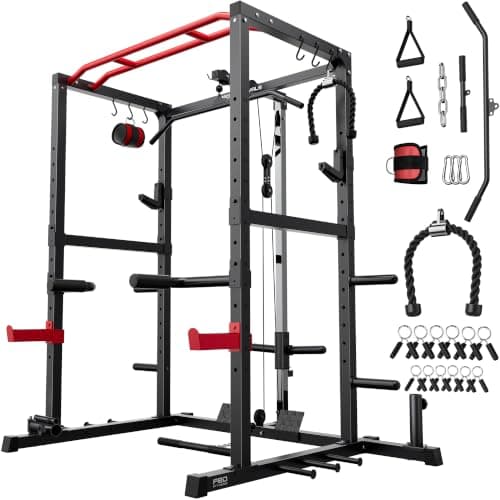
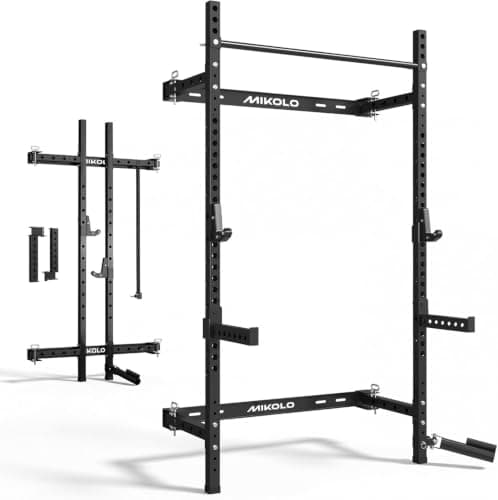
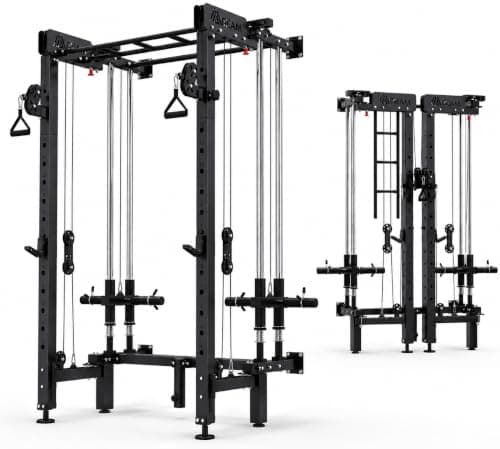
The Mdeam folding wall rack is the pick if you want cables and your floor back: it's the rare unit that bolts to the studs, carries a dual pulley system, and still folds flat against the wall when you're finished. If you can't drill, the SPORTSROYALS cage gets you the same lat pulldown and low row from a freestanding frame — at the cost of a permanent footprint. And if cables turn out to be optional for you, the Mikolo folding rack is the cleaner, better-documented fold-flat rack to pair with a separate cable station later.
The reason this page exists is a specific small-room problem. A barbell covers squats, presses, rows and deadlifts, and it covers them well. What it doesn't cover is the pulling and isolation work that needs a cable: lat pulldowns, seated rows, face pulls, tricep pressdowns, cable flyes. The conventional fix is to buy a second machine, and in a compact room the second machine is exactly what you don't have space for. A rack with an integrated pulley is the attempt to solve that with one frame and one footprint.
It works — with caveats that the product listings tend to skate past. The first is that integrated pulleys on this class of rack are almost always plate-loaded, not stack-loaded. You supply the weight, you change it by hand between sets, and you need somewhere to keep the plates. That's a materially different experience from a pin-select stack, and if the appeal of cables for you is speed between sets, it's worth knowing before you buy. The second caveat is depth: a pulley needs cable travel, so a rack with cables sits further off the wall — folded and unfolded — than a rack without them.
The third caveat is the one that decides the ranking. A wall-mounted folding rack with cables is a stud-anchored installation, full stop. There is no freestanding version of the Mdeam, and no drywall-anchor workaround exists that we would put our name to. So the honest ordering is: if you can drill, the folding unit wins because it's the only option here that gives the floor back. If you can't drill, you are choosing between a freestanding cage that owns its space permanently and a standalone compact cable machine alongside a no-drill squat stand.
We also want to be clear about the third pick, because it doesn't have cables. The Mikolo is here as the deliberate alternative to a combo unit: a 1,000 lb-rated fold-flat rack with safeties and a pull-up bar, doing the barbell half of the job extremely well, and leaving the cable half to a separate wall-mounted station bolted to the same wall. For a lot of rooms that two-unit approach ends up simpler than one machine trying to be both — better rack, better cables, and each one installed where it actually works. Our wall-mounted rack roundup covers that route in more detail.
Underneath all of this is one measurement worth taking before you spend anything: the width of clear, stud-backed wall you actually have. Not the width of the room — the width of the wall with no window, no radiator, no outlet and no closet door in it. Combo units are wider than plain racks because the pulley towers live outboard of the uprights, and that width is the constraint people discover after the box arrives rather than before.
How to choose a rack-and-cable combination
Start with install type, because it eliminates most of the field instantly. If anchoring into studs is available to you, a folding wall unit is the highest-value option in this entire category — it is the only configuration that provides barbell work, cable work and an empty floor. If anchoring isn't available, accept that you're trading floor for freedom and shop the freestanding cages in our small-space power racks roundup instead of forcing a wall unit into a situation it doesn't suit.
Work out what you'll actually load the pulley with
Plate-loaded pulleys need plates, and plates need storage and a floor that tolerates them. If you don't already own weight plates, factor that into the real cost of a combo unit — it's frequently the difference that makes a dedicated cable machine competitive again. Also think about ratio: a pulley's mechanical arrangement means the weight you hang isn't always the weight you feel, so treat plate numbers on a cable as relative progression rather than a comparison against your dumbbell loads.
Check the cable movements you care about are actually possible
"Dual pulley" on a listing can mean several different things. What you want to confirm is whether the pulley height adjusts, whether you can anchor low for rows and curls as well as high for pulldowns, and whether the attachment points clear the rack uprights during the movement. If your priority list is short — pulldowns and rows, say — a simple lat tower on a cage does that better than a wide-arm crossover. Our guide to whether you need a cable machine at home is a useful sanity check before you pay for pulleys you won't use.
Budget the install, not just the purchase
A combo wall unit is heavier and fussier to mount than a plain folding rack: more anchor points, more alignment, and cable runs that have to be square or they'll rub. Plan on a second pair of hands and a couple of hours. Our folding rack installation guide walks the whole sequence, and it's worth reading before you order rather than after, because it may change which rack you choose.