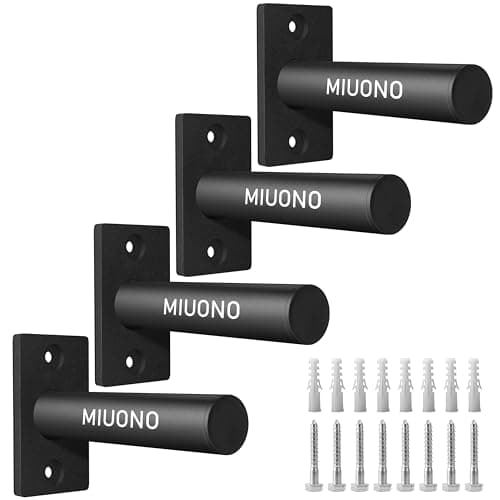
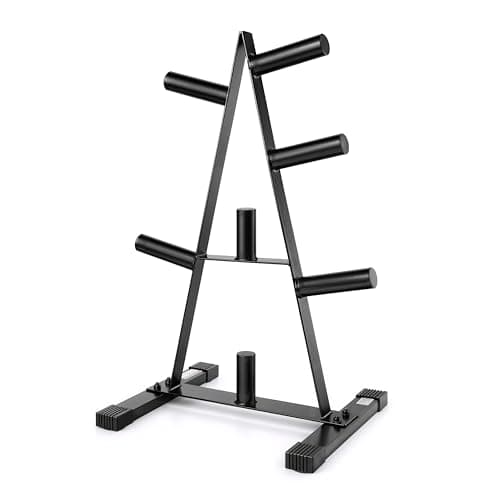
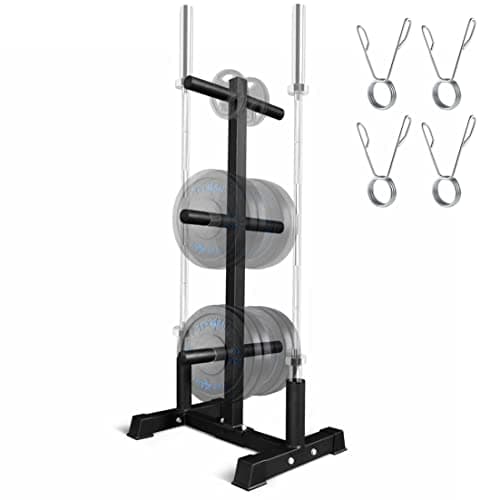
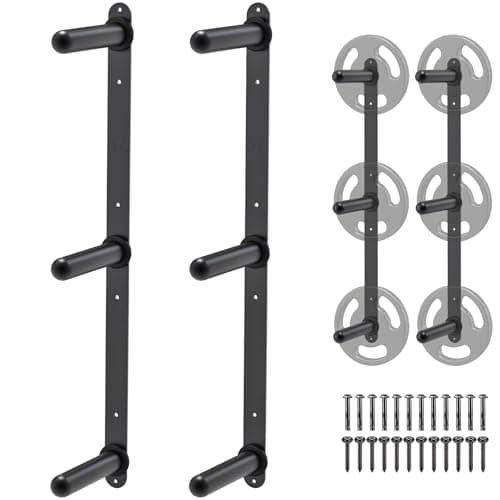
If you can drill, wall storage wins outright: the Kipika 3-peg rails hold a full Olympic set in about two inches of wall depth and take zero floor. If you cannot drill, the CAP A-frame tree is the answer, and it costs you roughly three square feet. That is the whole decision — everything else on this page is detail.
Plate storage is the part of a small home gym people plan last and regret first. A 160 lb bumper set arrives as ten discs, and unless there is somewhere for them to go they end up leaning against a wall, sliding under a bed, or stacked flat on the floor where they mark the boards and where you eventually catch a toe. In a room you also live in, that is not a cosmetic problem — it is the reason the gym gets dismantled.
There are three real forms of plate storage and they trade off along one axis: wall access versus floor space. Wall rails and pegs take no floor and require studs or masonry. A tree takes no wall and costs floor. Rack-mounted plate horns are a fourth option if your rack has them, and they are free, so check that first.
Read the wall warnings before you buy
Both wall options here carry explicit manufacturer warnings about mounting surface. The Kipika listing states it is suitable for concrete, solid brick and stone, and to avoid hollow brick, plasterboard and lightweight walls. The MIUONO listing warns in capital letters against mounting on drywall. Those are not boilerplate — a plate rack is one of the highest point loads anyone puts on a domestic wall.
In a US timber-framed house, that means finding studs and lag-bolting into them, not using drywall anchors. If you cannot locate studs where you need the rack, mount a horizontal timber batten across two of them and fix the rack to that.
Wall rails versus individual pegs
A rail is one object with several pegs at fixed spacing. A peg set is four separate objects you place wherever the wall allows. The rail is faster to install and looks tidier; the pegs fit around windows, radiators, light switches and awkward stud spacing that a 41-inch rail cannot.
In a small room, the pegs are often the more practical buy for exactly that reason — small rooms have fewer clean, uninterrupted stretches of wall. The trade is four separate installs and four chances to miss a stud.
How much capacity you actually need
Less than the numbers suggest, and it is worth doing the arithmetic rather than buying on the biggest figure. A typical small-space plate set is 75 to 160 lb total. Against that:
- Kipika rails: 1,200 lb published across the pair — many times any home set.
- MIUONO pegs: 330 lb per peg, so a 4-pack is 1,320 lb spread across four mount points.
- CAP tree: 500 lb published — comfortably more than a 160 lb bumper set.
Every option here has capacity to spare. The binding constraint is not weight, it is peg count and peg length — how many plates fit before a peg is full. Count your plates by diameter before ordering.
Where the plates should live relative to the bar
Storage that is far from the rack does not get used; plates end up on the floor by the bar instead. Mount the rack or place the tree within arm's reach of where you load, on the side you load from. In a room narrow enough that this matters, that usually means the wall directly behind the rack.
Order plates heaviest at the bottom and lightest at the top on a tree, and heaviest closest to the stud on a wall rail. Both reduce the leverage on the mount and make the common movement — grabbing a 10 lb plate — the easy one.
The free option: check your rack first
Many power racks and Smith machines ship with plate horns on the rear uprights, and a lot of people never use them. If yours has them, that is storage you already own with a load path straight into the frame. Our power rack roundup notes which cages include storage posts.
What about dumbbells and kettlebells?
Different problem, different rack. Plate pegs are sized for a 2-inch center hole and will not hold a dumbbell or a bell. For those, see vertical dumbbell storage ideas and the wider small-space weight storage guide, which covers what goes where across a whole room. If the dumbbells are the only thing on the floor, a bench with built-in storage can absorb the rack entirely and save you an object.
Floor protection under a tree
A loaded A-frame tree concentrates several hundred pounds onto four small feet, which will dent a wood floor over months. A square of interlocking mat underneath solves it for a few dollars — see the gym mat roundup.