Skip to content
RACK:RATIO

HUB 03 · Space-Saving Benches & Storage

How Much Weight Can a Weight Bench Hold?

The number on the box includes you. That single fact rules out more cheap benches than any other spec.

By Stephen V.Reviewed How we research
#ad

We earn a commission when you buy through our Amazon links, at no extra cost to you. It never changes our rankings, and we say so when the cheaper product is the better buy. How this works.

A weight bench's stated capacity is the total load on the bench — your bodyweight plus everything you are holding. A 600 lb bench under a 200 lb lifter leaves 400 lb for the bar, which sounds ample and is, but the number is not a barbell rating. Aim for a published capacity of at least twice your bodyweight plus your heaviest planned lift.

Bench capacity is one of the most misread specs in home gym buying, and the confusion costs people money in both directions. Some buyers assume a 660 lb bench can take 660 lb of barbell, which is wrong. Others assume every bench is fine because they only press 135 lb, which ignores that the bench is also holding them, and that the load is not applied evenly.

This page explains what the number means, what it does not cover, and how much margin to insist on. It matters more in a small space than in a garage, because small-space benches skew toward folding and lightweight designs, and those are exactly the ones where capacity varies most between models.

What the rated capacity includes

  • Your bodyweight. All of it, and it is usually the largest single component.
  • The bar and plates, or the dumbbells. Everything in your hands.
  • Dynamic load. Nothing published accounts for this, but a bar lowered quickly and stopped applies more instantaneous force than its static weight. Margin covers it.

So a 200 lb lifter pressing 185 lb is applying about 385 lb, not 185. On a 600 lb bench that is comfortable. On a 300 lb bench it is uncomfortably close, and on a bench that publishes no rating at all you are guessing.

What the number does not tell you

Three things, all of which matter as much as the headline figure:

  1. Whether the load was tested flat or inclined. An adjustable bench at a steep incline concentrates load on the rear support, which is a different structure from the flat position. Ratings are rarely broken out by angle.
  2. Stability, which is separate from strength. A bench can hold the weight and still rock. Wobble under a heavy press is a safety issue that no capacity number captures.
  3. Pad width and gap. On many adjustable benches there is a gap between the seat and back pads. Capacity does not describe how that feels under your back.

The short answer

Quick picks

#ProductBest forScorePrice
01
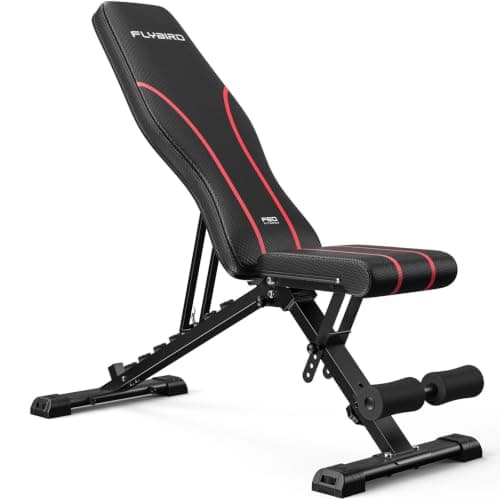
FLYBIRD FLYBIRD WB2 Adjustable Weight Bench
FLYBIRD WB2 Adjustable Weight Bench

The internet's default adjustable bench, and rightly so: it folds flat to store against a wall, tilts from decline through steep incline, and costs about a hundred dollars. For a compact setup it's the obvious bench.

Most small home gyms
8.8
$139.99Amazon
02
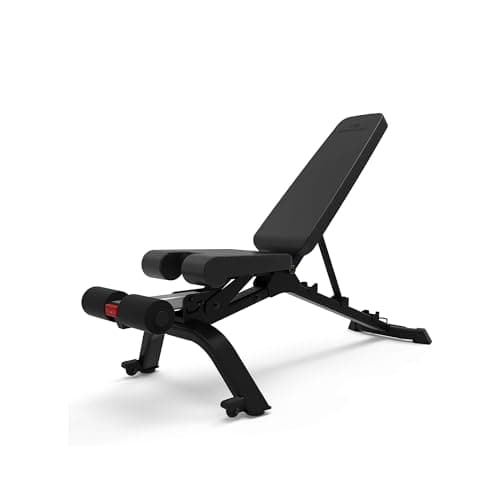
Bowflex Bowflex 3.1S Adjustable & Stowable Bench
Bowflex 3.1S Adjustable & Stowable Bench

Six back positions including a slight decline, a wide comfortable pad, and — the part that matters here — it folds and stands upright for storage. The bench to buy if you want one that lasts and still disappears.

Best adjustable bench overall
9.0
$159.99Amazon
03
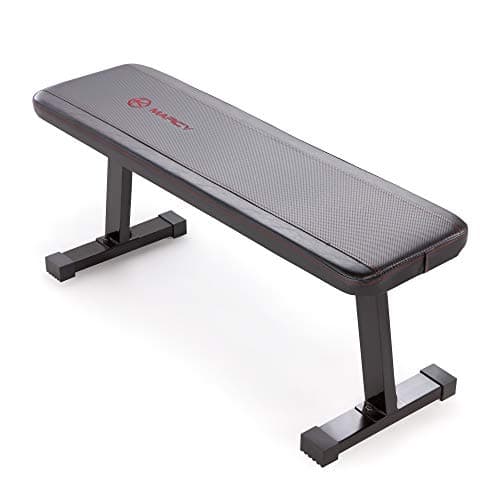
Marcy Marcy Flat Utility Weight Bench
Marcy Flat Utility Weight Bench

A 600 lb-rated flat bench for less than the price of a pair of dumbbells. It doesn't fold and it doesn't incline — it just sits there being stable, which for flat pressing is the entire job.

Cheapest solid flat bench
9.0
$74.37Amazon

#ad · Live prices from the Amazon Product API, as of Sep 9, 2026. Where we have no verified live price, we show none — we would rather leave a gap than print a number that has rotted.

In detail

The picks, in full

01
FLYBIRD FLYBIRD WB2 Adjustable Weight Bench

Most small home gyms

FLYBIRD WB2 Adjustable Weight Bench

Folds flatMulti-angle incline~600 lb rated~Under $110
8.8/10

The internet's default adjustable bench, and rightly so: it folds flat to store against a wall, tilts from decline through steep incline, and costs about a hundred dollars. For a compact setup it's the obvious bench.

Good

  • Folds flat for genuine wall storage
  • Wide angle range for the money
  • Light enough to reposition one-handed

Trade-offs

  • Pad is firm and a little short for tall lifters
  • Not a commercial-grade heavy bench
Fit
9
Value
9
Install
10
Build
7

Skip this if…

you press very heavy and want a wide, ultra-stable commercial pad — this trades some heft for foldability.

Spec sheet

Type
Adjustable incline bench
Folds
Flat — stands against a wall
Angles
Decline through steep incline
Rated load
~600 lb (per listing)
Install / renter
Freestanding — zero install
Unit weight
Light — one-hand to move
$139.99View on Amazon

Price as of Sep 9, 2026. Prices change — Amazon's is the one that counts.

#ad · we may earn a commission from this link to FLYBIRD WB2 Adjustable Weight Bench

02
Bowflex Bowflex 3.1S Adjustable & Stowable Bench

Best adjustable bench overall

Bowflex 3.1S Adjustable & Stowable Bench

6 positionsStows uprightWide padDecline to incline
9.0/10

Six back positions including a slight decline, a wide comfortable pad, and — the part that matters here — it folds and stands upright for storage. The bench to buy if you want one that lasts and still disappears.

Good

  • Wider, better-finished pad than budget benches
  • Stows upright to reclaim floor
  • Decline position most folding benches skip

Trade-offs

  • Costs more than the budget folding benches
  • Heavier to reposition
Fit
9
Value
8
Install
10
Build
9

Skip this if…

you only ever press flat — a fixed flat bench is cheaper, sturdier and just as useful for that.

Spec sheet

Type
Adjustable bench (decline to incline)
Folds
Yes — stows upright
Positions
6 back positions
Rated load
Not published — confirm on listing
Install / renter
Freestanding — zero install
Pad
Wide, firm upholstery
$159.99View on Amazon

$249.9936% off

Price as of Sep 9, 2026. Prices change — Amazon's is the one that counts.

#ad · we may earn a commission from this link to Bowflex 3.1S Adjustable & Stowable Bench

03
Marcy Marcy Flat Utility Weight Bench

Cheapest solid flat bench

Marcy Flat Utility Weight Bench

600 lb ratedFlat onlyCompactBudget
9.0/10

A 600 lb-rated flat bench for less than the price of a pair of dumbbells. It doesn't fold and it doesn't incline — it just sits there being stable, which for flat pressing is the entire job.

Good

  • 600 lb rating at a very low price
  • Nothing to flex — no incline hinge
  • Small enough to tuck against a wall

Trade-offs

  • Flat only
  • Doesn't fold flat for storage
Fit
8
Value
10
Install
10
Build
8

Skip this if…

you want incline pressing or shoulder work — this bench has one angle and that's it.

Spec sheet

Type
Flat utility bench
Folds
No — but small enough to slide aside
Rated load
600 lb (per listing)
Install / renter
Freestanding — zero install
Footprint
Compact — smaller than adjustables
Pad
Firm flat upholstery
$74.37View on Amazon

$79.997% off

Price as of Sep 9, 2026. Prices change — Amazon's is the one that counts.

#ad · we may earn a commission from this link to Marcy Flat Utility Weight Bench

What ASTM certification actually means

Some benches — the FLYBIRD above among them — advertise ASTM certification. ASTM International publishes consensus standards for fitness equipment covering structural integrity, stability and labeling. A bench certified to the relevant standard has been tested against a defined protocol rather than the maker's own bench test.

That is a genuine signal and it is worth preferring, but read it precisely: certification confirms the product met a standard, it does not mean the capacity figure is higher or that the bench suits your particular use. Treat it as a reason to trust the published number, not as a number in itself.

How much margin to insist on

A workable rule for a home lifter:

Your trainingMinimum published capacity
Dumbbells only, under 50 lb per handAbout 400 lb
Barbell bench, up to bodyweightAbout 600 lb
Barbell bench, above bodyweight800 lb or more, and check stability
No published rating at allDo not buy it for barbell work

The last row is the important one. Plenty of inexpensive benches simply do not state a capacity. That is fine for a bench you will do dumbbell rows on and nothing else; it is not fine for anything you get under with a loaded bar.

Why folding benches are the ones to check

A folding bench has a hinge in the load path, which a fixed bench does not. Good folding benches solve this with an over-center lock and a rated pin, and their published capacities are as high as fixed benches — the Finer Form and FLYBIRD both publish figures in the hundreds of pounds. Cheap folding benches solve it with a friction catch, and those are the ones that publish nothing.

If you are buying for a small room, you are probably buying a folding bench. Read the capacity line specifically, and if there is not one, treat the absence as the answer. Our folding bench roundup only includes models whose makers publish a figure.

Stability checks you can do at home

  1. Push the top corner sideways with the bench empty. Any rock means the feet or the frame are not square. On carpet, put a firm mat underneath before you judge this.
  2. Sit on the very end and lean back. The far foot should not lift.
  3. Check the pad gap at incline. Set the angle you actually use, then lie on it. A gap you can feel through your back will not improve with load.

If the bench rocks on carpet specifically, the bench is probably fine and the floor is the problem — see home gym on carpet.

When capacity is not the limiting factor

For most people in a small space, it will not be. The genuine constraint is usually folded footprint, backrest angle range, or whether the bench fits under a bed. Capacity is a filter — rule out anything without a published number, then choose on the specs that decide daily use. Our flat versus adjustable comparison covers those.

How we picked

We don't run a testing lab

We compiled published specifications, manufacturer documentation and aggregated owner reviews, then scored each product against a published rubric that weights fit-for-small-space, value, install reversibility and build. The scores are judgments from documented research — they are notmeasurements we took, because we don't have a lab and we're not going to pretend we do. Every dimension is cited in Sources.

Questions

Frequently asked

Does bench weight capacity include your body weight?
Yes. The published figure is the total load on the bench — you plus the bar plus the plates, or you plus the dumbbells. A 200 lb lifter pressing 185 lb is applying roughly 385 lb to the frame. This is the single most misread spec in bench buying.
What weight capacity do I need in a home weight bench?
For dumbbell work under 50 lb per hand, about 400 lb published is comfortable. For barbell benching up to your own bodyweight, look for about 600 lb. Above that, 800 lb or more, and pay as much attention to stability as to the number. Avoid any bench for barbell work that publishes no rating at all.
Are folding weight benches strong enough for barbell work?
The good ones are — several folding benches publish capacities in the hundreds of pounds and use an over-center lock rather than a friction catch. The ones to avoid are those that publish no capacity figure, which is common at the bottom of the market. Check for the number specifically, because the hinge is the part that varies.
Does ASTM certification mean a bench is safer?
It means the bench was tested against a published consensus standard for structural integrity and stability rather than against the manufacturer's own criteria. That is a genuine reason to trust the stated capacity. It does not itself raise the capacity or guarantee the bench suits your particular use.

Keep reading

Receipts

Sources

We don't run a testing lab, and we don't pretend to. Every dimension and rating traces to a manufacturer spec sheet or manual, named and linked above. Where a maker doesn't publish a number, the spec reads "Not published" rather than a guess. Read our full method.