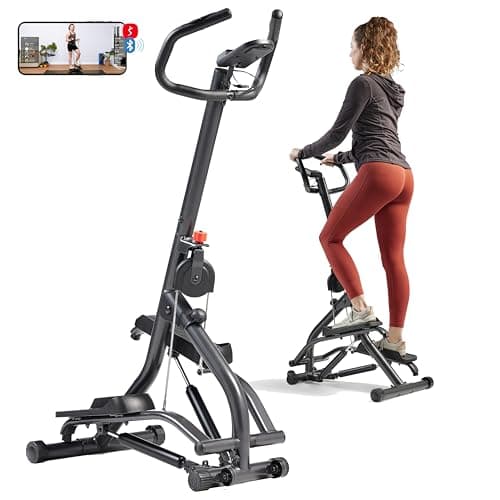
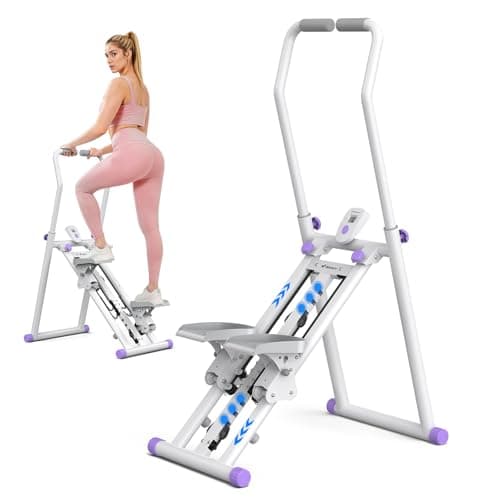
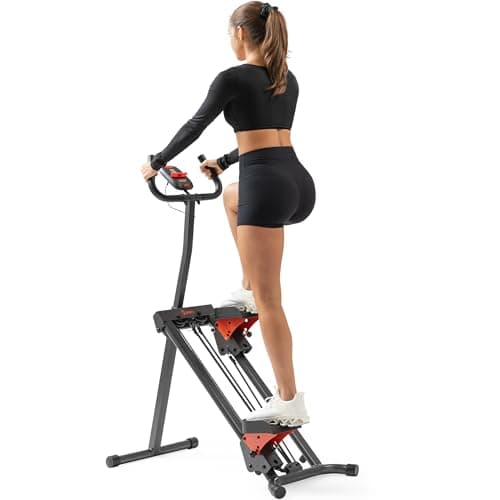
For most small rooms the Sunny SF-S025005 is the pick — it is the only climber here with a published flat fold, 9.6 inches thick, which is the difference between storing it under a bed and standing it in the corner of a room you wanted back. Buy the Sunny SF-S021001 instead if the ceiling is the constraint: it is 50.2 inches tall with a step that tops out at 16.9 inches, and it is the only machine here that publishes both numbers, so it is the one we would put in a basement.
A vertical climber is a strange fit for a small apartment on paper and a very good one in practice. Every machine below occupies between 4.1 and 5.1 square feet — less floor than any compact elliptical we rank, and about the area of a bath mat. None of them has a motor. None of them puts an impact into the floor, because your feet never leave the pedals. All four fold. The whole category is built around taking up height instead of area, which is exactly the trade a small room can usually afford — right up until the point where it cannot, which is the first thing this page is about.
Three different machines are sold as "vertical climbers"
Search the term and you will be shown three product classes that train differently, cost differently and fit differently. Sorting them out is most of the buying decision:
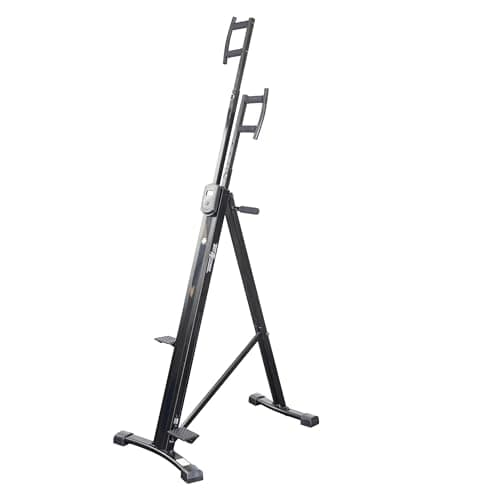
- Ladder-style climbers. A tall frame, near vertical, with grips and pedals that move together so you climb hand over hand. Bodyweight is the resistance. This is the machine most people picture, and it is the tallest thing in the category — the Body-Solid below is 85 inches, which is 7 ft 1 in of frame.
- Step climbers with a handlebar. Pedals on vertical rails, a fixed handlebar to hold, a long vertical stride. They are 50 to 56 inches tall, they fold, and they are what most of this category actually sells today. Three of the four picks below are this machine.
- Mini steppers. A hydraulic box you stand on, 13 to 16 inches tall, often with arm bands and no handlebar. Real equipment, genuinely tiny, and a different product with its own roundup. Nothing on this page is one.
The listings blur all three deliberately — "stair stepper", "stair climber" and "vertical climber" appear in the same title on machines that share nothing but a pedal. Read the height. Under about 20 inches it is a stepper, around 50 inches it is a step climber, and over 80 inches it is a ladder climber.
The numbers that decide it
We ranked these on five published figures, in this order. Every one of them is on the spec block of each pick, and where a maker does not publish a number the row says so rather than guessing:
- Assembled height.The one number that can disqualify a machine outright. You stand on it, so the room needs the machine's height or your height plus the step height, whichever is greater — plus clearance.
- Folded shape, not just "folds". Two machines here fold to roughly the same volume and store nothing alike: one lies down 9.6 inches thick, the other stands up 57.5 inches tall. Only one of those goes under a bed.
- Step height and stride. How far the pedal actually travels. It sets both the difficulty and the ceiling arithmetic, and it is the number that separates a climb from a march.
- Rated load. Published maximum user weight, which runs from 265 lb to 330 lb across four machines that look nearly identical.
- Resistance type. Bodyweight, hydraulic or numbered levels. This decides whether the machine still challenges you in month six.
How the four compare
| Machine | Floor footprint | Height | Folded | Rated load |
|---|
| Sunny SF-S025005 | 38.2 x 18.3 in | 55.5 in | 63.4 x 18.3 x 9.6 in, flat | 330 lb |
| Sunny SF-S021001 | 30.9 x 19.3 in | 50.2 in | 10.6 x 19.3 x 57.5 in, upright | 265 lb |
| MERACH MR-2448 | 35 x 19 in | 50 in | Folds; size not published | 330 lb |
| Body-Solid BFMC10B | 37 x 20 in | 85 in | Folds; size not published | 330 lb |
The floor column is tighter than it looks — a single square foot separates the smallest machine here from the largest. The height column is where the real spread lives: 35 inches between the shortest machine and the tallest, which is the difference between a machine that fits under a basement duct and one that does not fit in the basement at all.
Ceiling arithmetic: the sum nobody does before ordering
On a step climber you rise by the step height. The sum is your standing height, plus the machine's maximum step setting, plus a few inches so you are not brushing plaster at the top of every stride. Worked through for a 5 ft 10 in rider:
- Sunny SF-S025005, step height up to 23.5 in: about 7 ft 10 in at the top of the climb. Under a standard 8 ft ceiling that is tight but workable — and the fix is free, because the step height is adjustable down to 8.9 in.
- Sunny SF-S021001, step to stabilizer up to 16.9 in: about 7 ft 3 in. This is the machine for a low room. The MERACH is nominally 50 in tall, a fraction under it, but publishes no step height, so this sum cannot be done for it at all.
- Body-Solid BFMC10B: the arithmetic is different, because the frame itself is 85 in and your hands work at the top of it. You need the ceiling to clear 7 ft 1 in of machine with room to spare, which in practice means a full 8 ft ceiling and nothing hanging from it.
Then do the same sum for the ceiling fan, the pendant light and the smoke detector, because that is where these failures actually happen — almost nobody hits the ceiling itself. Our ceiling height guide for a home gym works through the clearance every movement needs, and a climber belongs near the top of that list alongside the overhead press.
Resistance: bodyweight, hydraulic or numbered levels
This category is unusually split on how it loads you, and the three answers suit different buyers:
Bodyweight only — the Sunny SF-S025005 and the Body-Solid. There is no dial. Intensity is how high you set the step and how fast you move, which is genuinely enough for most people for a long time, because climbing your own bodyweight is not easy. It is also the most honest kind of resistance: nothing fades, nothing wears out, nothing to adjust.
Hydraulic — the Sunny SF-S021001. Cylinders resist the pedal, and the intensity changes with the step-height setting rather than with numbered levels. Hydraulics warm up over a long session and soften as they do; makers in this category say so themselves, which we documented on the mini stepper roundup where one manufacturer publishes that resistance decreases after about 30 minutes by design. For 20 minute sessions this never comes up.
Numbered levels — the MERACH, at nine of them. On paper this is the most progressable machine here, and at the lowest price. It is also the pick with the least published documentation, which is the trade.
What "foldable" actually buys you
Every machine on this page folds, and the word means two different things. The Sunny SF-S025005 folds flat: 9.6 inches thick, lying down, over a footprint 63.4 inches long. That goes under a bed frame or behind a sofa, and it is the only one here that publishes a figure saying so. The Sunny SF-S021001 folds narrow: 10.6 inches deep but 57.5 inches tall, standing against a wall or in a closet, and it rolls there on transport wheels. MERACH and Body-Solid both say their machines fold and neither publishes a figure, so plan those two around their in-use footprint and treat the fold as a bonus.
Measure the storage slot before the floor slot. A five-and-a-quarter foot flat space under a bed is a different thing from a 15 inch gap beside a wardrobe, and the two machines that fit them are not interchangeable. If storage is the whole problem, our guide to how much space a home gym really needs sets out in-use versus stored footprint across everything we cover.
Noise, honestly
Structurally this is one of the quietest categories in cardio, for a reason that has nothing to do with engineering claims: there is no motor in any of these machines and no impact in the movement. Your feet stay on the pedals, so nothing strikes the floor, and nothing hums through a shared wall at 6 am. What a neighbor can hear is mechanical — rails, pedals and the frame rocking slightly under a hard climb — and that is a contact-point problem a firm mat mostly solves.
We do not measure decibels and will not repeat a maker's number as though we had. Listings in this class quote figures as low as 25 dB, which is quieter than a library and not a number anyone measured in a living room. Our quietest cardio machines roundup explains how we reason about noise across the whole category, and the short version applies here cleanly: no motor and no impact puts a climber near the top of the list.
Floors, mats and getting it into the room
A climber concentrates its weight onto a small stabilizer base and rocks fore and aft while you work. On hardwood that marks a finish; on carpet the feet sink and the frame goes out of level, which makes the rocking worse. The fix is a firm mat, not a soft one — see our home gym mat roundup for what survives under a machine, and home gym on carpet if the room in question is carpeted, which most bedrooms are.
Getting one in is the easiest part of this category. These are 24.5 to 49 lb machines in a single box — the Sunny SF-S025005 ships at 35 lb including packaging, in a carton 40.6 inches long — so a staircase and a standard doorway are non-events. Nothing needs to be drilled, bolted or anchored, and nothing plugs into a wall, which makes the whole category renter-safe by default. It is one of the few things we cover where the only thing at risk is your floor finish.
Two famous climbers you cannot currently buy
Worth saying plainly, because both dominate the search results for this term: the MaxiClimber 2.0 and the Relife CT01— the two budget ladder-style climbers most people have seen — both returned "Currently unavailable" on Amazon when we selected for this page. They are real products and may come back. They are not buyable today, so neither is ranked here.
One more that we verified and did not rank: the Stamina Cardio Climber 55-2125 is the magnetic-resistance step up in this category, with eight levels, a published 300 lb capacity and an 89 lb frame that rolls rather than folds. It costs several times what anything on this page does. We left it off because Stamina's own listing publishes no assembled dimensions at all and the figure retailers repeat for it reads like a shipping carton, and on a site whose whole promise is that the dimensions are right, we would rather leave a good machine out than publish a number we cannot stand behind.
Who should buy something else instead
A climber is a specific machine for a specific want: upright, full-body, zero-impact cardio that takes height instead of floor. If that is not precisely what you are after, something else here is a better buy:
- You want daily step count while you work: a walking pad slides under a desk and runs while you answer email. No climber does that.
- You want the absolute smallest machine: a mini stepper is about one square foot and 16 lb, at the cost of range of motion and any upper-body work.
- You want weight-bearing cardio with a long, low stride: a compact elliptical keeps your head lower and your knees happier, and takes more floor to do it.
- You want to sit down: a folding exercise bike is the smallest seated cardio that still gives you resistance levels.
If none of those substitutes — if what you want is to climb, in a room with more ceiling than floor — then this is your category, and the four machines above are the ones whose published numbers we can stand behind. The rest of the small-space cardio picture is in the compact cardio hub.