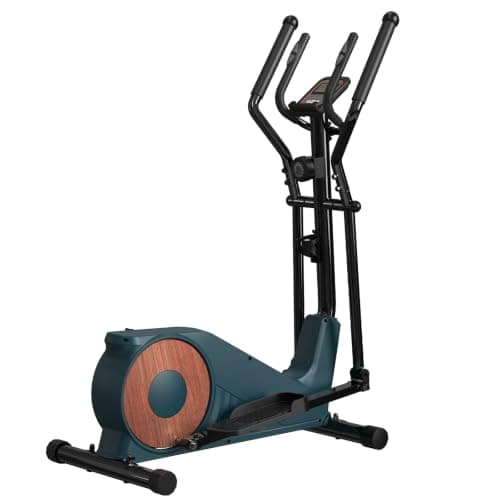
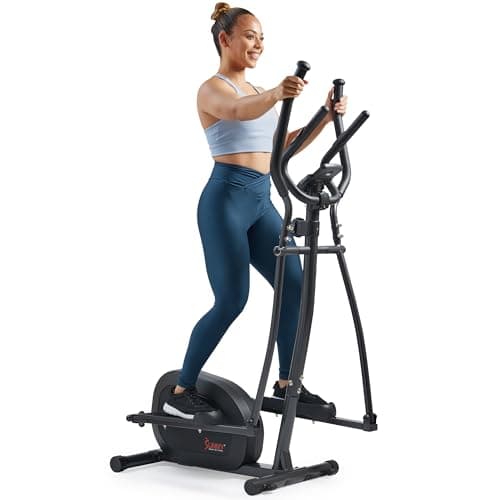
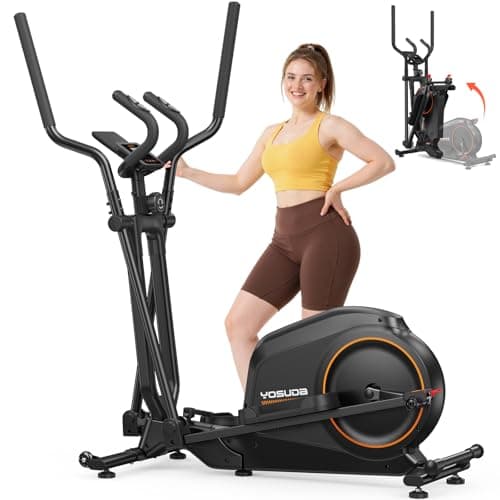
For most small rooms the YOSUDA E03 is the pick — 36.6 by 21.7 inches in use, which is under six square feet, and it is the only one here that folds afterward. Buy the Sunny Health & Fitness compact instead if your ceiling is the constraint: it is the one machine in this category whose maker publishes a pedal step height, and at 6.5 to 12.8 inches it is the lowest we found published anywhere.
An elliptical is a hard machine to put in a small room, and it is worth saying that plainly before any of the picks. A walking pad is a slab that slides under a bed. A folding bike collapses into something you carry with one hand. An elliptical is a piece of furniture with a moving arm at head height, and nothing about the category folds the way the rest of compact cardio does. Most of them do not fold at all.
People still want one, for a reason no other machine covers. An elliptical is weight-bearing but impact-free: your feet never leave the pedals, so nothing strikes the floor, and the movement still loads your legs and hips the way walking does. For anyone with knees that object to running, above a neighbor who objects to footfall, this is the one machine that answers both complaints at once. That combination is worth the square footage, provided you have measured the square footage first.
The three numbers that decide it
Elliptical marketing leads with resistance levels and flywheel weight. Neither one decides whether the machine fits. These do:
- Assembled footprint. Length front to back is the number that surprises people — the drive and the stride both live along that axis, so an elliptical is long and comparatively narrow. Width is what decides whether it fits beside a bed.
- Pedal step height. How far off the floor the pedal sits at the top of the arc. Add it to your own height and you have the clearance the room actually needs. Almost nobody publishes it.
- Stride length. How far the pedal travels. Short strides feel like stepping in place; long strides feel like walking. It is the single biggest driver of whether the machine still gets used in month four.
The listing trap: that number is probably the box
Half the ellipticals sold on Amazon publish a "Product Dimensions" figure that is the shipping carton, not the assembled machine. It is easy to spot once you know the tell: if the height is smaller than the stride is long, or if the whole thing would fit under a desk, you are reading a box. One popular 15.5 inch stride model in this category lists itself as 23.8 inches tall — that is a carton lying on its side, and it is roughly a third of the machine's real height.
Two machines were dropped from this page for exactly that. We did not want to publish a footprint we could not stand behind, and on a site whose whole promise is that the dimensions are right, quoting a carton would be worse than leaving a good machine out. Every product below has an assembled figure from Amazon's structured item-dimensions field, from the maker's own spec sheet, or from both agreeing.
How the four compare
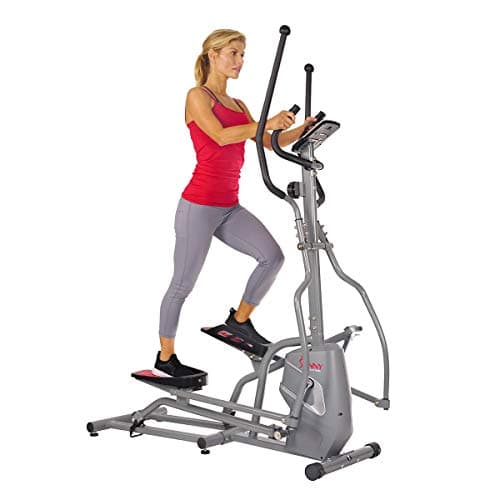
| Machine | Floor footprint | Height | Stride | Weight |
|---|
| YOSUDA E03 | 36.6 x 21.7 in (folds) | 61.4 in | 15 in | 66 lb |
| XVGVSV E317 | 48.2 x 20.1 in | 59.8 in | 15.5 in | About 75 lb |
| Sunny Smart Compact | 40.7 x 26.4 in | 59.8 in | 11 in | 62.8 lb |
| Sunny SF-E3810 | 58 x 22 in | 68 in | 18 in | 86.5 lb |
Read the width column if the machine has to live beside something, and the length column if it has to live against a wall. The spread here is real: 20.1 inches versus 26.4 inches of width is the difference between fitting down the side of a bed and not, and 36.6 inches versus 58 inches of length is nearly two feet of hallway.
Ceiling clearance: the arithmetic nobody does
Standing on an elliptical raises you by the pedal step height, and then your head needs somewhere to go. The sum is simple and almost never done: your standing height, plus the machine's maximum pedal height, plus a few inches so you are not brushing the ceiling on every stride.
Worked through on the two machines here that publish the number: a 5 ft 10 in rider on the Sunny compact tops out at about 6 ft 10 in, which clears a standard 8 ft ceiling with a foot to spare. The same rider on the SF-E3810, whose pedal reaches 18.5 in, tops out near 7 ft 5 in — still fine under 8 ft, and a straightforward failure in a 7 ft basement or under a duct run. Neither the YOSUDA nor the XVGVSV publishes a step height, so measure the pedal at the top of its travel when the machine arrives, or budget for somewhere between 12 and 16 inches, which is where this class of machine tends to land.
Do the same arithmetic for a ceiling fan or a pendant light, which is where most of these failures actually happen — the ceiling itself is rarely the thing you hit. Our ceiling height guide for a home gym covers the clearance every movement needs, and the elliptical is one of the few cardio machines that belongs in that conversation at all.
Stride length and how tall you are
Stride is the number that decides whether the machine feels like exercise or like a novelty. Under about 13 inches, the motion is closer to marching than striding and taller riders end up mincing. Around 15 to 16 inches it starts to feel like walking. At 18 inches it feels like walking with intent, and that is as long as anything in this size class gets.
Height limits are stated inconsistently across the category, and where a maker does state one it is worth believing. YOSUDA puts the E03 at users up to 5 ft 9 in, which is unusually honest and unusually restrictive; if you are 6 ft, that is a straightforward disqualifier rather than a rounding error. The SF-E3810's 18 inch stride is the answer at the other end, at the cost of nearly two more feet of floor.
The trade is direct and unavoidable: stride length is measured along the machine's long axis, so a longer stride means a longer machine. There is no compact 20 inch stride elliptical, and anything claiming to be one is quoting a different number.
Noise, honestly
Every machine here uses magnetic resistance and none has a motor, which puts them structurally among the quietest cardio you can own — there is no belt, no roller and nothing to hum through a wall at 6 am. What a downstairs neighbor might hear is the frame rocking under a hard stride, which is a contact-point problem rather than a machine problem, and a mat under the feet handles most of it.
We do not measure decibels and will not repeat a manufacturer's number as though we had. One listing in this batch claims 20 dB, which is quieter than a recording studio and obviously a marketing figure. Treat every dB claim in this category the same way. Our quietest cardio machines roundup sets out how we reason about noise across the whole category, and the short version is that impact matters and motor hum matters, and an elliptical has neither.
Floors, carpet and what goes underneath
An elliptical concentrates 60 to 90 pounds of machine plus your bodyweight onto four small feet, and it does so while rocking slightly fore and aft. On hardwood that marks the finish. On carpet the feet sink, the frame goes out of level and the rocking gets worse — the fix is a firm mat that gives the stabilizers something flat to sit on, not a soft one.
A mat is not optional equipment here, it is part of the purchase. See our home gym mat roundup for what actually survives under a machine, and home gym on carpet if the room you have in mind is carpeted, which most bedrooms are.
Getting it into the room
These ship in one heavy box — 66 to 86.5 pounds of machine, plus packaging — and they arrive 90 to 95 percent assembled, which sounds generous until you are carrying the crate up a staircase. Measure the doorway and the stair turn before ordering, not after. Once built, all four have transport wheels, but wheels move a machine across a level floor; they do not get it through a doorway or down a flight.
Assembly itself is genuinely short by home-gym standards — the makers quote 20 to 30 minutes and that is roughly right for the pedals, handlebars and monitor. Nothing here needs to be drilled, bolted or anchored, which keeps the whole category renter-safe. It is one of the few pieces of equipment we cover where nothing is at risk except your floor finish.
Who should buy something else instead
If the constraint is storage rather than impact, an elliptical is the wrong machine and you will not enjoy owning it. Nothing here disappears. The honest alternatives:
- You want step count and the smallest stored size: a walking pad slides under a bed. An elliptical never will.
- You want zero-impact cardio in about a square foot: a mini stepper is a fraction of the object, with a fraction of the range of motion to match.
- You want to train while you work: a seated under-desk elliptical or pedal unit does that job; a standing elliptical does not.
- You want a machine that folds to nothing: a folding exercise bike is the smallest real cardio machine that still gives you resistance levels and a seat.
- You want upright full-body cardio in less floor: a vertical climber does the same impact-free job in four to five square feet, and most of them fold — the trade is that they take their size in height instead.
If none of those substitute — if what you specifically want is upright, full-body, weight-bearing cardio that puts nothing into the floor — then this is your category, and the four machines above are the ones whose numbers we can stand behind. Work out how much room you are really working with first; how much space you need for a home gym covers in-use versus stored footprint across everything we cover.