A bedroom is the most common room a home gym ends up in, and it is a better room than its reputation — but it is not simply "a small space." Three things make it its own problem: the bed owns the floor and the storage, the room is usually upstairs over somebody, and it has to still work as a bedroom when you are finished training. Get those three right and a bedroom will run a complete strength program. Get them wrong and you own a clothes rail with a barbell through it.
This page is about the room, not the gear. We already publish the kit lists — the small-space essentials and the under-$500 build— and the five picks at the bottom are the pieces from those lists that survive contact with a bed. What follows is the part nobody writes down: which measurements decide the room, what changes when the floor is carpeted and the ceiling below is somebody's living room, and the three layouts that actually work.
Why a bedroom is not just a small room
Our other layout guides handle rooms with a single job. A closet is storage you are converting. A studio apartment is one room doing everything at once. A garage corner is unfinished space you are allowed to make ugly. A bedroom is different on four counts, and every recommendation below follows from them.
- The bed is immovable and enormous. A queen frame is roughly 33 to 34 square feet of floor before you walk around it. In a small bedroom that is most of the room, and unlike a sofa it cannot be pushed aside for a session.
- It is usually upstairs.Bedrooms sit on joisted floors above a room somebody is using — a living room, a kitchen, or in an apartment, a stranger's bedroom. That makes transmitted noise the binding constraint, not floor strength.
- It is usually carpeted. Carpet plus soft underlay is the least stable base in the house, and it is what most bedroom equipment ends up standing on.
- It has to stay a bedroom.Guests, a partner who did not ask for a gym, a landlord's inspection, or simply wanting the room to be restful. Kit that cannot be made to disappear does not belong here.
The five numbers to measure before you buy anything
Take a tape measure into the room before you shop, not after. These five numbers rule out more equipment than any spec sheet does, and four of them are specific to bedrooms.
- Under-bed clearance. The single most valuable number in the room, and the one nobody knows. Measure from the carpet to the underside of the frame rails. It varies enormously — a platform bed can be almost nothing, a divan can be sealed shut, a frame on risers can swallow a folded bench. This number decides whether your storage problem is solved or permanent, so check it against the folded thickness of anything you plan to slide under there rather than assuming it fits.
- The training rectangle. Stand where you would train, hold a broom at shoulder width and press it overhead, then lunge forward and back. The rectangle you just swept is the space you need free — for most people somewhere near 6 by 6 feet, and less if you keep to dumbbells and bands. Measure it as a rectangle on the floor, not as square footage, because a long thin gap beside a bed is not the same as a square.
- Door swing. Bedroom doors almost always open inward, and the arc they sweep is dead floor you cannot put a bench in. Mark it. If the arc eats the only usable corner, a rehung door or a bench that folds is the cheap fix.
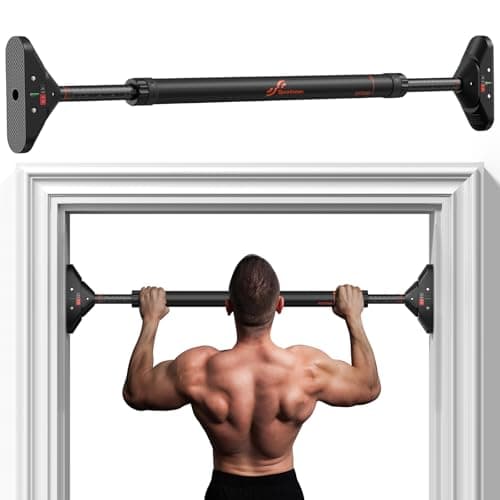
- The doorway opening itself. If a doorway pull-up bar is in the plan, measure the clear width. Bedroom and closet doors are frequently narrower than the main doorways downstairs, and leverage-mount bars publish a minimum width — the one we rank starts at 29.5 inches. Measure before you order; there is no workaround for a frame that is too narrow.
- Ceiling height where you would stand. Not the middle of the room — the spot you would train in. Upstairs bedrooms are the most likely rooms in the house to have a sloped ceiling, a dormer, or a light fitting hanging where your barbell wants to be. Our ceiling height guide has the clearance each movement needs.
Upstairs: noise is the constraint, not strength
The question people ask is whether the floor will hold it. The honest answer is that it almost certainly will — floors are rated as a distributed load, a bedroom gym weighs less than the furniture in a lot of rooms, and the fix for a heavy concentration is to spread it. The question they should ask is whether the room below can live with it.
A bedroom gym transmits noise in three ways, and they are worth separating because they have different fixes. Impact — a dumbbell set down hard, a dropped plate, a jump — travels straight through the joists into the ceiling below and is the one that ends home gyms. Vibration is a motor or a flywheel humming into the structure, which matters if a walking pad runs while somebody watches television underneath. Airborne noise — music, a fan, your breathing — is the least of the three and the easiest to contain.
The practical upshot for a bedroom: choose equipment that never produces impact in the first place, and put a dense layer between everything else and the floor. Bands make no impact at all. Adjustable dumbbells make none if you set them down rather than drop them — and on this site we never recommend dropping an adjustable dumbbell anyway, because the mechanism is not built for it. A barbell in an upstairs bedroom is the one honest "probably not" on this page: not because the floor will fail, but because the only way to lift one quietly is to never miss a rep. Lifting without annoying the neighbors and how to soundproof a home gym go deeper on both.
Carpet changes what you can stand on it
Most bedrooms are carpeted, and carpet is not a neutral surface. Modern underlay is deliberately soft, which means a bench foot or a rack upright sinks into it unevenly and the whole thing rocks under load. Carpet is also worse than it looks at absorbing impact noise — it deadens the sharp edge of a sound while passing the low-frequency thump into the structure more or less intact.
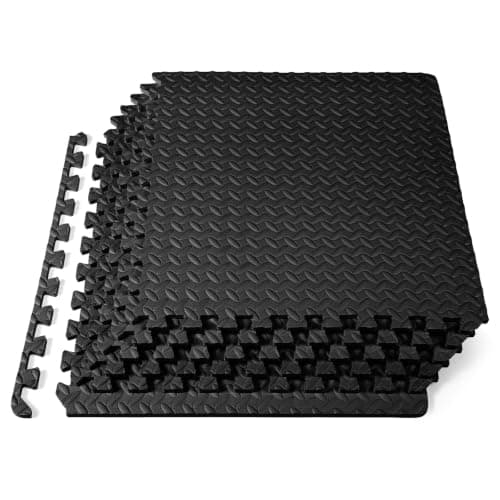
The fix is a firm, flat layer between the equipment and the carpet: interlocking foam tiles for a bench and dumbbells, rubber-topped tiles or a rigid board underneath for anything heavier. Our home gym on carpet guide works through the underlay problem, what needs plywood and what does not, and how to avoid the two ways carpet gets permanently marked — crushed pile under a static foot, and a bald patch where a machine rubs. In a rented bedroom that second one is your deposit, so it is worth ten minutes of reading.
Three bedroom layouts that work
1. The spare or guest bedroom
The best-case version, and the one most people searching for this actually have: a room with a bed in it that nobody sleeps in most weeks. Push the bed against the longest wall rather than centering it — a guest bed does not need access on both sides — and you convert a walk-around gap into one continuous training rectangle. Put the bench and dumbbells against the opposite wall, a doorway bar in the frame, and mats down over the training rectangle only. The room still sleeps a guest with ten minutes of tidying, which is the whole point of the layout.
This layout takes the most equipment of the three. If you want a rack in it, a folding wall-mounted one is the only sensible choice in a bedroom — see folding squat racks — and it needs studs, a landlord who is fine with lag bolts, and an honest answer to the barbell noise question above.
2. The shared bedroom the gym has to vanish from
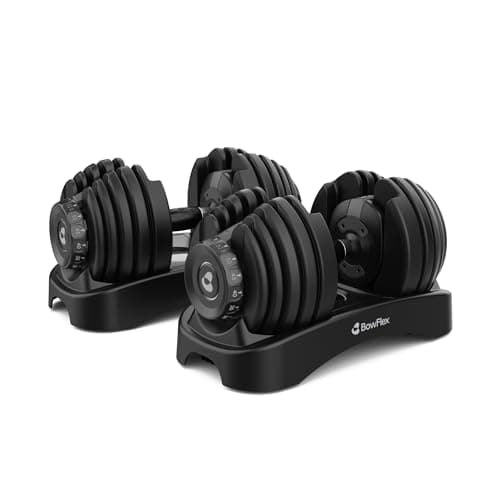
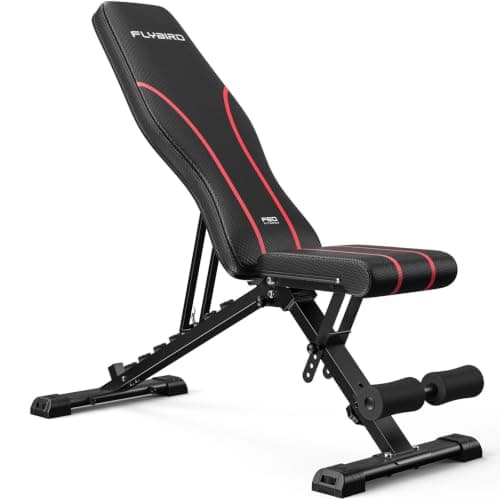
The room you sleep in, with someone who did not ask for a gym. The rule here is that every piece has to be storable in under a minute, which rules out most of the category and leaves a surprisingly complete kit: a band set in a drawer, one pair of adjustable dumbbells in the closet or under a nightstand, a bench that folds flat and goes behind the door, and a doorway bar that lifts out. Mats roll or stack in a wardrobe.
The practical trick is a single home for everything — one shelf, one corner of the closet — because the failure mode is not space, it is a pair of dumbbells living on the floor beside the bed for three weeks. If you are the person who will not put it away, buy less equipment, not more storage.
3. The box room
A single bed or a small double and almost nothing else — the bedroom equivalent of a dorm room. There is no training rectangle here with the bed down, so the layout is vertical and doorway-based: bands anchored in the door, a doorway pull-up bar, one pair of light-to-mid adjustable dumbbells, and the floor space at the foot of the bed for the few minutes a set takes. Skip the bench; use the bed edge for supported rows and the floor for pressing, which is a genuinely effective substitute with dumbbells.
If the box room is the only room you have and you want more than that, the honest answer is that the equipment is not the constraint — the bed is. That is a furniture decision, not a gym one.
What does not belong in a bedroom
- Anything you intend to drop. Bumper plates, dropped kettlebells, box jumps. The room below decides this one, not you.
- A full power cage, in a shared bedroom. It is a permanent four-post object with a footprint you cannot reclaim. In a spare room it is a fair choice; beside a bed somebody sleeps in, it is a mistake you have to disassemble.
- Loud cardio.Air bikes and rowers with chain drives are fine in a garage and hard to justify over someone's ceiling. If cardio is in the plan, our quietest cardio ranking is built on exactly this constraint, and a walking pad is usually the bedroom answer because it slides under the bed between uses.
- A mirror you have not secured. Bedrooms have the most leaning full-length mirrors of any room in the house, and a mirror next to where you train needs to be fixed, not leaned. Our renter-friendly mirror guide covers the no-drill options.
What to buy, in order
The five picks below are the pieces that fit every bedroom layout above, listed in the order we would buy them for this room specifically. This is not the general small-space order — the bedroom version puts silence and storability ahead of capability, because those are the two things that get a gym thrown out of a bedroom. Each card carries its live price; nothing on this site quotes a price in the prose, because the number on the card is the one that is actually current.
Keeping it a bedroom
The test we would apply: if a guest slept in the room tonight, how long would it take to make that possible? Under ten minutes is a bedroom with a gym in it. An afternoon is a gym with a bed in it, and you should know which one you are building before you buy — a lot of arguments about home gyms are really arguments about that distinction.
Three things make the difference in practice. Give every piece one home rather than a general area. Prefer pieces that fold, stack or collapse over pieces that are merely small; a 40 lb bench that folds flat disappears, and a 25 lb bench that does not, does not. And keep the training rectangle a rectangle — the moment equipment starts living in it, the room stops being usable for either purpose.
The room below is part of your setup
If you train in an upstairs bedroom, decide early what is underneath and when it is occupied. A living room at 9 pm and an empty kitchen at 6 am are different rooms entirely, and the schedule is free where flooring is not. Beyond timing, the order of effectiveness is: pick equipment that makes no impact, put a dense layer under what is left, set weights down rather than releasing them, and keep the heaviest static storage near a wall rather than mid-span.
That last one comes from the floor load guide and it costs nothing: a joist is stiffest at its ends. Dumbbells stored against the wall are both quieter and structurally better placed than the same dumbbells stored in the middle of the room, and in a bedroom the wall is usually where you wanted them anyway.
When the bedroom is the wrong room
Worth saying plainly, because the alternative is usually closer than people think. If the bedroom is shared and your training is genuinely heavy, a garage cornerwill take equipment a bedroom never will, on a slab that does not transmit into anyone's ceiling. If the only problem is storage, a closet conversion may free the bedroom floor entirely. And if you are in one room with no spare anything, the studio apartment guide solves a harder version of this same problem.
The bedroom wins when it is the room with the door you can close, which for a lot of people is the real reason the gym ends up there. That is a good reason. It just comes with a floor somebody is sitting under.