A living room is the best-proportioned room in most homes for training and the worst room to leave equipment in. The rule that makes it work is simple and absolute: every piece has to be out of sight in about a minute, because the room has another job and other people in it. Get that right and a living room will run a complete dumbbell and bodyweight program. Get it wrong and you have put a gym in the middle of the household.
We publish a page for most of the rooms a home gym ends up in — a bedroom, a closet, a garage corner, a dorm room, and a studio apartment where there is only one room at all. The living room is the gap, and it is genuinely its own problem: plenty of floor, a hard deadline every evening, and an audience.
What makes a living room different
- The floor is the best in the house. Living rooms are usually the largest open rectangle in the home, and the furniture around the edges leaves a real clear middle. That is the opposite of a bedroom, where the bed owns the center.
- The sofa is immovable in practice. It can be pushed, but it will not be pushed twice a day for long. Plan around where it already is rather than around where it could go.
- The room has a deadline.Somebody wants it back at six o'clock. This is the constraint that eliminates most equipment, and it eliminates it completely rather than partially.
- It is usually on the ground floor.Which is good news, because the room below is often a basement or nothing at all. If you are in an apartment it is somebody's ceiling, and then the rules from the apartment noise guide apply in full.
- The flooring is the nice flooring. Hardwood, engineered boards, or a rug you chose. This is the room where a dropped dumbbell costs real money.
The sightline test
Before you buy anything, do this: sit where people sit — the sofa, facing the television — and look at the spot you would train in. Then look at the spot where the equipment would live between sessions. If the second spot is in that view, the arrangement will not survive a month, no matter how reasonable it sounds now. Equipment that is visible from the sofa stops being equipment and becomes clutter, and clutter in a shared room is a negotiation you lose.
The spots that pass the test, in rough order: inside a closet or cupboard in the hall; behind a door that stays open; behind the sofa, if the sofa is not against a wall; standing upright beside a bookcase where it reads as furniture. The spots that fail: along the wall under the television, in the corner you can see from everywhere, and "just here for now."
Three layouts that work
1. The rug rectangle
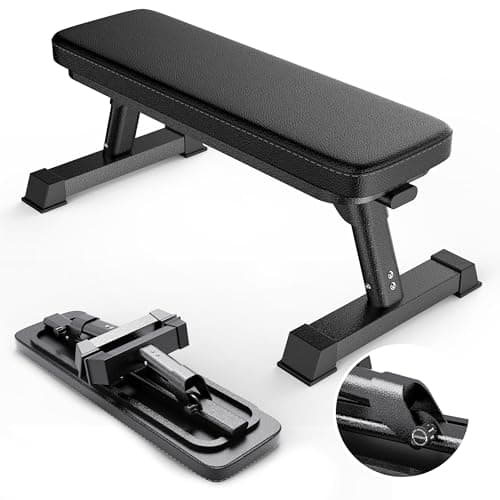
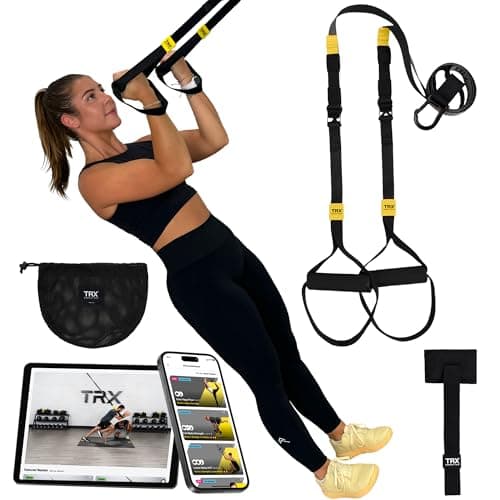
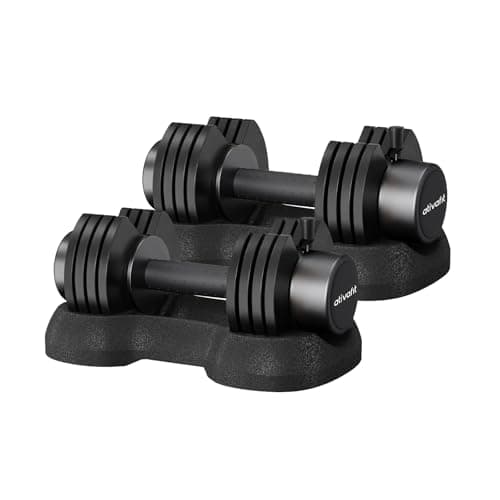
The simplest and the one we would start with. Train on the existing rug or on a mat laid over it, in the clear space between the sofa and the television, and store everything in one cupboard. Nothing is installed, nothing is visible, and the room is unchanged. A pair of light adjustable dumbbells, a folding flat bench and a suspension trainer in a bag is a complete pushing, pulling and squatting setup that fits in a cupboard the size of a suitcase.
The limitation is load: light dumbbells and bodyweight, with no barbell and nothing dropped. For a lot of people that is the whole program, and in a shared room it is also the only version that nobody else complains about. If even a folding bench is too much object for the room, a wall-mounted bench folds up flat against the wall and reads as a shelf when it is not in use.
2. Behind the sofa
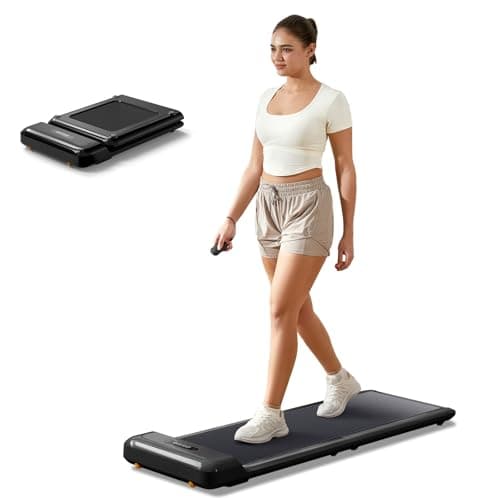
If the sofa floats rather than sitting against a wall, the strip behind it is the single most underused floor in the house — and it is invisible from the seating position, which is the point. A walking pad lives there flat and comes out in front of the television to use. A folding bench stands upright there. A dumbbell pair sits on a low shelf or in a basket. Nothing in this layout is ever seen from the sofa, which is why it survives.
3. The door-anchored corner
The version for people who want pulling without drilling anything. A suspension trainer anchors over a closed door, which gives you rows, chest presses, assisted squats and core work from a strap set that packs into a bag. Pair it with the same door for band work, and the only permanent change to the room is nothing at all. Our suspension trainer ranking covers the field, and the renter guide covers the rest of the no-drill options.
What not to put in a living room
- Anything that does not store. A power cage, a selectorized stack, a non-folding treadmill. These are fine choices in a spare room and wrong in this one.
- A barbell and plates. Not because the floor cannot take it — it almost certainly can — but because a loaded bar cannot be put away, and a rack of plates in a living room is a permanent decision disguised as a purchase.
- Chalk, and anything that sheds. Obvious in hindsight. This is the room with the nice rug.
- A mirror leaned against the wall. A full-length mirror next to where you train needs to be fixed rather than leaned, and in the room with the most foot traffic that is a safety point rather than an aesthetic one. Our mirror guide has the no-drill options.
What to buy, in order
The four picks below are the pieces that pass the sightline test in every layout above, in the order we would buy them for this room. It is not the general small-space order — the living room version puts storability and floor sympathy ahead of capability, because those are the two things that get a gym evicted from the main room of a house.
Protecting the floor you actually care about
The living room usually has the best flooring in the home, which changes the flooring decision from "do I need a mat" to "which mat comes up cleanly." Interlocking foam tiles are the right answer here precisely because they lift out in seconds and leave nothing behind — they are not a renovation, they are a layer you put down for an hour. A single-piece mat is tidier to look at and heavier to move. Our home gym mat ranking compares both, and home gym on carpet covers the case where the living room is carpeted and the equipment needs a firm layer to stand on.
Cardio in the main room is easier than strength
One genuine advantage of this room: it is the natural home for a walking pad, because the television is already here and a pad under a standing desk is a different use case from a pad in front of a screen. A fold-in-half pad stands in a closet between uses and passes the sightline test completely. If the living room is on an upper floor, put something under it and read the downstairs-neighbor page first.
When the living room is the wrong room
If you want to lift heavy, it is. The living room caps out at what you can store in a minute, which in practice means dumbbells under about 50 lb per hand, a bench and bodyweight work. If that ceiling is the problem rather than the space, the honest alternatives are a garage corner, which takes equipment no living room will, or a spare bedroom, which will at least tolerate a folding wall rack. And if the living room is the only room you have, the studio apartment guide solves a harder version of this same problem.
The living room wins when the real constraint is that you will not go and train somewhere else. A gym in the room you already sit in gets used, and a better gym in a cold garage sometimes does not. That is a good enough reason — it just has to fit in a cupboard.