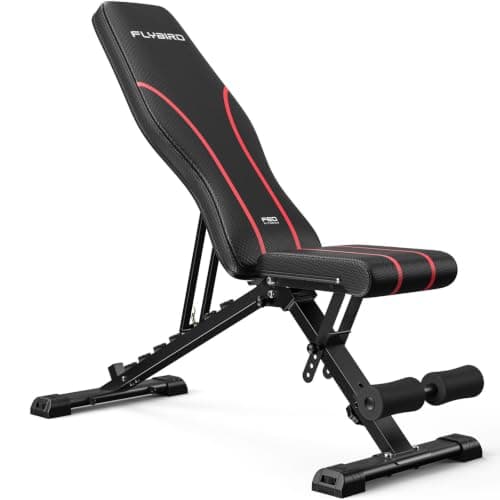
You need a bench if you want the bottom of a press, an incline, or a stable elevated base for one-arm rows — and you do not need one for anything else. If the answer is yes, the FLYBIRD WB2 is the pick for most small rooms: it adjusts from decline through steep incline, folds flat to stand against a wall, and its listing publishes a rating around 600 lb. If you are not sure yet, press from the floor for a month first. That costs nothing and answers the question better than this page can.
We rank which bench to buy five different ways — the folding ones, the adjustable ones, the ones under $200, the ones with storage and flat versus adjustable. This page is the question that comes before all of them, and the answer is genuinely sometimes no.
What a bench actually adds
Three things, and it is worth being precise because the marketing is not.
- The bottom of a press. On the floor your upper arm stops when your elbow lands, which cuts the last few inches of the movement. A bench lets the weight travel below that point. Whether you want that range is the single biggest reason to buy one.
- An angle. Incline pressing changes which part of the push is loaded, and there is no floor substitute at all. A flat bench does not give you this either — only an adjustable one does, which is why the adjustable kind dominates our rankings despite costing more.
- A stable elevated base. For a one-arm row, a split squat rear foot, a hip thrust shoulder line or a step-up, you want something that will not slide or tip. A bench is engineered for that. A dining chair is engineered to be sat on, and the difference matters when you are loaded.
What it does not add: strength, safety, or the ability to lift heavier. A bench is a geometry tool.
What the floor genuinely substitutes for
More than people expect. Floor pressing with dumbbells is a real movement with a real history, not a consolation prize; it just has a shorter range at the bottom. Floor pressing also removes the stability demand of a narrow bench, which is why some people press more from the floor than off one.
Beyond pressing, the substitutions are good: a bed edge or a sofa arm works for supported one-arm rows, the floor works for hip thrusts with a shorter range, a wall works for seated shoulder pressing, and a step or a low stool covers step-ups. Our bedroom gym guide leans on exactly these substitutions for rooms where a bench will not fit, and the dorm room build drops the bench entirely for the same reason.
The honest test: do the dumbbell press you would normally do, from the floor, for four weeks. If the only thing you miss is the bottom few inches and an incline, buy a bench. If you did not notice, you have just saved the floor area and the money.
What to look for, if the answer is yes
Four specifications, in this order, and two of them are frequently missing from listings.
- Does it adjust, and through what range? Decline through steep incline is the widest useful span. Flat-only is cheaper and more stable, and it is a real choice rather than a lesser one — see flat versus adjustable.
- Does it fold, and how flat? In a room with another job, this is the spec that decides whether the bench stays. A bench that folds flat stands against a wall or slides behind a door.
- Rated load — and which number it is. Some listings publish a total rating, some publish a max user weight, and the two are not the same claim. One of our picks publishes 300 lb max user; another publishes around 600 lb total. Our bench capacity guide separates them.
- Pad width and gap. Narrow pads feel unstable under heavy pressing; a gap between the back pad and the seat pad is uncomfortable on an incline. Neither is usually published, which is worth knowing before you order on price alone.
The three benches, and the fourth pick
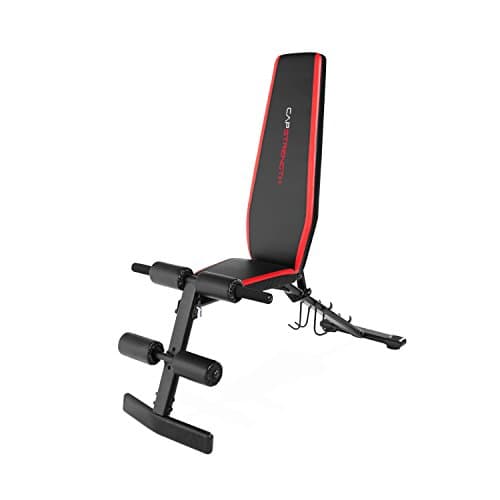
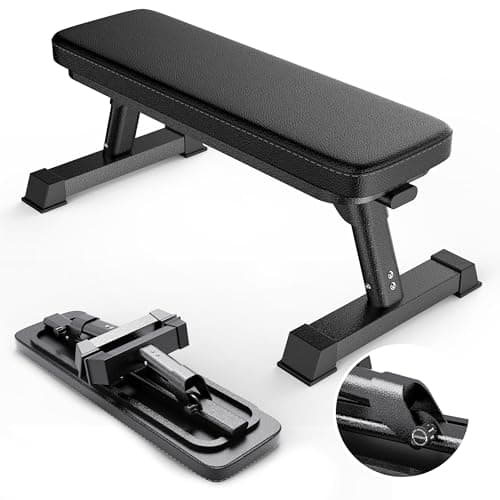
The picks below cover the yes answer at three price points, plus the thing to buy if your answer is no. The FLYBIRD WB2 is the small-room default: folds flat, adjusts through the full range, light enough to move with one hand. The CAP FM-CS104B is the cheapest honest adjustable — four back positions, a published 300 lb max user weight and a 28 lb frame, with dumbbell holders on the leg brace; CAP publishes no assembled dimensions at all, which we flag on its card rather than estimating. The Finer Form is the flat-only choice for anyone who presses heavy and wants a planted feel.
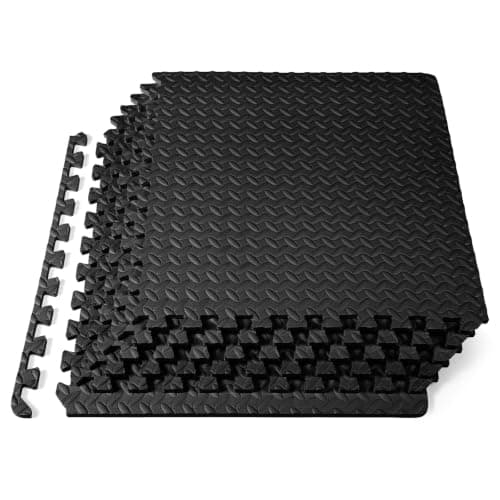
The fourth pick is a set of interlocking mats, and it is there deliberately. If you have decided against a bench, the floor is now your bench, and a half-inch EVA layer is what makes floor pressing comfortable and keeps dumbbell ends off a finished floor. It is also the cheapest item on this page by a wide margin.
The floor area a bench actually costs
A bench is roughly four feet by one and a half, plus the space to lie on it with your arms out, plus room to get a dumbbell to the floor on each side. Call it a 6 by 5 ft working rectangle while in use — comparable to the training rectangle you already need for standing work, which is why a bench rarely enlarges a room's requirement so much as occupy the middle of it.
Stored is where the formats separate. A folding bench stands flat against a wall at around a foot of depth; a non-folding bench is a permanent object you walk around. In a spare room that is fine. In a living room or a bedroom it is the whole decision, and our fold-flat guide ranks the categories where that distinction matters most.
Do not use a chair, a coffee table or a stability ball
Three substitutions people try that we would not. A dining chair has a narrow base, often a sloped seat, and no engineering assumption about a loaded person lying across it. A coffee table is built for a vase. A stability ball turns a press into a balance exercise, which is a different movement and not the one you were trying to do. If a bench does not fit the room or the budget, press from the floor — that is a legitimate movement, and the alternatives above are not.
When a bench is clearly the wrong purchase
- You do not own dumbbells or a barbell yet. Load first, geometry second. Our $300 build deliberately puts the bench fourth in its buying order for exactly this reason.
- Your dumbbells top out light. At 19 lb per hand, the bottom few inches of range is not your limiting factor, and the floor is fine.
- The room has no permanent or semi-permanent spot for it. A bench that lives in a hallway gets resented, then sold. Buy a folding one or buy none.
- You train mostly bodyweight and bands. A doorway pull-up bar and a band set is a better next purchase than a bench, in both footprint and cost.
And when it is clearly right
If you own dumbbells at 35 lb per hand or more, press regularly and have a spot for it, a bench is the best-value purchase in a dumbbell gym — it unlocks the full range of the press, adds incline, and makes rows and split squats better immediately. If a barbell is in your plan at all, a bench stops being optional: barbell benching requires one, and so does the rack question we work through in do you need a squat rack at home.
Storage, which decides whether you keep it
Two things make a bench stay in a small room: it folds, and it has somewhere to go. If you already own a non-folding bench, wall brackets will hang it vertically and reclaim the floor — our wall-mounted bench guide covers that option, and small-space weight storage handles the plates and dumbbells that come with it.