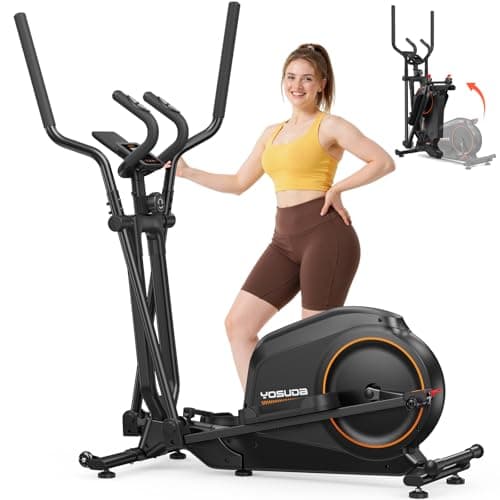
In an apartment the elliptical usually wins, and the YOSUDA E03 is our pick because it is the only one of the four that folds — 36.6 by 21.7 inches on the floor, under six square feet before it folds at all, with magnetic resistance that needs no outlet and puts no footfall into the ceiling below. Buy the treadmill instead if you specifically want to run, in which case the Sunny Health SF-T7515SMART is the value route to a real running deck. Everything else on this page follows from those two sentences.
The usual version of this comparison argues about calories and joints. We are not going to, because we have no lab and no business making either claim about a stranger. What we can compare is what the two machines do to a small room, and that turns out to be the more useful argument anyway: these two categories fail in a small space for completely different reasons, and knowing which failure you can live with settles the question in about a minute.
The one-line answer
- An elliptical grows upward. It stands you on pedals above the floor and swings your head through an arc, so the number that rules it out is ceiling height — your own height plus the pedal at the top of its travel.
- A treadmill grows lengthwise. A real running deck is five feet or more front to back, and when it folds it becomes a tall object leaning in a corner. The number that rules it out is floor length, then stored height.
- Impact is the tiebreaker if someone lives below you. On an elliptical your feet never leave the pedals, so nothing lands. Running is a sequence of landings, and a mat changes that less than people hope.
- Power is the quiet tiebreaker. Both ellipticals here are magnetic — no outlet, no motor to fail. Both treadmills need a socket near the wall you plan to use.
Height is the number nobody checks
This is the mistake we see most often, and it is specific to ellipticals. The pedal is not at floor level, and at the top of the arc it is higher still. Add your own height to that figure and you have the clearance the machine actually needs. The Sunny SF-E3810 on our compact elliptical roundup publishes a maximum pedal step height of 18.5 inches, which puts a six-foot rider somewhere near seven feet six — fine under a standard eight-foot ceiling, not fine under a basement duct or a sloped upstairs wall. Our ceiling height guide has the clearance each movement needs, and the elliptical is the one cardio machine it applies to.
Most makers do not publish step height at all. Two of the four machines on this page leave the field blank, and we say so on their Spec Blocks rather than guessing. If your ceiling is the constraint rather than your floor, that silence is itself a reason to choose a machine whose maker does print the number.
Length, and the second footprint
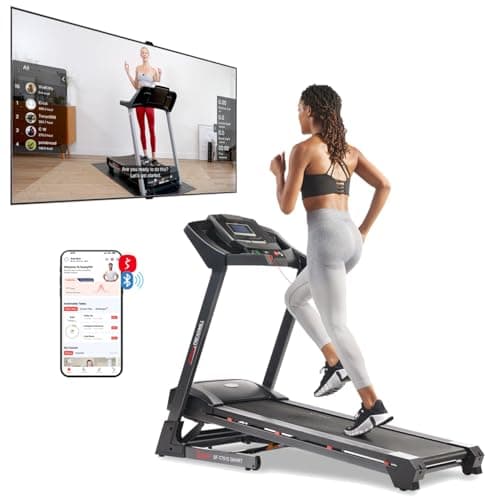
A treadmill has two footprints and only the second one folds. The Sunny SF-T7515SMART is 64 inches long in use and 55 inches tall folded, at 123.5 lb. A soft-drop hydraulic fold does the lowering for you, which is genuinely the feature worth paying for here, but transport wheels get 123 lb across a level floor and no further. Our folding treadmill storage guide is about exactly this: the fold is only useful if there is a wall for the machine to stand against when it is done.
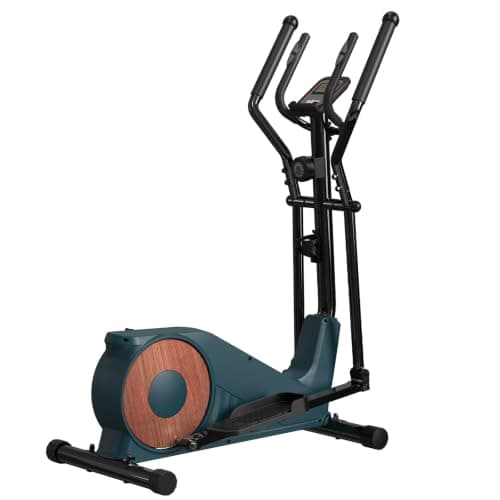
Ellipticals mostly do not fold, which is why the YOSUDA is the pick. The other two here are permanent objects — but the XVGVSV E317 is 48.2 inches long and only 20.1 inches wide, narrower than most interior doorways, so it lives down the side of a bed or along a hallway wall instead of in the middle of the room. In a small space, narrow is sometimes worth more than foldable.
How the four compare
| Machine | Type | Floor footprint | Folds? | Rated load / weight |
|---|
| YOSUDA E03 | Elliptical, magnetic | 36.6 x 21.7 in | Yes — 2 sq ft, maker claim | 350 lb / 66 lb |
| Sunny SF-T7515SMART | Treadmill, 1.0-8.0 mph | 64 in long in use | Yes — soft-drop, 55 in tall | 300 lb user / 123.5 lb |
| XVGVSV E317 | Elliptical, magnetic | 48.2 x 20.1 in | No | 400 lb / about 75 lb |
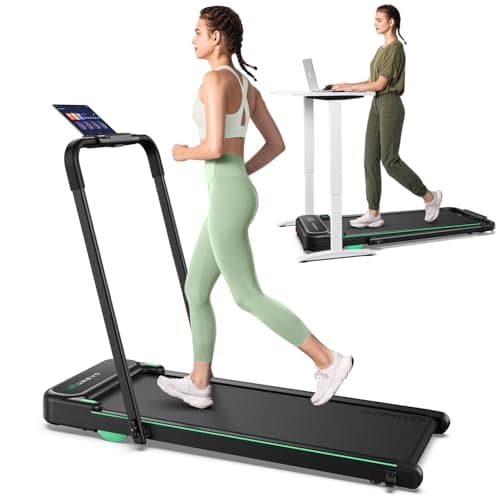
| UREVO Strol 2E | 2-in-1 pad / treadmill | Not published | Handle folds flat | Not published |
Two of those rows contain the words "not published." That is not an oversight on our part — it is the state of the listings, and on a site that ranks by stored size we would rather print the gap than fill it in.
Who should buy which
Buy the elliptical if you live above someone, if the room has to go back to being a room, if there is no outlet where the machine would stand, or if you want a machine with no motor to fail. Buy the treadmill if running specifically is the point, if you are training for something that happens on your feet, or if a standing desk is involved — a pad or treadmill works under a desk and a standing elliptical never will. The walking pad vs folding treadmill comparison is the next fork down once the elliptical is ruled out.
What a mat does and does not fix
If the treadmill wins and somebody lives below you, a mat is worth buying and worth understanding. It protects the floor, stops the machine creeping, and takes the sharp edge off the sound in your room. What it does not do is stop the low-frequency thump of a footfall traveling through the joists, because that is structural transmission rather than airborne noise. Our downstairs-neighbor page is honest about where that line falls, and the mat question works through the thicknesses.
The hybrid is a real third answer
The UREVO Strol 2E is on this page because it collapses the choice rather than making it: handle down it is a flat pad that slides under a desk or a bed, handle up it is a jog-capable treadmill with a rail to hold. It is the cheapest machine here and the one that asks least of the room. What it gives up is belt size and top speed, so it is a poor answer for anyone who genuinely runs — but for a small room where the honest use case is walking with the option to jog, it does more per square foot than either pure category. It leads our folding treadmills under $300 ranking for the same reason.
Where we would spend the money
In rough order for a small space: a folding magnetic elliptical if the ceiling allows it; a 2-in-1 pad if the budget is tight and the room is tighter; a real folding treadmill only once you are sure there is both the length to use it and the wall to stand it against. Buying the treadmill and discovering the second part afterward is the single most common way compact cardio ends up on a resale listing.
Two adjacent comparisons finish the picture if you are still choosing between categories rather than machines: treadmill vs exercise bike and rowing machine vs treadmill. Both are built on the same footprint-first logic as this one.