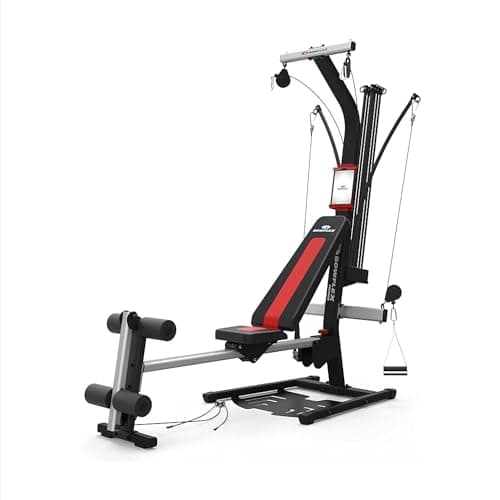
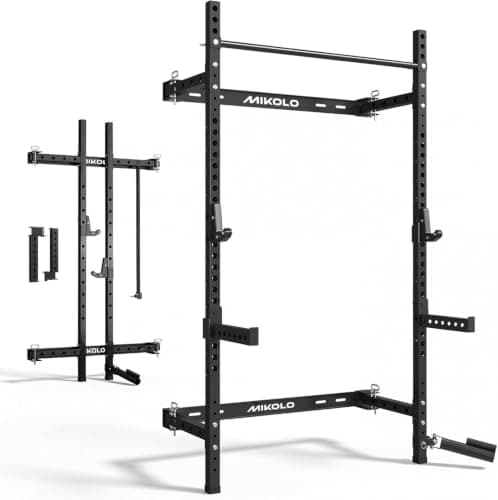
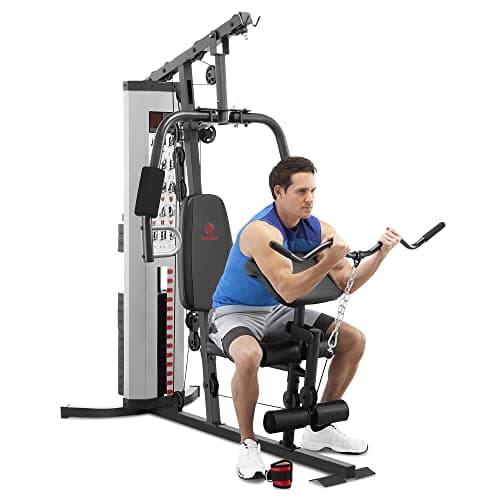
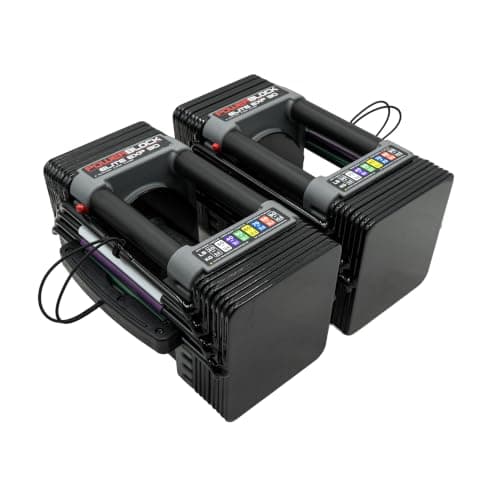
In a small home gym, free weights win, and the reason is square feet rather than biomechanics: a pair of adjustable dumbbells like the PowerBlock Elite EXP stores on a shelf and covers every movement pattern, while every machine on this page is a permanent object that is the same size whether you are using it or not. Machines earn their footprint in exactly two situations, and both are worth knowing before you decide.
The keyword data behind this page is interesting: people search "machines vs free weights," "gym equipment vs free weights" and "home gym vs free weights" in roughly equal numbers, which tells you the question is really "what should I buy," not "what is better for hypertrophy." We are going to answer the first one, because the second one is a question for someone with a lab and we have said repeatedly that we do not have one.
The small-space case for free weights
- They shrink. This is the whole argument. A pair of adjustable dumbbells occupies roughly a shelf; the equivalent machine capability occupies a corner of the room permanently. In a room with another job, an object that disappears is worth more than an object that is slightly better to use.
- One object, every pattern. Squat, hinge, press, row, carry, core — all available from one dumbbell pair plus a bench. No machine at this price covers that spread.
- They scale by purchase, not by replacement.Add a plate, add a kit, add weight. A machine's ceiling is fixed the day it arrives.
- They move house. Worth a line, because people in small spaces move more often. Our how to move a home gym guide exists because the machine half of this question is a genuinely hard moving problem.
The two situations where a machine wins
First: when you will not supply the stability. A free weight requires you to hold the path yourself. For most people that is a feature, and for some — training alone, no spotter, no interest in learning a barbell lift — it is a reason to buy a guided path instead. A selectorized stack or a rod-resistance gym gives you a fixed groove and a pin, and a pin is a lower-friction decision than a loaded bar at 6 a.m. There is also a middle option people forget: a Smith machine is a barbell on a fixed rail, which is a guided path with real plates on it. Our compact Smith machine ranking and whether a Smith machine belongs in a small home gym cover that case, footprint included.
Second: when nothing can be dropped or stored.This is the apartment-specific one. A rod-resistance machine has no plates to store, nothing to drop, and nothing to roll into a neighbor's ceiling. That is a real advantage in a third-floor apartment, and it is why the Bowflex PR1000 keeps appearing in small-space recommendations despite a footprint that is objectively worse than a dumbbell pair.
What each route costs in a small room
| Route | Footprint when unused | Weight source | Covers |
|---|
| Adjustable dumbbells + bench | A shelf and a wall | The dumbbells themselves | Every pattern, up to the pair's ceiling |
| Folding wall rack + barbell | Flat against the wall, plus plate storage | Your own plates | Heavy squat, press, pull, hinge |
| Rod-resistance all-in-one | Permanent, partly folding | Built in — up to 210 lb rods | Guided push, pull, legs, row |
| Selectorized stack | Permanent corner unit | Built in — 150 lb stack | Guided press, pulldown, leg, pulley |
Read that first column before the last one. In a small space the footprint-when-unused is the number that decides whether you still own the equipment in two years.
The answer most people should hear
Buy the dumbbells. Add a bench. Add a doorway pull-up bar for a few dollars. That is a complete program in a closet, and it is the setup our small-space essentials list and beginner listboth arrive at from different directions. Then, if you find you want a barbell, add a folding wall rack rather than a machine — it is the only "big" purchase in this category that gives the floor back.
Buy the machine if the pin and the fixed path are what will get you to train, or if nothing in your building can be dropped and plate storage is genuinely impossible. Both are legitimate. What we would not do is buy a machine because it looks like more gym — in a small room, it is mostly more object.
The hybrid that actually works in a small room
The most capable small-space setup we recommend is not on either side of this argument: it is a folding wall-mounted rack with a cable pulley, plus a dumbbell pair. You get free weights for everything, cables for the pulldowns and pressdowns that free weights do badly, and a wall that folds flat when you are done. Our folding racks with cables ranking covers that combination, and the lat pulldown routes are the cheapest way to add the one movement free weights cannot replicate.
What free weights genuinely cannot do
Two things, and it is worth being straight about them. A vertical pull with resistance below your bodyweight — a lat pulldown — has no free-weight equivalent; you either do pull-ups at full bodyweight or you add a cable. And isolated leg work past what a dumbbell can load is hard without a machine. Everything else on a typical machine circuit has a free-weight version that works at least as well in a small room. Our do you need a cable machine page argues this out in detail.
Noise is the quiet tiebreaker
If you are above someone, the machine side has a real edge that nobody mentions: a stack or a rod has nothing to drop and nothing to set down hard. Free weights are only quiet if you are disciplined, and dropped dumbbells are the loudest thing in a small-space gym. Our apartment noise guide and can you drop adjustable dumbbells both land on the same rule, which is to place rather than release. If you know you will not, that is an honest argument for the pin.