Skip to content
RACK:RATIO

HUB 05 · Cable, All-in-One & Power Towers

The Best Wall-Mounted Pull-Up Bars

Two numbers decide this purchase and most listings publish neither: how far the bar stands off the surface, and what framing it needs behind the screws.

By Stephen V.Reviewed How we research
#ad

We earn a commission when you buy through our Amazon links, at no extra cost to you. It never changes our rankings, and we say so when the cheaper product is the better buy. How this works.

For most rooms the SELEWARE 48 in multi-grip bar is the pick: 500 lb of published rating on 4 mm welded steel, a span that lands on either 16 in or 24 in stud centers, and anchor rings for straps or a bag. If the wall is the problem rather than the solution — no studs where you need them, or nothing you can give up two feet of depth to — go up instead. The Ultimate Body Press ceiling bar drops 14 in below the joists, which is the one drop figure a standard 8 ft ceiling can actually spare. The XMark is the bar to buy if you want the last one you ever buy, and it wants a garage wall to do it on.

A mounted bar is the step after a doorway bar, and it is worth being clear about what you are buying with the drill. A doorway bar costs about thirty-five dollars, needs no tools, comes down in ten seconds and is limited by the door frame it sits in — width, capacity and the fact that your knees find the frame on every rep. A mounted bar gives you a genuinely wide grip, a capacity in the hundreds of pounds, room to swing your legs, and somewhere to hang rings or a bag. What it costs is holes.

That trade is the whole page. Everything below is ranked on how well each bar survives contact with a real room: how far it projects, what framing it needs, and whether the maker publishes those numbers at all. Three of the five do. Two do not, and we say so on their cards rather than filling the gap with a guess.

Projection and drop: the number that decides it

A wall bar's projectionis how far the bar sits out from the wall. A ceiling bar's drop is how far it hangs below the joists. They are the same specification wearing two names, and between them they decide three things:

  • Whether you can pull without hitting anything. Too little projection and your knees and chest find the wall on every rep. Around 14 to 22 in is where the bars that publish a number land, and the taller you are the more you want.
  • How much room the bar takes permanently. The XMark stands 22.5 in proud of the wall across a 50 in width. That is nearly two feet of depth you cannot put a shelf, a bed or a bench into, forever.
  • Where the bar ends up. Ceiling height minus drop is bar height, and that arithmetic is the difference between a pull-up and a tucked hang.

Only XMark (22.5 in), Ultimate Body Press (a 14 in riser) and Kipika (25.8 to 41 in adjustable) publish it. SELEWARE and Fitarc do not, and their listings' structured dimension fields are the shipping carton — XMark's listing puts the item weight of an 11-gauge steel frame at 0.000625 lb, which tells you how much that field is worth in this category. Where a maker is silent, our spec sheet says "not published" and you should plan to measure the bar when it arrives, before you mark the wall.

Your framing decides which bars are candidates

Every bar here is rated in the hundreds of pounds and every one of those ratings assumes the anchors hold. The steel is almost never the weak link — the wall is. So the first thing to establish is not which bar you want but what is behind the drywall:

  • 16 in centers. The most common US framing. Everything on this page works, including the XMark, which specifically needs 16 in centers across a 48 in span.
  • 24 in centers. Common in newer construction and in garages. The SELEWARE spans it (48 in = two bays), the Ultimate Body Press risers flip to fit it, and the XMark and Fitarc are out.
  • Metal studs, hollow block or drywall alone. No bar on this page is rated for any of them. Fitarc is the only maker here that says so on the listing; the rest leave you to work it out.

Find the studs with a magnet rather than a stud finder if you want certainty — you are looking for the drywall screws, and they mark the center of the framing. The same anchor-first logic runs through our guide to what a wall-mounted rack can hold, and it applies with more force here, because a pull-up bar takes your full bodyweight as a shock load every time you drop off it.

How the five compare

BarMounts toProjection / dropBar widthRated
SELEWARE SWPUB-03Wall, 16 or 24 in centersNot published48 in500 lb
Ultimate Body Press CMPCeiling, 16 or 24 in joists14 in drop42 in300 lb
XMark XM-9025Wall, 16 in centers22.5 in projection50.25 in850 lb
Kipika KPPUB-15Ceiling, spacing not published25.8-41 in drop48 in500 lb
Fitarc FWMPUB-1Wall, 32-36 in spanNot published39 in440 lb

Read the "mounts to" column first — it eliminates faster than price does. Then read the rated column knowing that the number describes the bar, not your wall.

The short answer

Quick picks

#ProductBest forScorePrice
01
SELEWARE SELEWARE 48" Multi-Grip Wall-Mount Pull-Up Bar (SWPUB-03)
SELEWARE 48" Multi-Grip Wall-Mount Pull-Up Bar (SWPUB-03)

A fully welded 4 mm steel bar rated to 500 lb that spans 48 in, which lands on either 16 in or 24 in stud centers — the two spacings almost every US wall uses. Multi-grip, with two anchor rings for straps, rings or a bag. The gap in its paperwork is the one this page cares about most: SELEWARE never says how far the bar stands off the wall.

The wall bar most rooms should get
8.5
$119.99Amazon
02
Ultimate Body Press Ultimate Body Press Ceiling Mount Pull-Up Bar (CMP)
Ultimate Body Press Ceiling Mount Pull-Up Bar (CMP)

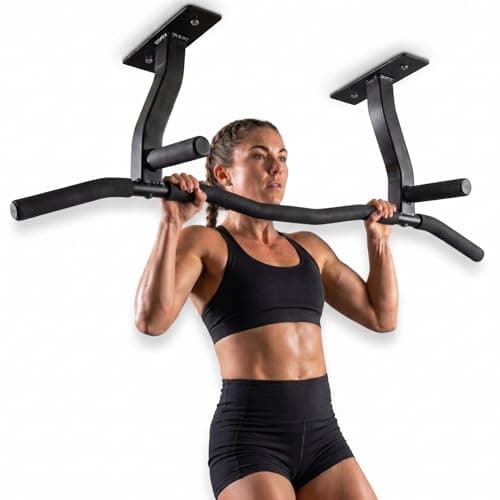
The shortest drop here at 14 in, which is exactly what a standard 8 ft ceiling can spare — it puts the bar near 6 ft 10 in, high enough to hang with bent knees and low enough that you are not brushing the joists. Its risers flip to fit 16 in or 24 in joists, so you do not have to know your ceiling's framing before you order. The catch is a 300 lb rating, the lowest on this page.

A standard 8 ft ceiling
8.3
$89.95Amazon
03
XMark XMark Commercial Wall-Mounted Multi-Grip Pull-Up Bar (XM-9025)
XMark Commercial Wall-Mounted Multi-Grip Pull-Up Bar (XM-9025)

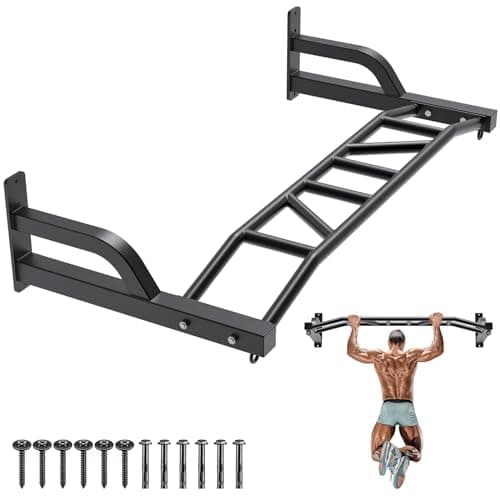
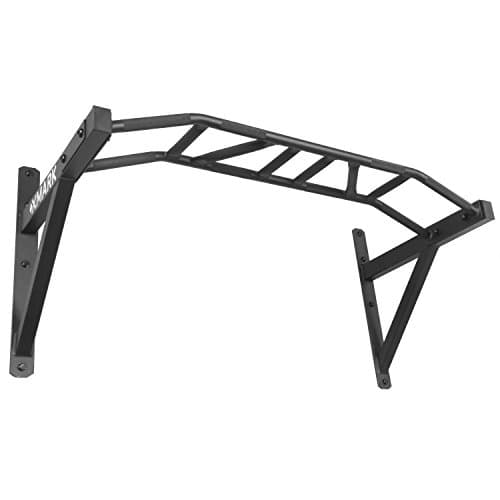
The only bar here that publishes its projection outright — 22.5 in off the wall — on 11-gauge steel rated to 850 lb with a lifetime warranty and a 28 mm knurled bar. It is also the one that claims the most room: nearly two feet of permanent depth across a 50 in width. Worth it in a garage, hard to justify in a bedroom.

The bar that outlives the house
8.0
$255.00Amazon
04
Kipika Kipika 48" Ceiling Pull-Up Bar (KPPUB-15)
Kipika 48" Ceiling Pull-Up Bar (KPPUB-15)

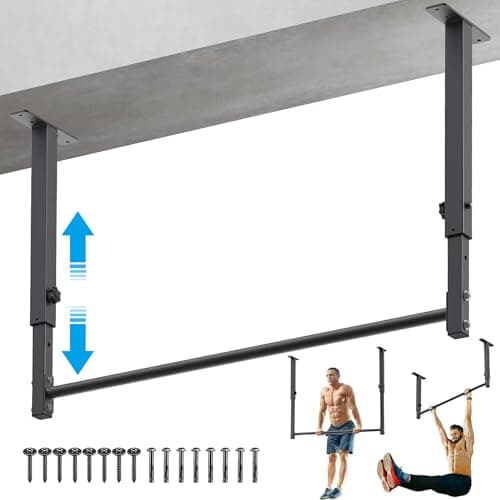
The only bar here whose drop adjusts — 25.8 in to 41 in — which is the right answer under a high basement or garage ceiling where a fixed 14 in riser would leave the bar out of reach. It is rated to 500 lb across eight bolt positions per base plate. Under a standard 8 ft ceiling, though, even the shortest setting puts the bar near 5 ft 10 in.

High ceilings and garages
7.5
$92.99Amazon
05
Fitarc Fitarc Wall-Mount Pull-Up Bar (FWMPUB-1)
Fitarc Wall-Mount Pull-Up Bar (FWMPUB-1)

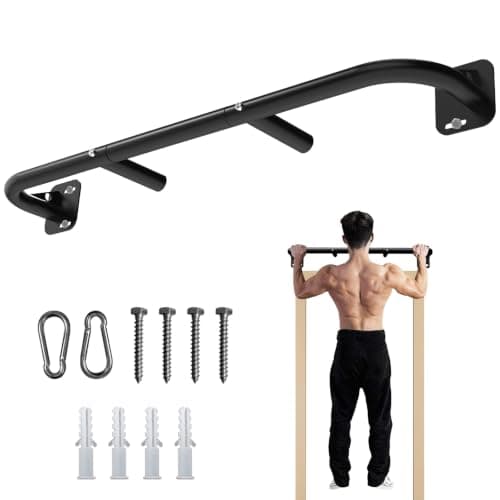
A flat 39 in bar with two neutral grips, rated to 440 lb, for about a third the price of the multi-grip frames. It earns its place on candor rather than steel: Fitarc publishes the exact stud span it needs (32 to 36 in, two bays at 16 to 18 in centers) and states outright that it will not mount to drywall alone, hollow block or metal studs — which is more than most of this category admits.

The cheapest honest way in
7.3
$39.99Amazon

#ad · Live prices from the Amazon Product API, as of Sep 9, 2026. Where we have no verified live price, we show none — we would rather leave a gap than print a number that has rotted.

In detail

The picks, in full

01
SELEWARE SELEWARE 48" Multi-Grip Wall-Mount Pull-Up Bar (SWPUB-03)

The wall bar most rooms should get

SELEWARE 48" Multi-Grip Wall-Mount Pull-Up Bar (SWPUB-03)

48" stud span500 lb rated4 mm welded steel2 anchor rings
8.5/10

A fully welded 4 mm steel bar rated to 500 lb that spans 48 in, which lands on either 16 in or 24 in stud centers — the two spacings almost every US wall uses. Multi-grip, with two anchor rings for straps, rings or a bag. The gap in its paperwork is the one this page cares about most: SELEWARE never says how far the bar stands off the wall.

Good

  • 48 in span sits on 16 in or 24 in centers, so it fits most US framing either way
  • 500 lb from 4 mm fully welded steel at a mid-range price
  • Two anchor rings make it a mount for straps, rings or a bag as well as a bar

Trade-offs

  • SELEWARE does not publish how far the bar stands off the wall — the number this page is built on
  • Screws are included for wood and concrete, but nothing here mounts to drywall alone
  • No published warranty term
Fit
9
Value
9
Install
8
Build
8

Skip this if…

you cannot find framing that gives you a clean 48 in span, or the wall behind is metal stud or hollow block — the 500 lb rating assumes solid wood or concrete behind every screw.

Spec sheet

Type
Wall-mounted multi-grip bar, fully welded
Bar width
48" — spans 16" or 24" stud centers (per listing)
Wall projection
Not published — measure the wall before you commit it
Rated load
500 lb (per listing)
Steel
4 mm alloy steel, powder-coated
Grips
Wide, narrow and neutral positions
Anchor points
2 round rings for straps, rings or a heavy bag
Hardware
Screws included for wood and for concrete
Shipping weight
26.5 lb (per listing)
Install / renter
Drills into studs or solid concrete — not reversible
$119.99View on Amazon

Price as of Sep 9, 2026. Prices change — Amazon's is the one that counts.

#ad · we may earn a commission from this link to SELEWARE 48" Multi-Grip Wall-Mount Pull-Up Bar (SWPUB-03)

02
Ultimate Body Press Ultimate Body Press Ceiling Mount Pull-Up Bar (CMP)

A standard 8 ft ceiling

Ultimate Body Press Ceiling Mount Pull-Up Bar (CMP)

14" drop16" & 24" joists300 lb rated20" parallel grips
8.3/10

The shortest drop here at 14 in, which is exactly what a standard 8 ft ceiling can spare — it puts the bar near 6 ft 10 in, high enough to hang with bent knees and low enough that you are not brushing the joists. Its risers flip to fit 16 in or 24 in joists, so you do not have to know your ceiling's framing before you order. The catch is a 300 lb rating, the lowest on this page.

Good

  • 14 in drop is the shortest here, and it is what an 8 ft ceiling can actually give up
  • Reversible risers cover 16 in and 24 in joists, so either framing works
  • Ships with a printed mounting template and all the hardware

Trade-offs

  • 300 lb rating is the lowest on this page — a weight belt eats that headroom quickly
  • 42 in bar is six inches narrower than the wall bars, so the widest grip is narrower too
  • A ceiling install is the least reversible thing on this page
Fit
9
Value
9
Install
7
Build
8

Skip this if…

you already train weighted pull-ups — 300 lb published is you plus the belt plus whatever you hang on it, and the makers with 500 to 850 lb ratings cost barely more.

Spec sheet

Type
Ceiling / joist-mounted bar, reversible risers
Bar width
42" (per listing)
Drop
14" below the joist (Ultimate Body Press)
Joist spacing
Risers flip to fit 16" and 24" joists on center
Rated load
300 lb (maker does not say whether that includes added weight)
Grips
4 angled positions, 20" parallel spacing, high-density foam
Material
All steel, powder-coated
Weight
11.2 lb item (listing); 15 lb shipping (maker)
Included
Bar, parallel grips, mounting template, all hardware
Install / renter
Lag-bolts up into joists — permanent holes in a ceiling
$89.95View on Amazon

Price as of Sep 9, 2026. Prices change — Amazon's is the one that counts.

#ad · we may earn a commission from this link to Ultimate Body Press Ceiling Mount Pull-Up Bar (CMP)

03
XMark XMark Commercial Wall-Mounted Multi-Grip Pull-Up Bar (XM-9025)

The bar that outlives the house

XMark Commercial Wall-Mounted Multi-Grip Pull-Up Bar (XM-9025)

22.5" off the wall850 lb rated11-gauge steelLifetime warranty
8.0/10

The only bar here that publishes its projection outright — 22.5 in off the wall — on 11-gauge steel rated to 850 lb with a lifetime warranty and a 28 mm knurled bar. It is also the one that claims the most room: nearly two feet of permanent depth across a 50 in width. Worth it in a garage, hard to justify in a bedroom.

Good

  • Publishes the number nobody else does: 22.5 in of clearance from the wall
  • 850 lb on 11-gauge steel, backed by a lifetime warranty
  • 28 mm knurled bar with 14 grips — the only knurled bar on this page

Trade-offs

  • 22.5 in of projection is nearly two feet of depth claimed permanently
  • Roughly double the price of the mid-range wall bars here
  • Needs 16" stud centers across a 48" span — 24" framing is out
Fit
7
Value
7
Install
8
Build
10

Skip this if…

the wall is in a room you also live in — a 50 in bar standing 22.5 in proud of the wall reads as furniture, and it is not coming down again.

Spec sheet

Type
Wall-mounted multi-grip bar, welded frame
Assembled size
50.25" W x 23.75" H x 23" D (XMark)
Wall projection
22.5" from the wall (XMark)
Rated load
850 lb when properly installed (XMark)
Steel
11-gauge alloy steel, powder-coated
Bar
28 mm knurled; 14 grip positions; 7" inside grip width
Stud spacing
48" span on 16" stud centers (XMark)
Hardware
8 x 3" lag screws included
Warranty
Lifetime (XMark)
Install / renter
Lag-bolts into wood studs — permanent
$255.00View on Amazon

Price as of Sep 9, 2026. Prices change — Amazon's is the one that counts.

#ad · we may earn a commission from this link to XMark Commercial Wall-Mounted Multi-Grip Pull-Up Bar (XM-9025)

04
Kipika Kipika 48" Ceiling Pull-Up Bar (KPPUB-15)

High ceilings and garages

Kipika 48" Ceiling Pull-Up Bar (KPPUB-15)

25.8-41" drop500 lb rated48" bar8-hole base plates
7.5/10

The only bar here whose drop adjusts — 25.8 in to 41 in — which is the right answer under a high basement or garage ceiling where a fixed 14 in riser would leave the bar out of reach. It is rated to 500 lb across eight bolt positions per base plate. Under a standard 8 ft ceiling, though, even the shortest setting puts the bar near 5 ft 10 in.

Good

  • 25.8 to 41 in of adjustable drop — the only bar here that tunes to the ceiling you have
  • 500 lb rated, with eight bolt positions per base plate rather than four
  • 48 in bar gives a wider grip than either fixed ceiling option

Trade-offs

  • Kipika publishes no joist spacing — "any standard joist" is not a specification
  • Even the shortest setting drops 25.8 in, which a standard 8 ft ceiling cannot spare
  • The listing claims "no drilling or extra tools required", which cannot be true of a bolted joist mount
Fit
7
Value
8
Install
7
Build
8

Skip this if…

your ceiling is a standard 8 ft — subtract the 25.8 in minimum drop and the bar lands near 5 ft 10 in, which is a tucked hang rather than a pull-up.

Spec sheet

Type
Ceiling / joist-mounted bar, adjustable drop
Bar width
48" (per listing)
Drop
Adjustable 25.8" to 41" below the ceiling (per listing)
Rated load
500 lb (per listing)
Base plates
8-hole design, 8.3" x 2" footprint
Material
Heavy steel tube, electrophoretic coating
Item weight
20.4 lb (per listing)
Joist spacing
Not published — Kipika says only "any standard joist"
Install / renter
Bolts up into joists — permanent
$92.99View on Amazon

Price as of Sep 9, 2026. Prices change — Amazon's is the one that counts.

#ad · we may earn a commission from this link to Kipika 48" Ceiling Pull-Up Bar (KPPUB-15)

05
Fitarc Fitarc Wall-Mount Pull-Up Bar (FWMPUB-1)

The cheapest honest way in

Fitarc Wall-Mount Pull-Up Bar (FWMPUB-1)

32-36" stud span440 lb rated39" bar2 neutral grips
7.3/10

A flat 39 in bar with two neutral grips, rated to 440 lb, for about a third the price of the multi-grip frames. It earns its place on candor rather than steel: Fitarc publishes the exact stud span it needs (32 to 36 in, two bays at 16 to 18 in centers) and states outright that it will not mount to drywall alone, hollow block or metal studs — which is more than most of this category admits.

Good

  • Publishes the exact stud span it needs, which most cheap bars leave you to guess
  • States what it will not mount to — drywall alone, hollow block, metal studs
  • 440 lb rating and two neutral grips at the lowest price here

Trade-offs

  • No published wall projection, and a flat bar of this design sits close to the wall
  • 39 in and fixed — no angled wide grips, no anchor rings
  • 4.9 lb of steel: the rating leans entirely on your anchors, not on the bar
Fit
8
Value
9
Install
6
Build
6

Skip this if…

your studs are 24" on center — the published span is 32" to 36", so a 24" bay is too narrow and two bays at 48" is too wide.

Spec sheet

Type
Wall or beam-mounted straight bar with neutral grips
Bar width
39" (per listing)
Stud span
32" to 36" — two bays at 16" to 18" centers (per listing)
Wall projection
Not published — a flat bar of this type sits close in
Rated load
440 lb (per listing)
Grips
Straight bar plus two neutral grips
Will not mount to
Drywall alone, hollow concrete block, metal stud framing (per listing)
Item weight
4.9 lb (per listing)
Extras
Carabiners for bands and straps
Install / renter
Screws into solid studs, joists, beams or solid concrete
$39.99View on Amazon

Price as of Sep 9, 2026. Prices change — Amazon's is the one that counts.

#ad · we may earn a commission from this link to Fitarc Wall-Mount Pull-Up Bar (FWMPUB-1)

Wall or ceiling?

Both work; they fail differently. A wall bar is easier to reach, easier to install alone and easier to inspect, and it claims a strip of wall plus up to two feet of the floor in front of it. A ceiling bar claims nothing you were using, which in a small room is a real argument — the space under a pull-up bar is space you still walk through. It also puts you further from every surface, so kipping, leg raises and rings all have room.

The reasons to choose the ceiling are usually negative ones: there is no wall with two usable studs, or the only wall is shared with a neighbor who would rather not hear you, or the wall is already carrying a folding rack. The reason to choose the wall is that drilling up into a ceiling, overhead, with a bar you are about to hang your whole bodyweight from, is a harder job to do well.

Do the height math before you drill

Bar height equals mounting height minus drop. Run it before you order, because it is not recoverable afterward:

  • Ultimate Body Press, 14 in drop, 8 ft ceiling: the bar lands around 6 ft 10 in. Most people hang from that with knees bent, which is normal and fine.
  • Kipika, 25.8 in minimum drop, 8 ft ceiling: the bar lands near 5 ft 10 in. That is a tucked hang, not a pull-up. In a 10 ft basement or a garage with exposed joists, the same adjustment range is exactly what you want.
  • Any wall bar: you choose the height, so put the bar so that your extended hands reach it with your heels off the floor, then check that your head clears the ceiling at the top of the rep. That second check is the one people skip.

Our ceiling height guide for a home gym works through the clearance each movement needs. Pull-ups are the movement that decides whether a low-ceilinged room can be a gym at all, and a ceiling-mounted bar is the version of this purchase most likely to fail that test.

What these bars will not mount to

Every capacity on this page is conditional. Repeated plainly, because listings bury it:

  • Drywall alone. Never, with any anchor, at any rating. A pull-up bar applies a shock load that toggle bolts in plasterboard are not designed for.
  • Metal stud framing. Common in apartments and in finished basements. Fitarc rules it out explicitly; treat the silence of the others as the same answer.
  • Hollow concrete block. The face shell is thin and the anchor has nothing behind it. Solid concrete or solid brick is fine with the right sleeve anchors.
  • A joist you have not positively identified. Overhead, a miss is worse than on a wall, because you find out at the top of the first rep.

Renters: this is where we stop being reversible

Most of what this site recommends leaves with you and leaves nothing behind. This page does not. Every bar here puts four to eight lag screws into structural framing, and the holes are the size of the screw plus whatever the drywall does around them. On a normal lease that is a patch-and-paint job at move-out, which is survivable, but it is a decision rather than an afterthought.

If that is a problem, the honest answer is that a no-drill doorway bar gets you 80 percent of the training for none of the commitment, and a suspension trainer over a door covers the rowing patterns a bar cannot. Our renter-friendly home gym ideas collects everything that installs without a drill.

What a mounted bar does to the room

A wall bar is not a flat object. At 22.5 in of projection the XMark occupies a volume roughly the size of a nightstand, permanently, at head height — and you cannot put anything under it either, because you need floor to stand on and land on. Budget the depth of the bar plus about two feet of clear floor in front of it.

A ceiling bar takes the same clear floor but no wall, which is why it is often the right answer in a room already at capacity. Either way, put something soft where you land: see our home gym mat roundup for what survives being dropped onto, and lifting in an apartment for how much of that landing your downstairs neighbor hears.

Who should buy something else instead

  • You rent and cannot drill. A doorway bar, without hesitation. Nothing on this page is worth a deposit.
  • You want dips and knee raises too. A power tower is one freestanding object that covers all three, at the cost of a permanent floor footprint — we compare the two approaches in power tower vs doorway pull-up bar.
  • You want to squat and press from the same wall. A wall-mounted folding rack with an integrated pull-up bar does both, folds flat, and uses the same studs you were going to drill anyway.
  • You cannot do a pull-up yet. Buy the bar anyway, but buy bands with it — assisted reps from a band are the fastest route to the first unassisted one. See the resistance bands we rank.

If none of those apply — if you own the wall or the lease is relaxed, and you want the widest grip and the highest capacity per dollar in home training — then a mounted bar is the best value in this entire site, and the five above are the ones whose published numbers we can stand behind.
How we picked

We don't run a testing lab

We compiled published specifications, manufacturer documentation and aggregated owner reviews, then scored each product against a published rubric that weights fit-for-small-space, value, install reversibility and build. The scores are judgments from documented research — they are notmeasurements we took, because we don't have a lab and we're not going to pretend we do. Every dimension is cited in Sources.

Questions

Frequently asked

How far should a pull-up bar be from the wall?
Far enough that your knees and chest clear it through the whole rep. The bars here that publish a figure sit 14 in (Ultimate Body Press, measured as a drop below the joists) to 22.5 in (XMark) from their mounting surface, and taller lifters want the upper end. Under about a foot, expect your knees to find the wall unless you keep your legs straight and behind you. Several makers do not publish the number at all — measure the bar when it arrives, before you mark the holes.
What stud spacing does a wall-mounted pull-up bar need?
It depends on the bar, and it is the spec that eliminates most candidates. The XMark needs 16 in centers across a 48 in span. The SELEWARE spans 48 in, which works on either 16 in or 24 in centers. Fitarc needs a 32 to 36 in span, which is two bays at 16 to 18 in centers and will not work on 24 in framing. Establish what is behind your wall first, then shop.
Can you mount a pull-up bar into drywall?
No. Not with toggle bolts, not with anchors, not at any rating. A pull-up bar applies your full bodyweight as a shock load, repeatedly, and drywall has no capacity for it. The screws must land in solid wood framing, a solid concrete or solid brick wall with the right sleeve anchors, or a structural beam. Metal stud framing and hollow concrete block are also out — Fitarc states both on its listing, and the silence of the other makers means the same thing.
Wall-mounted or ceiling-mounted pull-up bar?
Ceiling if the room is short of wall, if the only usable wall is shared with a neighbor, or if you want clearance on all sides for leg raises and rings. Wall if you would rather do the install at chest height than overhead, or if your ceiling is a standard 8 ft and you cannot spare the drop. Both need real framing; neither is reversible.
Will a ceiling pull-up bar fit under an 8 ft ceiling?
Do the subtraction: ceiling height minus the bar's drop. A 14 in drop under a 96 in ceiling puts the bar near 6 ft 10 in, which most people hang from with bent knees and is perfectly normal. A 25.8 in minimum drop under the same ceiling puts the bar near 5 ft 10 in, which is a tucked hang rather than a pull-up. Adjustable-drop bars are built for garages and basements with high or exposed joists, not for standard rooms.
How much weight can a mounted pull-up bar hold?
The published ratings on this page run from 300 lb to 850 lb, and every one of them is a rating for the bar rather than for your wall. The real limit is the anchors and the framing behind them: eight 3 in lag screws into solid studs is a different structure from four screws into whatever the drill found. If you train weighted pull-ups, buy the higher rating — the price gap between a 300 lb bar and a 500 lb bar here is small.
Is a mounted pull-up bar better than a doorway bar?
For training, yes — wider grips, hundreds of pounds of capacity, room to swing your legs, and anchor points for rings or a bag. For renting, no: a doorway bar needs no tools, leaves no holes and costs a fraction as much. The honest split is that a doorway bar is the right first purchase and a mounted bar is the right second one, once you know you will keep training and you own the wall or the lease allows it.

Keep reading

Receipts

Sources

We don't run a testing lab, and we don't pretend to. Every dimension and rating traces to a manufacturer spec sheet or manual, named and linked above. Where a maker doesn't publish a number, the spec reads "Not published" rather than a guess. Read our full method.