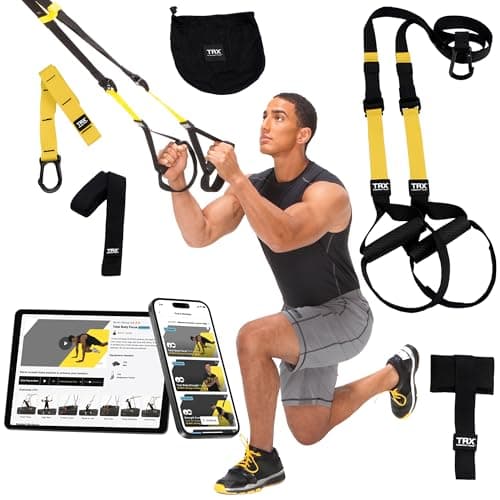
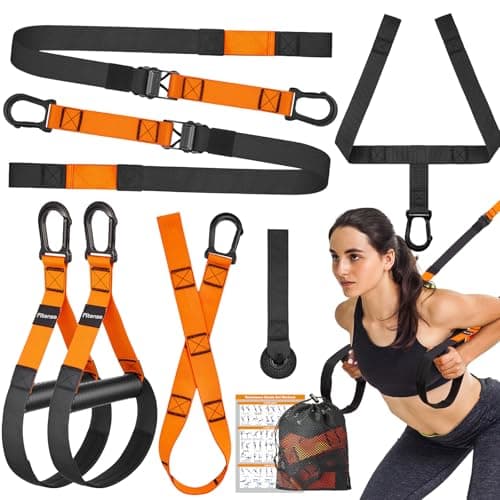
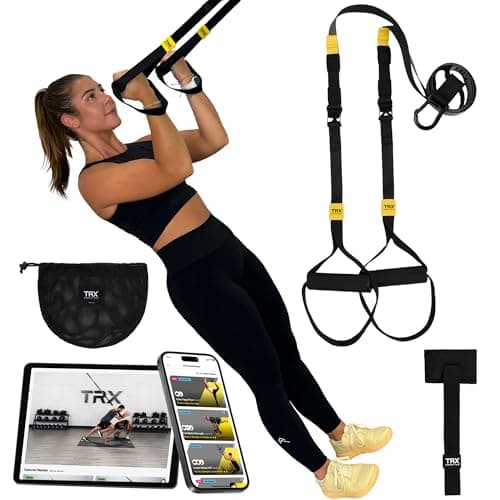
The TRX GO is the pick for most small-space readers: a published 700 lb rating, indoor and outdoor anchors, and a total kit weight of about a pound and a half that stores in a drawer. Step up to the Pro3 only if you will use it several times a week for years — what you buy is the handles and webbing, not extra capability.
Every small-space gym has the same hole in it, and it is on the pulling side. Pressing is easy — a bench and dumbbells, or the floor. Squatting is easy. Rows and pulldowns are the problem, because the equipment that does them well is either bolted to a wall or the size of a wardrobe. A suspension trainer is the exception: it anchors over a door, weighs almost nothing, and gives you rows, face pulls, chest presses, split squats and core work from one strap.
It is also the most lease-proof piece of equipment we cover apart from resistance bands. Nothing is drilled, nothing is left behind, and the whole kit fits in hand luggage. For a renter, a student, or anyone who moves every year, that is worth as much as the training value.
How the three differ
| Trainer | Published rating | Anchors | Kit weight |
|---|
| TRX GO | 700 lb | Indoor door + outdoor | About 1.5 lb |
| TRX Pro3 | 318 kg (about 700 lb) | 3 anchors | 1.7 lb |
| Fitense kit | Not published | Door + outdoor, 95 cm extension | About 2.9 lb |
Note the third row carefully. The Fitense kit is the cheapest by a wide margin and includes an extension strap the TRX products do not, but it does not publish a load rating. That is not a reason to avoid it — it is a reason to know what you are buying, and to weigh it if you are near the top of the bodyweight range.
The anchor decides whether it works in your room
A suspension trainer is only as good as the thing it hangs from, and this is where small rooms actually fail. Three anchor types, in order of how common they are:
- Door anchor. A padded stopper goes over the top or the hinge side of a closed door. Requirements: the door must close fully and must open away from you. Bi-fold, sliding and pocket doors will not work.
- Beam or bar anchor. A strap loops over an exposed joist, a pull-up bar or a rack upright. Best of the three if you have one — the anchor point is higher, which opens up more exercises.
- Outdoor anchor. A tree, a post, a park frame. Included on all three kits here.
If your only door opens inward toward the training space, the honest answer is a doorway pull-up bar as the anchor instead — see our doorway pull-up bar roundup. Hanging a trainer from a properly-seated bar solves both problems at once.
Anchor height and the exercises you unlock
The higher the anchor, the more useful the trainer. A door anchor at about 80 inches gives you rows, chest press, biceps and triceps work, split squats and planks. A ceiling-height anchor at nine feet adds deep-angle rows and full suspended lunges. This is why the Fitense kit's 95 cm extension strap is more interesting than it sounds: it lets you reach a higher anchor point in a room where the only fixture is well above the door.
What it replaces in a small gym
Honestly assessed: a suspension trainer replaces roughly the pulling half of a cable machine for someone at or below their own bodyweight in strength. It does not replace loaded rows for a strong lifter, because your bodyweight is the only load available — you adjust difficulty by changing body angle, and eventually you run out of angle.
For most people in a small room that limit is years away, and the tradeoff is worth it. If you already row heavy and want a load you can add plates to, our compact cable machine roundup and wall-mounted cable roundup cover the machines that scale.
Suspension trainer or resistance bands?
They overlap, and most people only need one. Bands give you variable resistance from a fixed anchor and are better for light, high-rep and rehab work. A suspension trainer gives you bodyweight resistance and is better for compound movements — rows, presses, lunges — where the stability demand is part of the point.
If you already own bands, a trainer adds meaningfully different work. If you own neither, bands are cheaper and the trainer is more capable. See our band roundup for the other side.
Safety, briefly and seriously
Two rules, both non-negotiable. Never anchor to a door that someone could open — lock it if the room allows, and tell anyone else in the home. And check the webbing at the load points before heavy sessions; the failure mode is sudden, and you are usually leaning back at the time.
Choose an anchor with a published rating if you are a heavier user. Both TRX products state theirs; the budget kit does not.